Political trust can shape the trajectory of democracy, writes Marta Kołczyńska. Its effects, however, are conditional and uneven – and increases in trust may sometimes even be conducive to democratic decline, rather than renewal
Low trust in politics and state institutions is one of the central challenges facing contemporary democracies. Much of the concern rests on the assumption that trust is necessary for democracy to thrive.
Researchers also expect that declining trust will result in democratic deterioration. During the Covid-19 pandemic, when trust proved crucial for public compliance with health measures, interest in the topic surged.
Changes in political trust tend to be followed by changes in democratic quality – typically in the same direction. However, this relationship comes with two important caveats.
My recent research with Paul-Christian Bürkner reveals that the positive link between political trust and democracy holds only in countries that are already strong liberal democracies. In weaker democracies, or in authoritarian systems, there is no similar pattern.
This is because political trust is not neutral, but reflects support for the political system as it exists. In illiberal democracies and electoral autocracies, trusting the system often means trusting those in power. When governments in these settings weaken democratic institutions, high trust can make it easier for them to do so. Instead of protecting democracy, trust can end up eroding it.
Political trust is not neutral. It reflects support for the political system as it exists
Recent cases of democratic backsliding show how this works in practice. In Poland after the 2015 parliamentary victory of the right-wing populist Law and Justice party, and in Hungary after the election of nationalist Fidesz in 2010, democratic standards declined while overall political trust increased. This increase was largely driven by supporters of the ruling illiberal parties. We see a similar pattern in Russia, where rising political trust has gone hand in hand with growing authoritarianism.
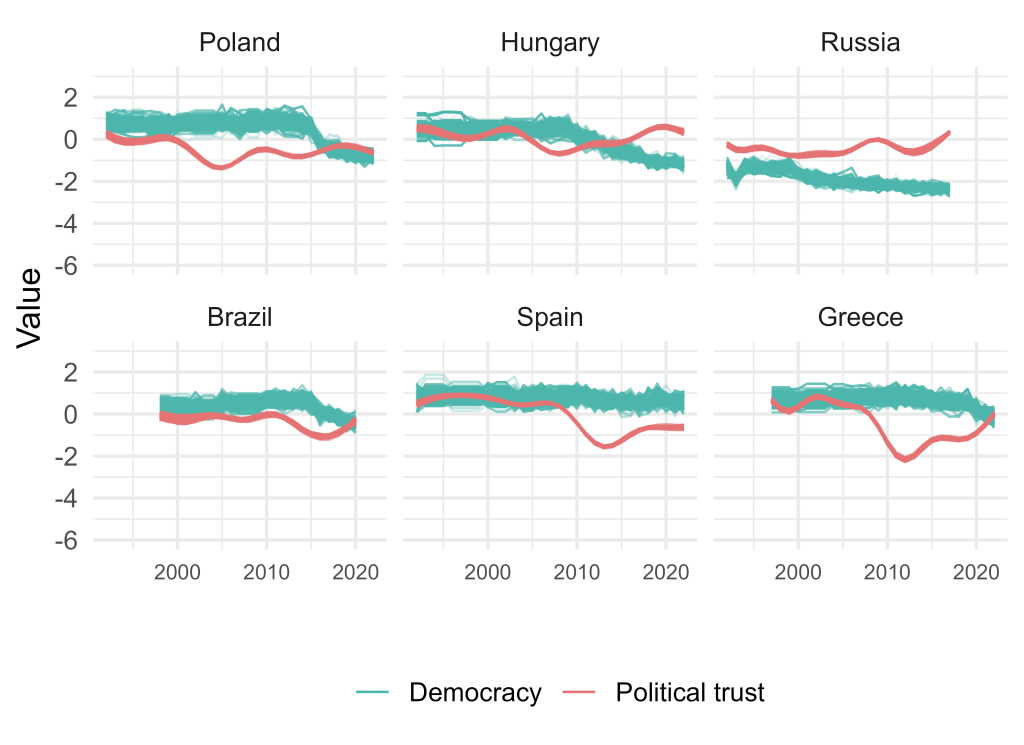
The second caveat concerns democracies. Here, drops in political trust often precede declines in democratic quality, but increases in democratic quality don't follow increases in political trust. In other words, falling trust can act as an early warning sign of democratic vulnerability.
Hungary provides a clear example. During the first decade of the 21st century, trust fell markedly. This created fertile ground for political challengers promising to break with the existing political establishment. In 2010, Viktor Orbán's Fidesz won a landslide electoral victory and began to weaken institutional checks and balances, leading to a significant decline in democratic quality.
Falling trust can indicate democratic vulnerability. After trust levels fell sharply in Hungary and Brazil, democratic quality declined in both countries
Brazil followed a similar pattern. After Dilma Rousseff was elected in 2010, political trust in Brazil soon started to decline. Around 2015–2016, amid a severe economic and political crisis and Rousseff’s impeachment, indicators of democratic quality also began to deteriorate.
There is nothing inherently pro-democratic about political trust. In illiberal or authoritarian countries, high political trust or satisfaction reflects support for the existing regime rather than for democracy itself. In such contexts, rising political trust is more likely to strengthen non-democratic rule than to move the country toward democracy.
In democracies, declining trust in government and state institutions can create opportunities for parties that challenge the status quo. Citizens who are distrustful and dissatisfied are more likely to support parties that promise to replace failing political elites. Once in power, these parties may weaken democratic institutions and systems of checks and balances, leading to democratic backsliding.
In democracies, distrustful citizens are more likely to support parties that promise to replace failing political elites
Importantly, declining trust is not a death sentence for democracy. Some countries show impressive democratic resilience. Spain, for example, saw a dramatic drop in political trust, as shown in the figure above, after the global financial crisis of 2008. Despite this decline, and the country's incomplete recovery, democratic institutions remained stable.
Greece, by contrast, experienced longer-lasting declines in trust after the financial crisis, raising concerns about the country’s democratic health. The Spanish and Greek examples underscore that democratic resilience depends on institutions, civic culture, and policy responses.
Social and political phenomena are not necessarily symmetric. A consequence of declining trust may be democratic backsliding, but an increase in trust need not necessarily signal democratic revival. On the contrary, increases in political trust, especially when concentrated among electoral winners, may instead signal further democratic deterioration.