
Western democracies' responsiveness machinery has been quietly dismantled. To repair the representative disconnect, says Lorenzo De Sio, we must first understand precisely what is broken
The dominant framing of the democratic crisis places citizens in the dock: increasingly uninformed, irrational, manipulated by fake news, captured by unscrupulous leaders. These phenomena are real, but hardly new.
Twentieth-century citizens of the mass society were far less educated than today's. Disinformation is the modern face of an ancient practice, long employed even by democratic governments. But if voters are not radically different from what they have always been, what has changed?
My new book Democrazia Addio argues that what changed are institutions and the way societies take their most important decisions. The crisis of trust, the growing disconnect and the rise of anti-establishment parties are symptoms of a democratic machinery that has stopped delivering, rather than the causes of its breakdown.
This thesis emerged out of evidence from the Issue Competition Comparative Project, which I directed across six Western European countries at the height of the so-called populist wave. Two findings reoriented my research. First, the increasingly vague category 'populism' fails to adequately describe new anti-establishment parties. Rather, the distinctive trait of such parties is a conflictual framing of contemporary transformations, and the mobilisation of the people these changes leave behind. Second, what emerged as a sometimes hidden but powerful driver of those critical elections was demand for economic protection – often not necessarily coupled with conservative attitudes. Citizens were not really demanding sovereigntist crusades; they were asking for protection in a world that had become more competitive and offering ever fewer certainties.
Contemporary transformations have made it increasingly difficult for politics to respond to citizens' demands. Are our regimes still genuinely democratic?
Why has the world become so? Peter Mair's dilemma between responsiveness and responsibility offered a first bridge: contemporary transformations have made it increasingly difficult for politics to respond to citizens' demands. Yet responding to citizens' demands is the very definition of democracy. This raises my book's most uncomfortable question: are our regimes still genuinely democratic?
The analytical anchor is Robert Dahl's definition: 'the continuing responsiveness of the government to the preferences of its citizens, considered as political equals.' The choice is deliberate: in this definition, freedoms and fundamental rights are just prerequisites for a bigger objective. Democracy is more ambitious than liberalism: it concerns outcomes, beyond procedures. A regime can preserve formal liberties while losing the substantive capacity to translate preferences into policy. That gap – which liberal-democratic theory sometimes tends to elide – is precisely where the contemporary crisis lives.
My book identifies three structural transformations, and shows how, rather than simply accumulate, they multiply one another.
The transition from mass parties to catch-all and ultimately cartel parties has hollowed out the linkage function. Party elites have detached themselves from membership and grown dependent on public funding and organised interests. The resource asymmetry between ordinary citizens and concentrated interests – which mass parties existed precisely to compensate – is now structurally unmatched.
The end of embedded liberalism operates through two reinforcing mechanisms. Capital liberalisation has produced external constraints – 'the markets' as a political actor – that systematically narrow the policy space available to elected governments. François Mitterrand's austerity turn of 1981–83 was the inaugural episode of a long sequence in which financial markets disciplined democratically elected programmes, regardless of mandate.
Capital liberalisation is narrowing the policy space available to elected governments, while trade liberalisation erodes national regulatory capacity over labour standards
Trade liberalisation and the credible threat of delocalisation have meanwhile eroded national regulatory capacity over labour standards, wages, taxation, and welfare – the building blocks of any meaningful democratic governance of the economy. Alongside this, global corporate giants now operate at scales that dwarf many national governments. They exert political influence through lobbying, delocalisation threats, supranational arbitration and captured expertise.
European integration occupies a distinctive position: a third transformation that might provide a solution or aggravate the problem. The EU is, in principle, the only scale at which democratic governance of the economy in Europe could realistically be reconstructed. Yet as currently constructed it moves in the opposite direction. Market integration without social and fiscal harmonisation produces a double democratic gap: constraints on national responsiveness, on top of supranational insulation from genuine European electoral competition (and often protecting national governments rather than making them more accountable). Europe is simultaneously the most promising terrain for a solution and, at present, an additional source of the problem.
Moreover, these three transformations are not parallel variables. They reinforce one another: cartelised parties cannot resist global giants; eroded economic governance fuels disaffection that further destabilises party systems; EU constraints reduce what national governments can deliver; and the absence of a politicised European arena leaves globalisation's casualties without institutional recourse at the only scale where recourse would be effective.
A fourth transformation shapes the environment in which debate on the first three can – or cannot – take place. Media commercialisation, ownership concentration, and the colonisation of public-sphere infrastructure by proprietary platforms have eroded pluralism and the equalising function media once partially performed. 'Astroturfing' completes the picture: synthetic mobilisations orchestrated by well-resourced networks exploit algorithmic curation to manufacture the appearance of public opinion.
The result is a public sphere structurally biased against a clear understanding of the very transformations that matter most. Citizens cannot easily demand the repair of a machinery whose breakdown they are not allowed to see.
If the diagnosis is structural, remedies must be structural: reconstructing instruments of mass politics that restore bidirectional aggregation between citizens and elites; renewing embedded liberalism to re-anchor open markets to social protection; taming global giants through antitrust and constraints on corporate political influence; politicising European decisions and overcoming opaque intergovernmental technocracy; and re-democratising the media system.
To repair democracy, we must first recognise that the representative disconnect is located in the institutional machinery that connects preferences to outcomes
Democracy is a political technology, built piece by piece. Its current malfunction is intelligible and, in principle, reparable. But the first step is analytical: recognising that the representative disconnect is not located in citizens' heads but in the institutional machinery that connects preferences to outcomes – and in a public sphere rendered incapable of bringing that disconnect into focus. Treating the fever – populist parties – will not cure the underlying condition. Restoring responsiveness will.


Lorenzo directs the Centro Italiano Studi Elettorali (CISE) and co-directs the Master's Programme in Government & Public Affairs at Luiss Guido Carli University.
He co-edits the Italian Political Science Review.
Formerly a Visiting Fellow at UC Irvine, the European University Institute, Stanford University, and SciencesPo Paris, his research focuses on quantitative analyses of public opinion, voting behaviour, and party competition.
Lorenzo has led major comparative projects (ICCP, POSTGEN) and developed the DAX online data analysis platform (PNRR/FOSSR).
He has also served on the Board of MEDem (Monitoring Electoral Democracy).
His work has appeared (or is forthcoming) in the American Political Science Review, Comparative Political Studies, Electoral Studies, Party Politics, Political Psychology, PS: Political Science and Politics, and West European Politics, among others.
His most recent book, Democrazia Addio, addresses the crisis of contemporary democracy for a broad public audience.
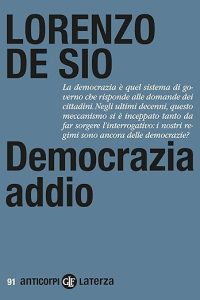
Democrazia Addio
Editori Laterza, 2026


