
Why do regime-change wars re-emerge when global order is under strain? As multilateral institutions lose effectiveness and legitimacy, Fulvio Attinà argues that states are increasingly turning to unilateral or coalition-based force. Interventions such as those in Iraq, Libya, Ukraine, and Iran reflect not isolated crises, but a deeper process of coalition reconfiguration during systemic transition
The reported attempt by the United States and Israel to force regime change in Iran raises a broader question: why do such interventions seem to reappear precisely when the international order is under strain?
This is not a coincidence. There is a historical pattern linking periods of global order transition with the use of military force to reshape political regimes.
Over the past five centuries, major changes in world order have followed large-scale wars. From early modern European conflicts to the two World Wars, each transition produced a new order led by a dominant power: the Netherlands, then Britain, and eventually the United States.
The postwar world order worked as long as it delivered benefits. Today, that condition is weakening – and as performance declines, so does legitimacy
After 1945, however, something changed. The United States and its allies did not rely on power alone. They built a system of international institutions to manage global problems: the IMF for finance, the GATT/WTO for trade, and the UN Security Council for security. This was an attempt to govern interdependence through rules rather than through repeated systemic wars.
Yet this system was never fully egalitarian. Decision-making power was unevenly distributed. Some states, especially the major powers, held privileged positions, while others had limited influence. The system worked as long as it delivered benefits. Today, that condition is weakening.
Global institutions are no longer performing as effectively as they once did. Financial governance has struggled with recurring crises. Trade cooperation has stalled. The UN Security Council is often paralysed by vetoes.
As performance declines, so does legitimacy. States are less willing to rely on multilateral solutions and more inclined to act on their own or within limited coalitions. At the same time, the old Western coalition is less cohesive, while no clear alternative coalition has fully emerged.
This creates a condition of systemic uncertainty: the old order is no longer fully functional, but a new one has not yet taken shape.
In this context, military interventions aimed at changing regimes take on a new meaning.
During the Cold War, such interventions were largely confined to spheres of influence and often shielded by veto power in the UN Security Council. Today, they are more openly linked to broader strategic competition.
Today, military interventions aimed at changing regimes are more openly linked to broader strategic competition
Recent examples, from Iraq and Libya to Ukraine and now Iran, suggest that major powers are increasingly willing to use force not just to defend interests, but to reshape political outcomes in other states.
These interventions often bypass or stretch international legal norms. The UN Charter formally restricts interference in domestic affairs, allowing force only with Security Council authorisation. In practice, this rule is frequently circumvented when major powers are involved.
What explains this pattern?
One answer lies in the reconfiguration of international coalitions. As the existing order weakens, states reposition themselves, seeking new alignments and advantages. Military intervention becomes one of the tools through which this repositioning occurs.
This idea echoes longstanding theories in international relations: major systemic changes are preceded by shifts in coalition structures. Today, we may be witnessing such a shift – but under conditions of much deeper global interdependence.
This brings us to a fundamental issue: sovereignty.
Traditionally, sovereignty implied that states could provide security and welfare independently. This was always an idealised assumption. In today’s world, it is clearly unrealistic. States depend on one another for economic stability, security, and even domestic governance capacity.
States are more independent than ever, but governed less effectively at the global level
Yet the institutions designed to manage this interdependence are weakening. The result is a paradox: states are more interdependent than ever, but governed less effectively at the global level.
The risk is that the transition to a new world order will be shaped less by negotiated reform and more by conflict. If so, regime-change wars may become a recurring feature of global politics, rather than an exception.
An alternative path would require reforming international institutions to make them more representative and effective. This would mean addressing the asymmetries in decision-making that have long undermined their legitimacy.
For now, however, the direction of change remains uncertain.
What is clear is that interventions like those involving Iran are not isolated events. They are part of a broader transformation – one in which the decline of the existing order, the reshaping of coalitions, and the redefinition of sovereignty are unfolding all at once.
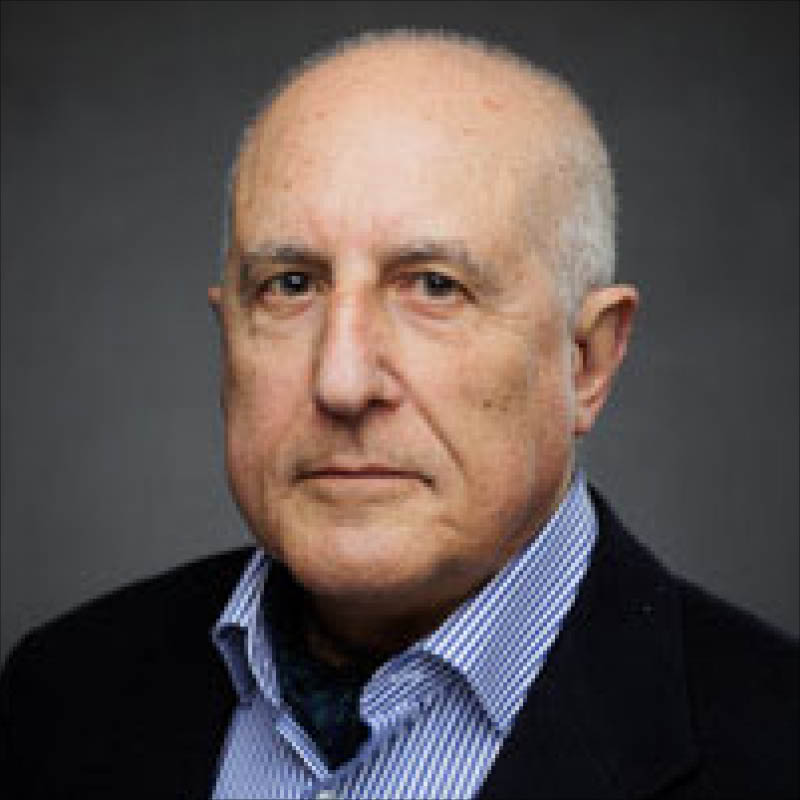
Fulvio's research and teaching has consistently focused on international politics and the European Union.
He has been Chair of the Italian Association of Political Science and Jean Monnet Chair Ad Personam.
He is the author of books and essays on world politics, multilateral security, EU politics, Euro-Mediterranean relations, mass migration and climate policy.
He has been a visiting professor at foreign universities, including the Chinese Academy of Social Sciences, Columbia University, New York University, and Shandong University.
At Catania, he currently teaches ‘World Institutions and Policies’ and ‘Methodology of Political Research’.

The Global Political System
Palgrave, 2011
also published in Italian, Spanish and Russian
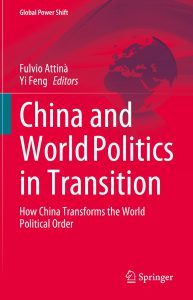
China and World Politics in Transition
Editor, with Yi Feng
Springer, 2023
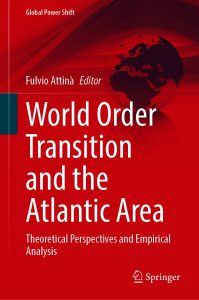
World Order Transition and the Atlantic Area
Editor
Springer, 2021


