
On 21 April 2026, the European Court of Justice delivered a landmark ruling that Hungary’s anti-LGBTQ+ law, in dehumanising LGBTIQ+ people, is incompatible with EU values. Koen Slootmaeckers analyses the Court’s ruling and its wider implications beyond Hungary
Formally presented by the Hungarian government as child protection legislation, Law No LXXIX of 2021 restricted access to content portraying homosexuality, gender reassignment, or any deviation from the sex assigned at birth. Its title explicitly associated these identities with paedophilia. This association was not incidental, but rather a structural legislative framing device.
In summer 2022, the European Commission referred Hungary to the European Court of Justice (ECJ), invoking not only a breach of internal market rules but also of the EU’s fundamental values laid down in Article 2 of the TEU. An unprecedented move, its outcome was far from certain.
Three outcomes were possible. The Court could deliver an activist ruling, confirming that Article 2 TEU encompasses LGBTQ+ rights as justiciable obligations. It could, in an improbable doomsday scenario, side with Hungary. The more likely scenario was that it would find a narrower path: ruling against the Hungarian law on internal market grounds while leaving the deeper fundamental-values question unresolved. This would give homophobic governments a license to discriminate as long as they were careful in their wording.
On 21 April 2026, the Court chose the first path. The unprecedented intervention of 16 member states supporting the commission provided the Court with the political backing to deliver an activist ruling. While the Court does not respond to political pressure in any simple sense, the breadth of that intervention signalled that the majority of member states would support the wide-reaching ruling of a breach of Article 2 TEU as a standalone, independently justiciable infringement. It argued that the stigmatisation and marginalisation of LGBTQ+ people is incompatible with EU membership.
The European Court of Justice has argued that Hungary's stigmatisation and marginalisation of LGBTQ+ people is incompatible with EU membership
While it did make a landmark ruling, the Court was careful to prevent Article 2 from becoming a catch-all legal argument, and not to overstretch the limited scope of the Charter of Fundamental Rights. It clarified that not every Charter violation entails an Article 2 violation.
The threshold is a manifest and particularly serious breach incompatible with the very identity of the Union. What cleared that threshold here was not simply that Hungary discriminated against LGBTQ+ people, but the coordinated, systematic character of the legislation, enacted across media law, advertising law, e-commerce, child welfare, and public education simultaneously – all governed by the same undifferentiated premise that LGBTQ+ content is inherently harmful to minors.
Additionally, the Court argued that the association of LGBTQ+ people with paedophilia, embedded in the law's very title, was capable of generating hateful conduct and entrenching the social invisibility of a minority group. The Court saw the Hungarian government’s persistent use of political homo- and transphobia as a breach of Article 2.
What makes this ruling so important is that it sends a clear message beyond the Hungarian case. The use of political homophobia by nationalist and far-right groups has become increasingly normalised in Europe. Hungary's legislative model was never purely domestic in its ambitions. It is part of the transnational anti-gender movement, and it is modular in its design, so that others can follow suit. Indeed, Romania and others looked to Orbán's law as a blueprint. The child protection frame has become the anti-gender movement's primary rhetorical tool precisely because it forecloses principled objection. Who, after all, could be against protecting children?
This landmark ruling prevents EU members structurally subordinating certain groups under the veil of child protection
Through this landmark ruling, the Court has now dismantled that logic. It found that minors can be adequately protected against age-inappropriate content without discrimination on grounds of sexual orientation or gender identity. In other words, the Court placed a strong limitation on EU members preventing attempts to structurally subordinate certain groups under the veil of child protection.
The ruling also categorically closes off the national identity defence. Hungary invoked Article 4(2) TEU, the provision requiring the Union to respect member states' national identities, as a constitutional shield against EU equality norms. The Court dismissed this very clearly by arguing that Article 4(2) must be read in conjunction with Article 2: national identity claims cannot be separated from the very values that define EU membership. This means that conservative governments are no longer able to hide behind legislative and constitutional amendments that undermine minority rights.
National identity claims cannot be separated from the values that define EU membership. Conservative governments can no longer hide behind constitutional amendments that undermine minority rights
Finally, this ruling sends an important signal at a time when enlargement is picking up speed again. A long-standing critique has revolved around double standards on fundamental rights conditions. The Court’s ruling has sent a clear message that the EU can uphold its values among member states, and that its judgment embeds a non-regression obligation. Once admitted to the EU, member states cannot amend their legislation in ways that reduce the protection already afforded to Article 2 values.
The Commission brought this case at a moment of considerable political risk, and it paid off. Of course, the next test lies with the implementation of the ruling. At a time when LGBT rights are regressing across Europe, we can only hope this ruling provides a turning point.


From an international political sociologist lens, Koen's award-winning research is broadly focused on the ways in which boundaries, inclusion and exclusion are maintained in society and within international relations.
He has done extensive research on the promotion of and resistance to LGBT equality in international politics.
More specifically, Koen has studied the EU accession of Serbia and how this process affects LGBT politics and activism.
His current research focuses on the place of Pride events within the LGBTI movement, as well as theorise a new politics to rebuild connections in society.
Koen's book, Coming in: Sexual politics and EU accession in Serbia, won the 2025 EUSA Best Book Prize
He has published articles in, among others, International Political Sociology, East European Politics, Politics, Contemporary Southeastern Europe, Journal of Homosexuality, and Europe-Asia Studies.

Coming In: Sexual Politics and EU Accession in Serbia, Manchester University Press, 2023
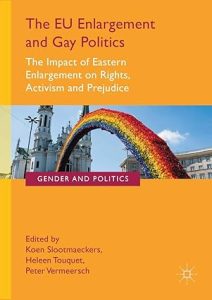
EU Enlargement and Gay Politics, co-edited by Koen Slootmaeckers, Heleen Touquet and Peter Vermeersch, Palgrave Macmillan, 2016


