
EU institutions, policymakers, and many experts often frame enlargement as a test for candidate countries. Adam Kola argues that it is equally a test for the European Union. The accession of Ukraine, Moldova and the Western Balkans will also reshape the EU by forcing it to reform and redefine itself
EU institutions and policymakers usually describe enlargement as a test for candidate countries. They must adopt the acquis, strengthen institutions, uphold the rule of law, align their policies, and prove they are ready to join. No credible enlargement can avoid conditionality. Yet, as several contributors to this series have highlighted, enlargement also requires the EU to adapt. Every new member changes the Union's institutions, priorities, and political identity.
This matters because Ukraine, Moldova and the Western Balkan states seek to join a Union under pressure. War, democratic fragility, institutional fatigue, geopolitical competition, and the return of security as a defining principle of European politics will shape their accession.
Many reform debates still assume a sequence: the EU reforms first and enlarges afterwards. History suggests otherwise. Every previous enlargement reshaped the Union's political geography, institutional imagination and understanding of its purpose. Southern enlargement linked membership to democratic consolidation. The 2004 enlargement redefined Europe after the Cold War and made the continent's old division politically unsustainable. Enlargement has repeatedly driven institutional and political change inside the Union.
The next enlargement will move the EU's external border eastwards and south-eastwards. It will also shift Europe's centre of gravity, placing security, reconstruction, resilience and democratic endurance at the heart of the Union's political identity.
Ukraine illustrates this transformation. Its resistance has changed the meaning of Europe in real time. The country has advanced its European claim through diplomacy and legal alignment, civic mobilisation, the defence of sovereignty, and the determination to secure a democratic future within Europe.
The next enlargement will shift Europe's centre of gravity, placing security, reconstruction, resilience, and democratic endurance at the heart of the Union's political identity
For much of the post-1989 period, scholars, policymakers, and public debates understood Central Europe through the accession of Poland, Czechia, Slovakia, Hungary, Slovenia and the Baltic states into the EU and NATO: the region that had 'returned to Europe'. Since 2022, Europe's political geography has shifted further east, and Ukraine has become central to what Europe is prepared to defend.
This does not make Ukraine identical to Central Europe in historical or cultural terms. Rather, it demonstrates that Europe's political frontier has moved. Central Europe now represents both an integrated region and a frontier where Europe's future is being contested.
Candidate countries also expose the limits of the Union's current design. The Western Balkans demonstrate the costs of delayed accession.
Enlargement forces the EU to confront challenges it has postponed for years. Decision-making, budgetary capacity, agricultural policy, cohesion, defence, reconstruction, the rule of law and differentiated integration all become more urgent once future enlargements become politically credible.
Enlargement therefore gives institutional reform a concrete direction. Preparing the Union for Ukraine, Moldova and the Western Balkans transforms abstract debates into practical decisions about the future shape of the EU. This does not require lower standards or accelerated accession without preparation. It requires connecting institutional reform to the realities of a larger and more geopolitically exposed Union.
A Union that expects candidates to become more capable, resilient and democratic should strengthen those same qualities within its own institutions
If the EU expects to accommodate Ukraine, Moldova and the Western Balkans, reform becomes a question of institutional resilience and geopolitical credibility. Enlargement transforms both candidate countries and the Union. A Union that expects candidates to become more capable, resilient, and democratic should strengthen those same qualities within its own institutions.
The current accession framework places most responsibility for adaptation on candidate countries. They reform while the EU evaluates, monitors, and decides. This asymmetry remains necessary, but it overlooks how much candidate countries contribute to redefining the Union itself.
A constructivist perspective helps explain why enlargement has this transformative effect. Europe is a political community shaped through inclusion, exclusion, boundary-making and institutional imagination, not only a territory, a legal order, or a market. Enlargement is one of the moments when these processes become most visible. It does not merely apply an existing definition of Europe. It helps produce a new one. Labels such as ‘candidate’, ‘neighbour’, ‘member’ or ‘European problem’ are not neutral. They decide who enters common politics. They also decide whose experience stays outside. In this sense, enlargement changes more than the Union’s borders. It changes the language of European responsibility.
Current debates risk two mistakes. One treats enlargement primarily as an administrative process in which candidate countries complete reforms, the EU verifies progress and accession follows. That approach overlooks the institutional changes that enlargement demands of the Union itself. The other allows institutional reform to become an open-ended justification for postponing enlargement. Reform then loses its purpose and enlargement loses its credibility.
A Union that expects candidates to become more capable, resilient, and democratic should strengthen those same qualities within its own institutions
Linking reform and enlargement offers a stronger path forward. Preparing for future members provides a clear objective for institutional change. The relevant question becomes how the EU can successfully accommodate Ukraine, Moldova and the Western Balkans while remaining effective, cohesive, and governable.
The next Union will not simply be a larger version of today's EU. War, reconstruction, borderland experience, democratic vulnerability, and societies defending their European future will all shape its evolution. Enlargement will play a central role in that transformation because it forces Europe to define the political community it seeks to become.
Candidate countries are participating in Europe's reconstruction. The European Union should recognise them as partners in that process.


Adam is the former Director of the Centre of Excellence IMSErt: Interacting Minds, Societies, Environments.
His work focuses on Central and Eastern Europe in a global context, with particular interest in intellectual and literary history, memory studies, postcolonial and post-imperial approaches to Europe, and the transnational circulation of knowledge.
He has written on the shifting meanings of Central Europe, the memory of communism, socialist postcolonialism, and the role of universities and knowledge institutions in contemporary Europe.
In 2021–2022, he was a visiting researcher at the Institute for Advanced Study, University of Amsterdam; in 2016–2019, he was a visiting scholar at the University of Chicago.
He is the author of more than 100 publications in Polish, Czech, Russian, German and English, and also translates from Czech and English into Polish.
His publications include Europe in Polish, Czech and Croatian Discourse (Nicolaus Copernicus University Press, 2011) and Socialist Postcolonialism: Memory Reconsolidation (Nicolaus Copernicus University Press, 2018, in Polish).
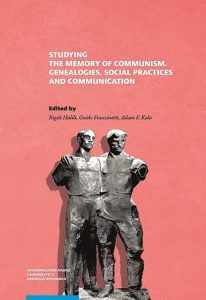
Studying the Memory of Communism: Genealogies, Social Practices and Communication (co-edited with Riegels Halili and Guido Franzinetti), Wydawnictwo Naukowe UMK, 2021

Nicolaus Copernicus in the Culture of Memory: Sedimentation of Knowledge (co-edited with Wojciech Piasek), V&R unipress GmbH, 2025


