
Norma Osterberg-Kaufmann built the participatory method Photovoice into democracy studies, creating a three-step design that asks participants to put a photograph before a single word. The pictures that came back said almost nothing about elections – but a great deal about mailboxes, crocheted lace, and a rental bike...
My pilot study asked twelve students on a master’s seminar in comparative democracy at Humboldt University Berlin, during the 2025/26 winter semester, to photograph an object or scene that, for them, embodied the concept of 'democracy'.
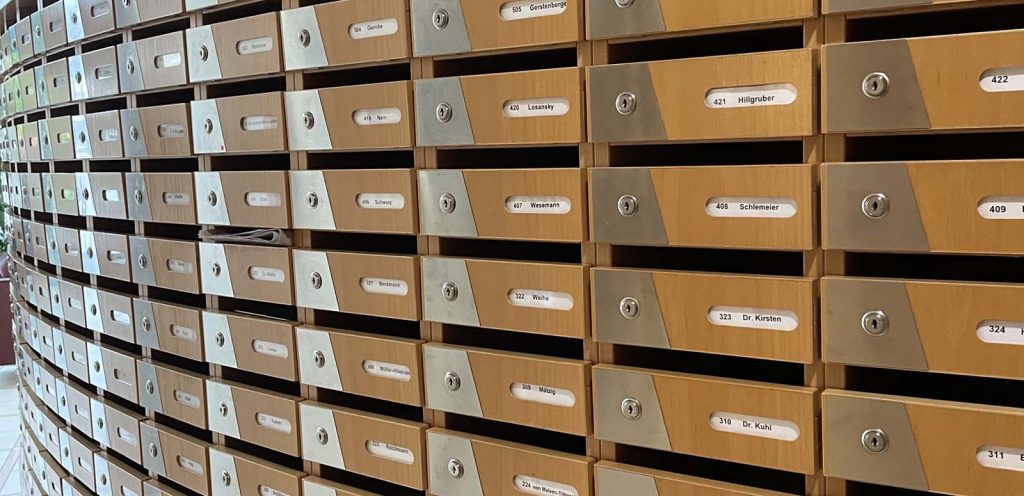
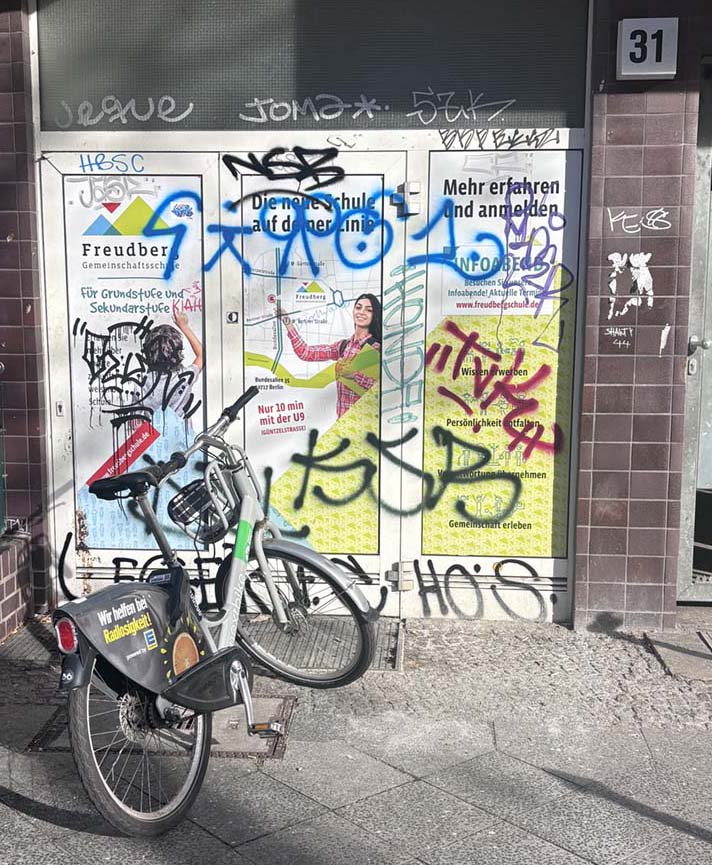
One participant photographed a wall of mailboxes (left), and described a system in which 'basically, every mailbox represents a separate household' – a claim to universal access. Her institutional wall of several hundred numbered compartments, some labelled with doctoral titles, also shows us a system you enter by belonging, not simply by showing up. Another participant photographed a rental bike, and graffiti tags sprayed over a school advertisement (right), captioned 'participation and a search for recognition'.
In both cases, the story is more harmonious than the object/s photographed. That gap is not a mistake that needs correcting – it’s the point where the imaginary becomes visible as an interpretive act. This is something no stereotypical interview or open-ended survey question could show because there would be nothing to which we could compare the answer.
Standardised surveys of how people think about democracy – the World Values Survey, Afrobarometer and others – present a list of characteristics drawn from a liberal-procedural catalogue and ask respondents to rate them. What isn't on the list may not register as absent; it may not register at all. Open-ended questions and focus groups loosen this grip, but remain textual and verbal from the first word to the last.
What such methods struggle to reach is what political theorists call democratic imaginaries: the symbols, feelings, and not-yet-fully-formed expectations through which people view the political order, rather than statements they would check off on a list.
Standardised surveys struggle to capture the symbols, feelings, and not-yet-fully-formed expectations through which people view the political order
Imaginaries resist being asked for directly. They tend to reveal themselves, through the words someone reaches for when asked to illustrate something rather than define it.
This is where Photovoice comes in: a participatory method from community health research. Inspired by Kei Nishiyama's classroom exercise, I turned it into a three-step design: photograph a subject that symbolises democracy; verbally explain the image; write a sentence stating the core principle on which the conception of democracy rests. The photograph comes first, the researcher’s question last. When someone puts democracy into words, they are already justifying a decision they have made.
None of the twelve photographs in the pilot showed a parliament, a ballot box, or a polling station. I asked participants not to photograph the German Bundestag, and I explain why that matters below.
I asked my students to photograph an object or scene embodying the concept of 'democracy'. Not one of the pictures that came back showed a parliament or a ballot box
What is more striking is what filled the gaps. Eleven of the twelve motifs are physical objects or environments: a piece of crochet, a ball of wool, a beehive, a wall of mailboxes. Most are composite: things whose appeal lies in how the parts hold together. Two participants who started from entirely different objects – one crocheting, one photographing a ball of wool – arrived independently at the same word for their core principle: interconnectedness. This is close to what Ryusaku Yamada argued this series should be focusing on: not technical vocabulary, but the words people reach for when asked what democracy means to them.
The vocabulary of election, majority, and opposition is not simply missing. It is touched upon and dropped: matters that must be 'negotiated, coordinated, decided' without anyone naming how; a voice that 'can be heard equally' without anyone asking whether it is counted.
Here, the question-master has to be honest about the design's construction. To encourage creativity, I asked participants not to simply photograph the Bundestag – an instruction that plausibly suppressed exactly the vocabulary whose absence might appear to be the study’s most interesting finding.
As Hong Do put it in this series, description is never neutral: whose experiences get documented shapes the picture before anyone starts analysing. My exclusion instruction is a small, traceable case of that. So I cannot yet tell which of the three things explain the missing vocabulary: my instruction; the medium, since a photograph shows cohesion more easily than procedure; or how these participants genuinely imagine democracy.
One data point speaks to this directly, and is suggestive rather than conclusive. The single image in the corpus that was sourced online rather than taken is also the only one naming a political institution.
The corpus behind this pilot is twelve cases from one seminar: narratives for all twelve, images for nine, core-principle texts for seven. A single coder – assisted by a large language model – has completed one pass, but it still awaits a second human coder: not a basis for claims about how people understand democracy, and I make none.
That touches on a question Dimitra Mareta posed about this series’ 'Fourth Theorist', proposed by Jean-Paul Gagnon: should that role be human, or can it be automated? I favour keeping a human involved – we’re not there yet, and should admit it.
My pilot survey created an artefact made before participants spoke, against which we can measure their own account of democracy
Also worth mentioning is a narrower version of a bias others in this series have flagged: our contributors all belong to one German Master’s seminar, unrepresentative in its own way, however illuminating the pattern.
What this pilot does show is something no verbal method can. It has created an artefact made before participants spoke, against which we can measure their own account. In the gap – the mailboxes, the bicycle – the imaginary becomes visible as interpretation, not description. This is exactly the raw material this series has called the non-textual mountains of data that future theorising will need.
The next step is not to trust the vocabulary that is missing. It is to run the design again without the exclusion, and see whether the ballot box returns.

Norma holds a PhD in political science from Humboldt University Berlin.
Her research focuses on concepts of democracy, measuring of meaning and understanding of democracy, legitimacy and mixed-methods.
She serves on the Editorial Board of the Zeitschrift für Vergleichende Politikwissenschaft, in which she recently co-authored the article Challenges in conceptualizing and measuring meanings and understandings of democracy, with Toralf Stark and Christoph Mohamad-Klotzbach.
She is the co-author, also with Toralf Stark and Christoph Mohamad-Klotzbach, of Conceptualizing Difference, published in the journal Democratic Theory.

She is a contributor to the Jean-Paul Gagnon-led book The Sciences of the Democracies.
UCL Press, 2025


