Feminist theory describes sexual violence as a means of reinforcing women's subordinate position in society. But its political consequences may be more complex. In a study of American women, Amanda Clayton and Lauren Chojnacki find that survivors of sexual assault or rape report higher levels of political participation than other women with similar backgrounds, suggesting that trauma can sometimes become a source of political mobilisation
When something is taken from you, what’s left behind has a purpose
Gretchen Whitmer, Governor of Michigan (2024)
Sexual violence is widespread. In the United States, more than half of women have experienced sexual assault, and about one in four has experienced completed or attempted rape. Feminist scholars have long described how sexual assault is about power – a tool to keep women in an inferior social position.
Yet many journalistic accounts and feminist biographies show how some women, rather than withdrawing from politics, have been mobilised by their victimisation. In one high-profile example, in 2014, Columbia University student Emma Sulkowicz carried a 50-pound mattress around campus to protest the university's handling of her sexual assault report. The protest became her entry into anti-rape activism.
In research forthcoming in the Journal of Politics, we uncover a relationship that may seem counterintuitive. Rather than withdrawing in the wake of sexual violence, some survivors turn their pain into purpose through political action.
Our theorising relies on semi-structured interviews we conducted with sexual assault survivors and members of groups that combat sexual violence (e.g., rape crisis centres and violence prevention centres). For many women, victimisation results in social withdrawal or other symptoms of post-traumatic stress disorder. For a substantial share of survivors, however, victimisation also becomes politically meaningful. This duality emerged in our interviews with anti-violence practitioners. As one advocate described:
[Survivors] can go down one of two paths: one where they just can’t get up, or one where the only reason they get up is to create some justice and space in the world. That’s how they make sense out of it.
For some women, experiencing sexual violence may shatter their core beliefs – but in ways that then foster personal growth and resilience. Psychologists call this process post-traumatic growth. Being a survivor also made many interviewees feel connected to other women. As one woman told us, ‘[My victimisation experience] helped me to identify as one of many. It helped me to say, I’m not the only one.’ Sexual assault can be a catalyst: a survivor begins to see what happened to her as part of a broader system of oppression.
To explore whether these patterns extend beyond our interviewees, we surveyed around 2,000 women across the US. Our findings reveal just how widespread sexual violence is: more than six in ten women in our sample reported an experience that meets the clinical definition of sexual assault or rape.
We looked at eight forms of political participation, including protesting, signing petitions, and donating to political candidates. Across all activities, survivors of sexual assault or rape report higher levels of participation than women with similar backgrounds. For example, 69% of sexual violence survivors engaged in at least one form of political participation, compared with just 58% of women who had not experienced sexual violence.
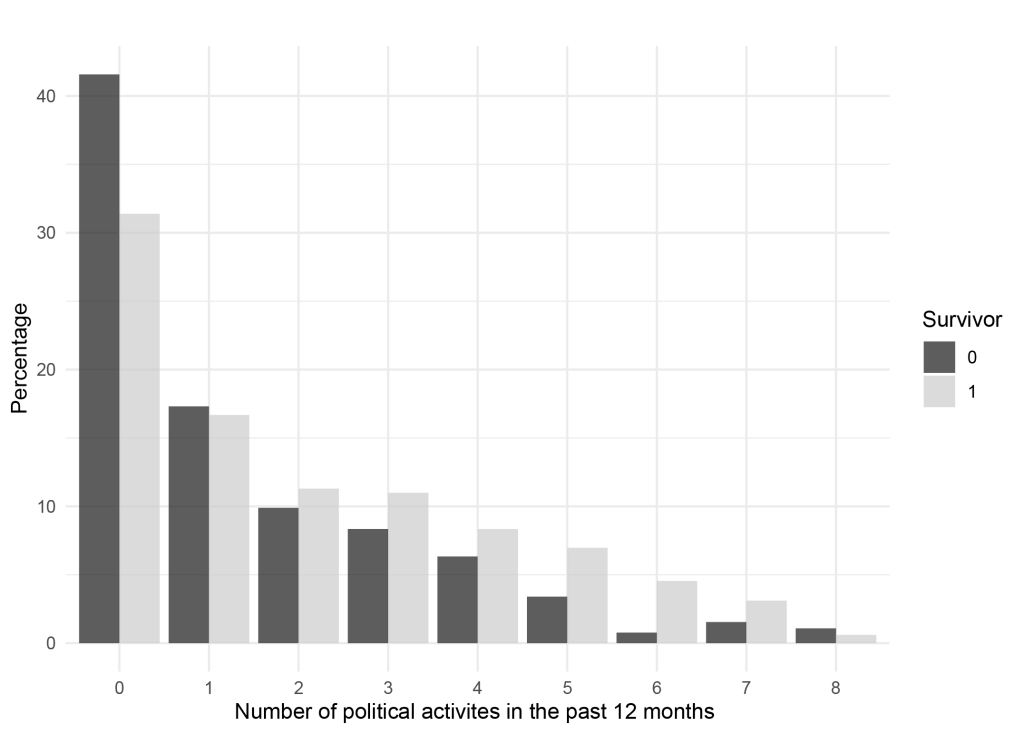
Our survey also measured engagement with political actions connected to women’s issues. For these activities, the association with sexual violence is strongest.
Many survivors reported actions in support of abortion rights in the wake of the Dobbs v. Jackson Supreme Court decision that overturned the federal right to abortion. One respondent said she went to a rally for: ‘Yes on Prop [Proposal] 3, which was to add abortion and reproductive rights to the Michigan constitution.’ Another respondent in Texas described how she wore a button in support of protest organisation Mothers Against Greg Abbott ‘because of the abortion bill here.’ (Texas Governor Greg Abbott has expressed strong opposition to abortion.)
Several respondents connected abortion access to support for survivors of sexual assault. One noted that she: ‘Signed several petitions supporting [reproductive health nonprofit] Planned Parenthood and rape victims.’ Another directly referenced her experience of sexual assault, writing: ‘I have posted (publicly, not privately) about abortion rights and my own rape...’
Many respondents also reported supporting victims of sexual violence, separate from the issue of abortion access. As one respondent described: ‘I volunteer on a crisis line and am working to create a Take Back the Night march on my campus. I’m also searching for training to be a victims’ advocate.’
For many survivors, advocating for women’s rights is a pathway to a more active political life.
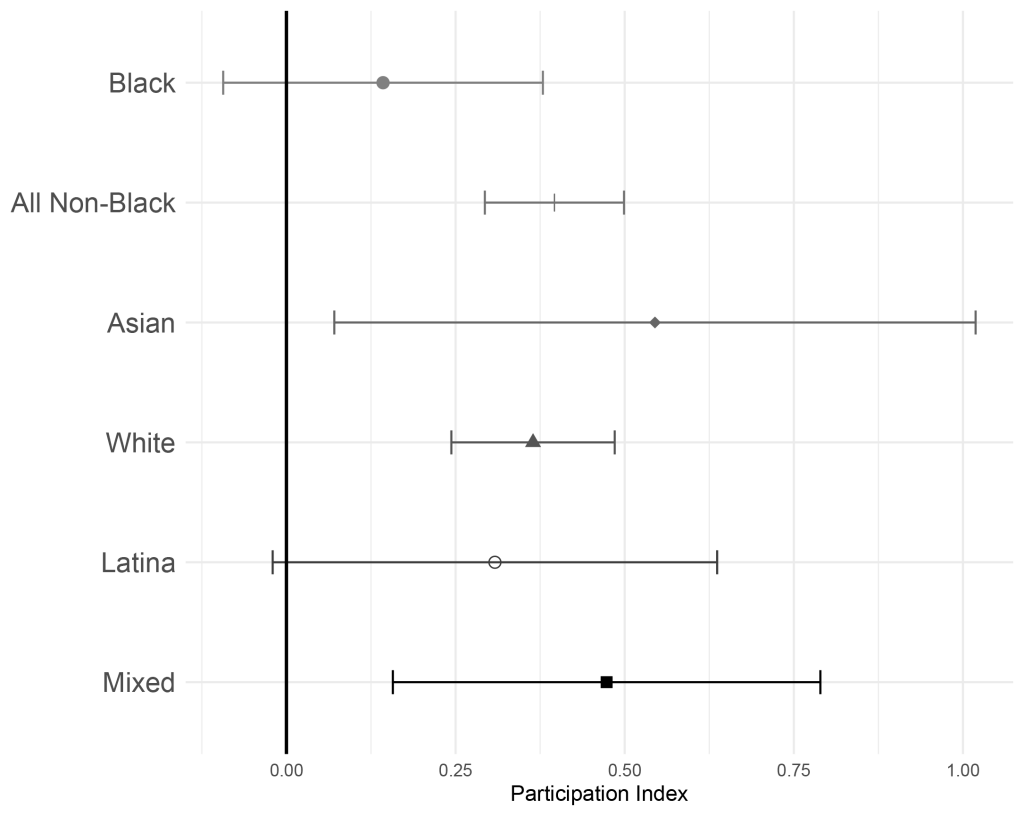
We find that the relationship between an assault experience and higher levels of political engagement appears across party lines, but partisanship moderates the association; it is strongest among Democrats, and more pronounced among women with higher levels of education and income. This relationship also varies by race and ethnicity. Among white, Asian, Latina, and mixed-race women, experiencing sexual assault is associated with greater political participation. For Black women, the association is about half as strong as for other groups and is not statistically significant. As one community organiser we interviewed explained:
For Black women, there are so many other things that have to come first. Being a woman is part of it, but it’s not the [whole] thing. It’s like the whole community is resting on our survival… Racial justice absolutely takes precedence.
Canonical feminist texts describe sexual assault as being about power – a physical manifestation of patriarchy to keep women subordinate. Second-wave feminist movements circulated this idea widely among American women, encouraging them to see their personal experiences as deeply political. Decades later, many women we interviewed for this study made a similar connection. Rather than turning away from politics, the trauma of sexual violence compelled them to fight for a more just political system for others.