Zoe Gueli argues that in Italy, the anti-Brussels rhetoric of governing right-wing party Fratelli d’Italia survives not because Italians are Eurosceptic, but because its rhetoric functions as a domestic political tool – one that EU institutions are structurally unable to counter
Italian Prime Minister Giorgia Meloni built much of her political career on attacking Brussels. Yet since entering government, she has largely cooperated with EU institutions, secured Recovery and Resilience Facility funding, and cultivated a reputation as a pragmatic European partner. Meloni has called for Italy to leave the euro and has described EU institutions as ‘usurers’. Why, then, does anti-EU rhetoric remain politically useful when governing requires cooperation, and when Italians themselves are not strongly Eurosceptic?
Here, I argue that this reflects what we might call strategic Euroscepticism: the deployment of anti-EU rhetoric primarily as a domestic political mobilisation strategy while maintaining pragmatic cooperation with EU institutions in government.
The Italian case suggests that Eurosceptic rhetoric functions less as a response to widespread public Euroscepticism and more as a strategic political resource. Populist parties like Fratelli d’Italia (FdI) direct citizen dissatisfaction toward EU institutions by exploiting narratives of grievance around sovereignty, identity, and institutional crises.
The Standard Eurobarometer data from Italy (2018, 2022, 2025) indicates that Italians are somewhat more likely to trust, support and identify with the EU, although only to a small extent. This suggests that FdI’s Eurosceptic positioning cannot be explained solely by an already Eurosceptic electorate. This finding complicates the assumption that Eurosceptic rhetoric merely reflects public opinion. If Italians continue to express relatively favourable attitudes towards the EU, electoral demand alone cannot fully explain the persistence of anti-Brussels discourse.
Fratelli d’Italia’s rhetoric portrays the ‘pure’ Italian people as threatened by EU institutions, but this is disproportionate to the level of public Euroscepticism revealed by survey data
If public demand cannot fully explain Eurosceptic communication, the question becomes what strategic purpose this rhetoric serves. Research on FdI consistently points toward a strategy of selective or strategic ambiguity regarding European integration. In their communication, the party constructs an image that portrays the ‘pure’ Italian people being threatened by immigration and EU institutions, deploying a classic populist strategy.
Yet the persistence of this rhetoric appears disproportionate to the level of public Euroscepticism revealed by survey data. The same research also finds that texts from the party, such as its 2018 manifesto, frame a conflict between people versus corrupt elites, and Italian sovereignty versus EU ‘exploitation’. This is not merely a matter of populist communication style; it also reflects a core component of the party’s ideology.
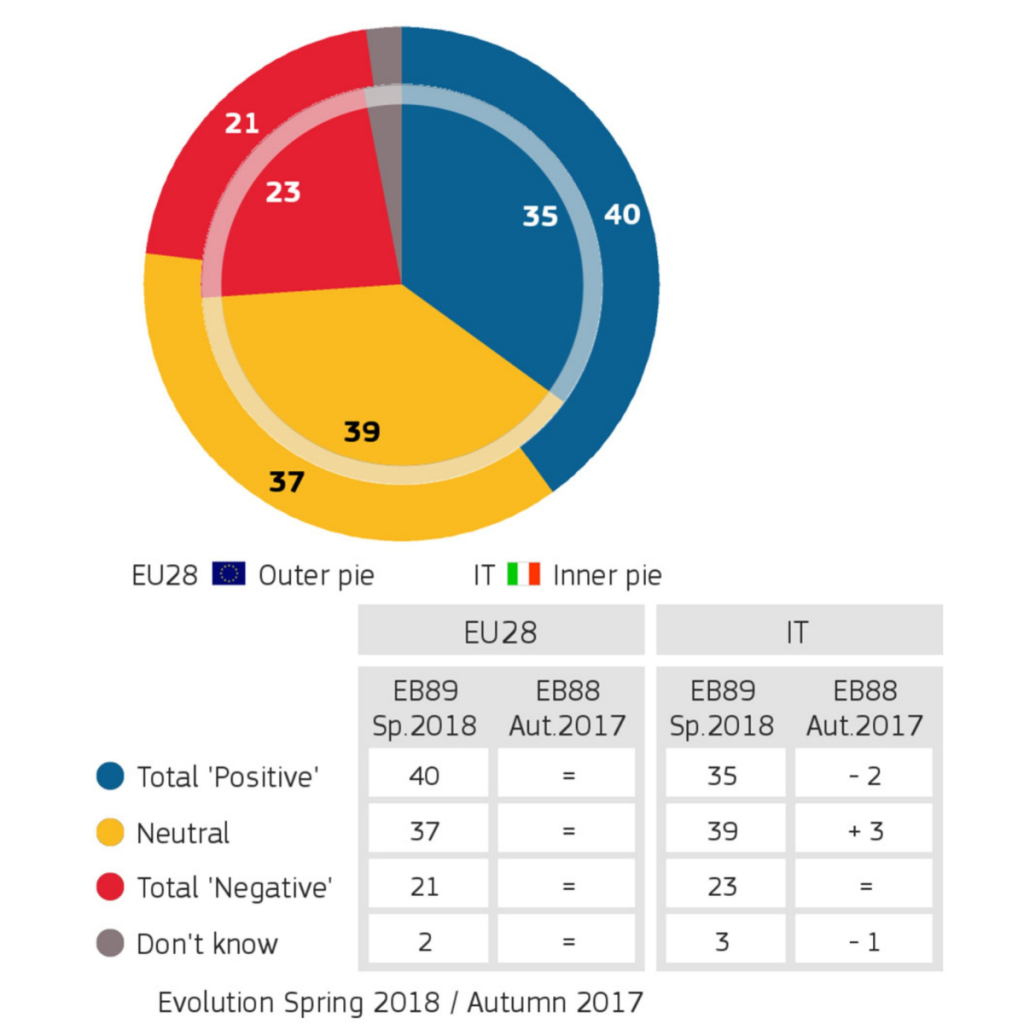
If party competition simply reflected public preferences, one would expect Eurosceptic rhetoric to weaken rather than persist under these conditions. The relatively weak Eurosceptic base in Italy, together with FdI’s comparatively soft Eurosceptic discourse, suggests that the party’s rhetoric performs two functions simultaneously. Domestically, it mobilises anti-establishment sentiment. Institutionally, it preserves sufficient ambiguity to avoid the kinds of confrontations with the EU that harder Eurosceptic positions have triggered elsewhere, including Article 7 proceedings.
Strategic Euroscepticism positions Fratelli d’Italia as the authentic anti-establishment alternative to the technocratic, EU-aligned political class
Strategic Euroscepticism enables FdI to shift political responsibility towards Brussels while presenting itself domestically as the authentic defender of Italian interests. Euroscepticism functions not to turn Italians against the EU, but to position FdI as the authentic anti-establishment alternative to the technocratic, EU-aligned political class.
The EU cannot effectively counter what it cannot formally identify as a violation. This is partly because democratic values should not interfere too much with individuals’ and parties’ voices and discourse. But it also means the EU remains structurally unable to penalise rhetorical Euroscepticism that stops short of formal violations. Institutional complexity, blame-shifting architecture and negotiating leverage means that the FdI pays effectively no price for the ambiguity in its strategic Euroscepticism.
Yet, this issue is unlikely to remain cost-free indefinitely. In an era of multiplying global crises such as energy, climate, immigration and war, the conditions for scapegoating are only becoming more favourable. If strategic Euroscepticism proves electorally successful, similar forms of blame-shifting may become increasingly attractive across Europe, particularly during periods of economic or geopolitical crisis.
Although current Italian data shows no measurable decline in public EU perception, the absence of visible damage is not evidence of immunity. Strategic Eurosceptic rhetoric may gradually undermine institutional trust over time, even where immediate changes in public opinion are not yet visible.
Strategic Eurosceptic rhetoric may gradually undermine institutional trust over time. EU institutions should therefore invest more heavily in direct, citizen-facing communication
Italy alone cannot demonstrate that this strategy characterises all European populist parties. However, it illustrates how Eurosceptic discourse can remain electorally valuable even where public support for EU membership remains comparatively stable. These dynamics place new demands on EU institutional communication. Rather than attempting to suppress criticism, EU institutions should invest more heavily in direct, citizen-facing communication that makes political responsibility more transparent and blame-shifting less effective.
Fratelli d’Italia did not need Italians to reject Europe. It merely needed Brussels to remain an easier political target than Rome.