In social media, while documenting what gets said is important, understanding who posts which sources to raise their visibility is also key. Katharina Tittel, William Allen, and Pedro Ramaciotti use immigration in France to show how far-right users of X cite sources strategically to achieve their goals
Debates about immigration have been central to the resurgence of radical-right parties in Europe. Social media platforms are fixtures in the extreme-right playbook, where prolific users post content to move public opinion on immigration and reflect growing dissatisfaction with and distrust of governments. But the contemporary media environment is fragmented; many sources confront audiences. So it is not just what these users say that counts: who they choose to amplify through reposts also sends politically consequential signals.
Understanding these dynamics matters particularly in France — and now. There are real prospects of the far-right Rassemblement National seriously contending for the presidency in 2027’s elections. Meanwhile, as in other countries, growing divisions in French media are appearing among relatively elite and institutionalised outlets like Le Monde and Le Figaro, and online sources and platforms that are explicitly partisan.
We examined over a million French-language X posts about migration and found that who users choose to amplify through reposts sends politically consequential signals
We examined over a million French-language X posts about migration, to identify the media sources to which they linked. Then, we estimated the ideological leanings of the users who posted them. To do this, we used an already-validated dataset and approach that includes calibration with high-quality surveys. We were able to reliably do this for about 18% of the users who, among other criteria, followed at least three French MPs, which we took to indicate a reasonable degree of political interest. Finally, Katharina conducted interviews with some of the most prolific far-right posters to learn why they posted in the ways they did. Many of these people were senior political and communications figures at regional, national, and international levels.
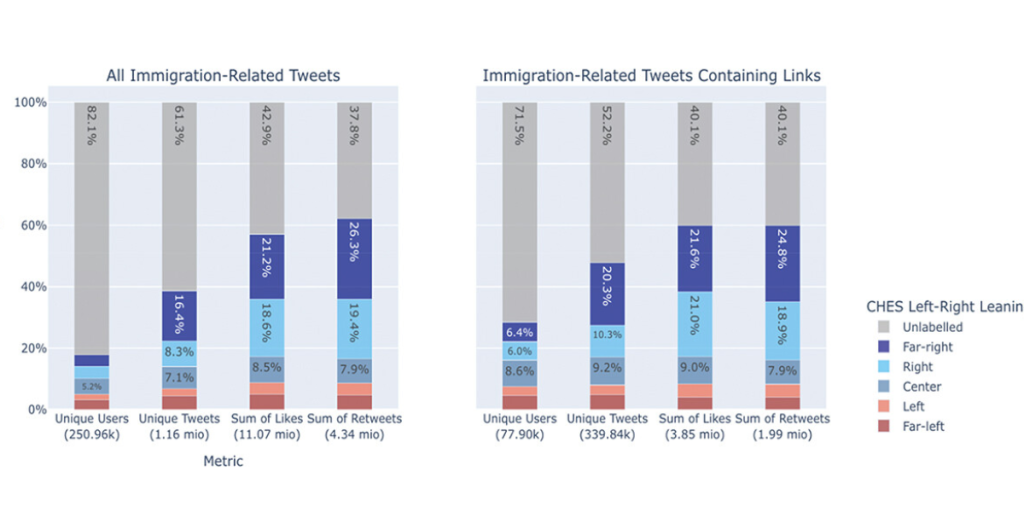
On immigration, posting on French X is largely the preserve of a minority of hyperactive right-wing users. Although they make up about 8% of the user base in our dataset, the graph below shows that they post about a quarter (24%) of all immigration-related posts that in turn get a lot of engagement through reposts (45%). By contrast, left-leaning users only post about 7–8% of immigration-related posts with similar levels of engagement. This pattern aligns with other work showing how politically extreme users tend to be particularly prolific. On immigration, however, prolific posters are overwhelmingly right wing.
Politically extreme users tend to be particularly prolific on social media. On immigration, however, prolific posters are overwhelmingly right wing
Furthermore, we don’t find evidence that right-leaning users operate within a filter bubble of like-minded sources. As the second graph shows, right-leaning users' posts are the most likely to contain links to hyper-partisan sources. However, these users also link to mainstream sources as much (if not more) than left-leaning users.
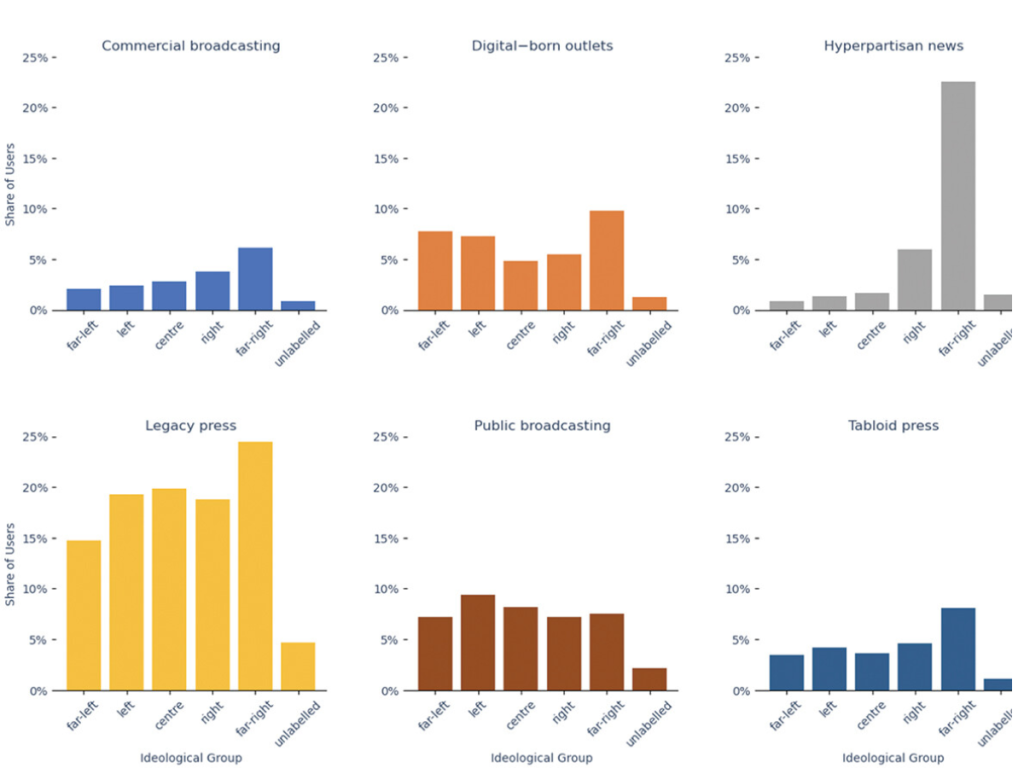
From the perspective of some of the most prolific right-wing users, three factors likely drive these patterns in source sharing. First, users consciously share hyper-partisan and alternative news sources because they consider them more representative of ‘the people’ and their interests. Second, to highlight perceived biases, users selectively share mainstream sources when content aligns with hyper-partisan agendas. They often do so to pressurise mainstream media into covering allegedly underreported incidents involving migrants and asylum-seekers or, as is frequently the case, French citizens of Arab or African origin who they present as not 'really' French. Third, users share content containing statistical and evidence-based sources to enhance their public perception as credible and respectable voices on immigration.
The choice about which sources to amplify through reposting is political: it carries meaning and can serve strategic goals. In debates about immigration in France, right-wing populist users strategically repost sources they think will signal and advance their objectives of defending systems of inequalities. This involves promoting hyper-partisan and conspiratorial sources while simultaneously undermining public trust in journalistic and political institutions.
Right-wing populists strategically repost sources they think will advance their objectives of defending systems of inequalities
These dynamics are not specific to France or to immigration, though this issue-country combination does express them well. We see them play out in many democracies under threat from a host of anti-democratic actors. Paying attention to who reposts which types of sources, and in what quantities, is therefore just as important for understanding populism and illiberalism as studying the content of those posts.