Regional organisations are increasingly powerful players on the global stage, accumulating authority that once belonged to sovereign states. However, Anja Jetschke and Samuel Standaert show that as these organisations grow, they distribute their power over different organs, creating checks and balances and increasing their organisational capacity
Governments across the world worry about international organisations. Brexit was, at its core, a revolt against the perceived overreach of the European Union. The United States, under the Trump administration, quit the World Health Organization, citing excessive interference in national health policy. Across the political spectrum, from Washington to Warsaw, the complaint is the same.
The academic literature has, similarly, documented the steady growth of international organisations: more policy areas, more competences, deeper involvement in domestic governance. The picture emerging is one of expanding institutional authority, with a few powerful organs at the centre pulling the strings.
But what if this picture is incomplete?
Our research, recently published in Political Research Exchange, starts from a simple observation: most studies of international organisations measure how much authority an organisation has, but almost none ask where that authority sits within the organisation. For example, an organisation might be granted broad competences over trade, security, and environmental policy. But are those competences concentrated in the hands of a few, or even a single powerful body? Or does the organisation spread them across multiple specialised organs?
Most studies of international organisations measure how much authority an organisation has, but where does that authority sit within the organisation?
This distinction matters enormously. A regional organisation with one or very few dominant decision-making bodies is a fundamentally different creature from one where agenda-setting, decision-making, implementation, and evaluation are distributed across several organs that must cooperate and check one another. The first resembles a centralised executive; the second a system with built-in checks and balances.
To answer this question, we built a new measure — concentration — and applied it to an original dataset covering 236 treaties and 98 regional organisations worldwide, from the African Union to the Association of Southeast Asian Nations (ASEAN) to the European Union, between 1945 and 2016.
We expected to find that as organisations grew more powerful, authority would concentrate in their most capable organs. Greater scope, we assumed, would bring greater centralisation. The existing literature pointed in this direction: if you delegate more to an organisation, you want efficient, decisive leadership.
We were wrong.
What we found was precisely the opposite. Regional organisations have expanded their scope, taking on more policy areas and deeper cooperation. As they have done so, the concentration of competences within those organisations has decreased, not increased. Power has not pooled at the centre. It has dispersed. The figure below illustrates this evolution for the European Union: each increase in the organisation’s scope and policy capacity has come with a dispersal of this power among its various organs.
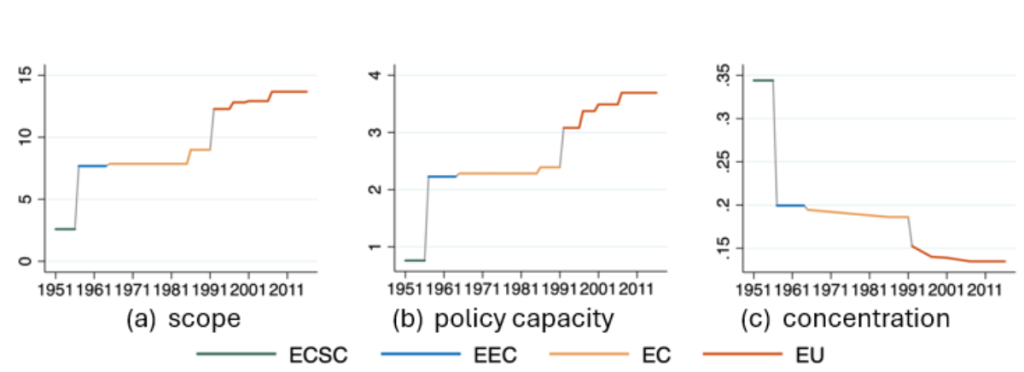
The pattern is striking in its consistency. No regional broad-scope organisation in our dataset concentrates its policy-cycle competences in a single organ or even a small group of organs. The broader an organisation's mandate, the more evenly it can distribute its competences across institutional bodies. This holds across regions, across time, and even when we account for factors like organisational age, membership size, and regional traditions of institution-building.
The EU has grown more authoritative as it covers more ground. However, this ground is managed by interdependent institutions, none of which holds a monopoly on power
The European Union – the organisation most frequently cited as the paradigm of excessive supranational authority – illustrates this vividly. Our data show that with each successive treaty revision, competences have become progressively more dispersed across the Commission, the Council, the Parliament, the Court of Justice, and an expanding array of specialised agencies. The EU has grown more authoritative in the sense of covering more ground. The ground it covers, however, is managed by an increasingly complex web of interdependent institutions, none of which holds a monopoly on power.
We tested two explanations.
The first, drawn from theories of rational institutional design, suggests that member states deliberately spread power as a sovereignty-protecting measure. The more they delegate, the more they insist on checks and balances that prevent any single organ from acting autonomously.
The second, drawn from theories of functional differentiation, suggests the process is more organic. As organisations take on more responsibilities, the sheer complexity of managing different policy areas across different stages of the policy cycle creates demand for specialised bodies. Agenda-setting requires different capabilities than implementation; monitoring requires different capabilities than dispute settlement. Organisations differentiate because governance complexity demands it.
As organisations take on more responsibilities, managing diverse policy areas creates demand for specialised bodies
Our statistical analysis points more strongly to the second explanation. It is not scope itself – the number of policy areas an organisation covers – that drives dispersion. Rather, it is the policy capacity: the accumulation of specific competences across the policy cycle. Organisations do not disperse power because member states calculate sovereignty risks. They disperse it because managing complexity requires it.
None of this means that concerns about international organisations are unfounded. Informal concentrations of power – a forceful Commission President, a dominant member state, a well-resourced secretariat – can diverge significantly from what the treaties say. Our data captures formal, de jure institutional design, not the day-to-day politics of who actually wields influence.
But it does suggest that the public debate has been working with an incomplete map. International organisations are not concentrated power centres. The same growth in authority that alarms national governments and publics is accompanied, at the institutional level, by increasing fragmentation and interdependence among organs. Whether that is reassuring or not depends on your view: dispersed authority may mean more checks and balances, but it also means more complexity, more coordination costs, and more opportunities for informal power to fill the gaps that formal structures leave open.
The next time a politician warns that Brussels, Geneva, or Nairobi is accumulating dangerous power, it is worth asking: which organ, exactly? The answer may be less straightforward – and more interesting – than the warning suggests.