When we think of democratic innovation, we usually picture citizens voting. But Annalisa Quaglia and Federico De Marco argue that a quiet transformation is underway elsewhere. Faced with the decline of remote areas, local public administrations are becoming the new collaborative arenas for democratic legitimacy – though not without significant challenges
Across Europe, rural and mountainous regions are in crisis. Demographic decline and economic fragility trap these areas in a vicious cycle, the multidimensional inequalities of which traditional top-down policies have failed to solve.
To fix this, a new paradigm is emerging. Public administrators are no longer simply enforcing rules; they are designing policies alongside citizens and local actors. This quiet shift is redefining democratic legitimacy, at a far remove from the ballot box.
For decades, governments tackled regional disparities using sectoral policies. They created separate and top-down initiatives for transport, healthcare, or education. This siloed approach, however, did not work.
Acknowledging the simple truth that local actors have the contextual knowledge to solve local problems, the European Union is therefore shifting towards place-based policies. But how does this work in practice? And what does it mean for democracy?
Italy offers a fascinating test case. Over the past decade, the country has launched two ambitious policy frameworks: the National Strategy for Inner Areas (SNAI), which tackles territorial cohesion in marginalised areas, and the National Strategy for Sustainable Development (SNSvS), which aligns Italy with the UN 2030 Agenda. The SNSvS governance structure is an interesting example of how to embed multilevel institutional coordination and participatory processes within national policy frameworks.
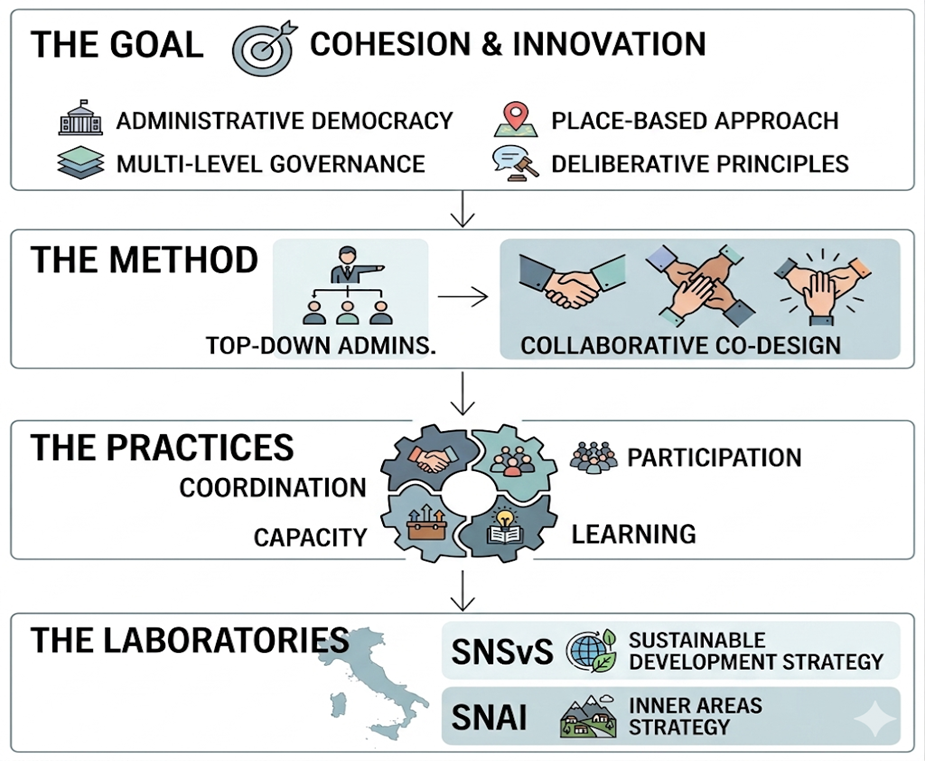
These strategies operate in different fields. Yet our research shows they share a revolutionary trait. They force mayors, national ministries, regional authorities, and citizens to sit at the same table. Public administration is fundamentally changing its skin.
Today, public administrations are no longer simply blind executors of state laws. Instead, they are becoming dynamic arenas for institutional co-design.
Public administrations are no longer simply blind executors of state laws but dynamic arenas for institutional co-design
In the SNSvS, national and regional actors connect through shared monitoring processes and thematic working groups. In the SNAI, the shift is even more radical. Neighbouring municipalities must collaborate across administrative boundaries. They design joint development strategies directly alongside civil society groups. A central feature of the strategy is the creation of so-called Area Strategies, where groups of municipalities collaborate to define shared development priorities. The governance model explicitly encourages cooperation among local authorities, and engages regional administrations and national institutions.
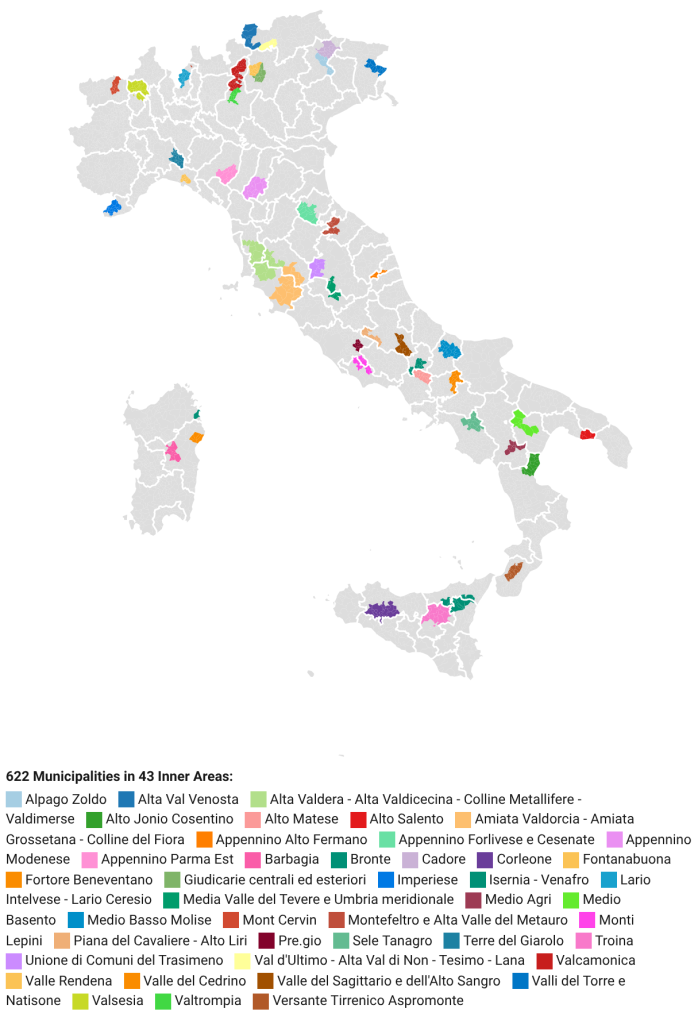
This generates a robust form of 'administrative democracy'. Democratic legitimacy does not stem only from elections. It grows through the inclusive and transparent practices of bureaucrats who facilitate these local negotiations.
Crucially, these frameworks act as engines for institutional learning. Sustainability and territorial cohesion require continuous adaptation. Institutions cannot rely on predefined, one-size-fits-all tools.
During our interviews with policy strategies actors, this shift became strikingly clear. As one national policy coordinator explained it:
The strategy should be understood as a collective learning process. The objective is not simply to produce policy documents but to enable administrations to grow together through collaboration and shared experimentation
In this process of 'growing together', regional administrations emerge as the vital link. They act as essential mediators between grand national frameworks and the complex reality of local governance.
However, this collaborative governance model hides a critical flaw: it requires a fundamentally different skillset. Managing stakeholders, strategic planning, and inter-institutional negotiation are not traditional bureaucratic skills; they require aptitudes in community-building, communication, and relationship-building.
National and regional administrations usually have the resources to handle this complexity. Smaller municipalities, however, face a paradox. As our research in Italy highlights, their small size can facilitate closer, more authentic communication with the community. Yet, success depends heavily on the culture of the local authority, and on whether mayors and officials are proactive problem-solvers rather than mere administrators.
Participatory policymaking in smaller municipalities depends on whether officials are proactive problem-solvers rather than mere administrators
We are asking the most peripheral, under-resourced local governments to execute the most complex forms of participatory policymaking. The recently created Open AgriLab in the Monti Reatini SNAI area is one such example. There, municipalities are using co-design tables and design thinking to structure local agro-food supply chains alongside citizens and businesses.
But such ambitious initiatives create dangerous 'capacity traps'. If we do not provide these small towns with structural technical support, or recruit people with relational skills, the policies will fail.
As Europe grapples with widening regional divides, the complex demands of the green transition, social inclusion and sustainability, the Italian cases offer both a clear warning and a profound opportunity. Territorial and sustainability policies are real-world laboratories for institutional innovation.
If we want to fix democratic deficits and bridge regional inequalities, we cannot rely on electoral reforms alone. We must invest heavily in local governments' administrative capacity. Because today, the frontlines of democratic legitimacy are not just at the polling stations. They are also in the collaborative, multi-level governance planning of our most peripheral towns.