
For decades, Europe prospered under American security guarantees, open trade and cheap external imports. That world is disappearing. Faced with a more antagonistic United States, a rising China and global geopolitical competition, Dennis Shen says the EU must either become a strategic power in its own right – or risk longer-term decline
For decades, the European Union benefitted from a comparatively comfortable geopolitical arrangement. The United States guaranteed its security, China provided cheap manufacturing, and Europe could concentrate on prosperity, regulation and social welfare. That era may be over.
The second Donald Trump presidency has brought with it American unilateralism. It has severely weakened the trust in NATO and intensified trade tensions, even with historical allies. China, meanwhile, is no longer just a rising exporter or a manufacturing hub but a systemic rival competing for technological, industrial and geopolitical pre-eminence. Europe thus faces a stark question. Can it become a leading geopolitical actor in its own right, or must it remain squeezed between Washington and Beijing?
The answer hinges on whether Europe is prepared to rethink its economic model, modernise institutions and consider a more strategic industrial policy. Those are the steps required for any true 'European sovereignty'.
Today, the EU still often behaves as if it were simply a large market rather than a strategic power. Nevertheless, in a modern era of competition between great powers, markets by themselves cannot secure energy systems or shape technological standards. If Europe desires greater geopolitical influence, it must develop the means of acting jointly in the areas that matter most – such as defence, energy and technology.
If Europe desires greater geopolitical influence, it must cooperate strategically in key areas such as defence, energy and technology
Importantly, the EU cannot stay fiscally fragmented while remaining geopolitically ambitious. If Europe wishes to stay autonomous, this in and of itself demands investment.
That is why the debate over joint European debt matters so much. The NextGenerationEU recovery fund demonstrated that the Union could borrow collectively when confronted with an existential challenge. Today’s challenge is broader but no less urgent: decarbonising the economy, strengthening defence capabilities and closing the technology gap with global peers such as the United States and China.
But such investments are expensive. Individual member states cannot shoulder them alone without increasing divergence inside the Union. Joint debt issuance presents a unique mechanism not simply for solidarity, but for strategic co-ordination. It would allow Europe to finance continental public goods such as cross-border electricity grids, semiconductor production and defence procurement.
Critics fear such borrowing may engender a so-called 'transfer union' within which fiscally conservative countries subsidise others indefinitely. German Chancellor Friedrich Merz recently echoed such concerns, arguing that, for constitutional and political reasons, Germany cannot continue down the path of new debt – including European debt. Rather, he argues, Europe requires 'fundamental modernisation'.
Chancellor Merz is right that the system needs modernising. But if he considers modernisation a substitute for investment, he may be wrong on that point.
Europe’s problem is not just excessive regulation or inadequate competitiveness. It is structural underinvestment compared with global rivals
Europe’s problem is not just excessive regulation or inadequate competitiveness. It is structural underinvestment compared with global rivals. Historically, the EU has trailed the United States on R&D spending as a percentage of output and, over the last decade, China has rapidly closed a previous gap. As of 2024, the R&D spending of the EU stood at 2.2% of GDP, lagging behind China (2.6%), Japan (3.4%) and the United States (3.5%).
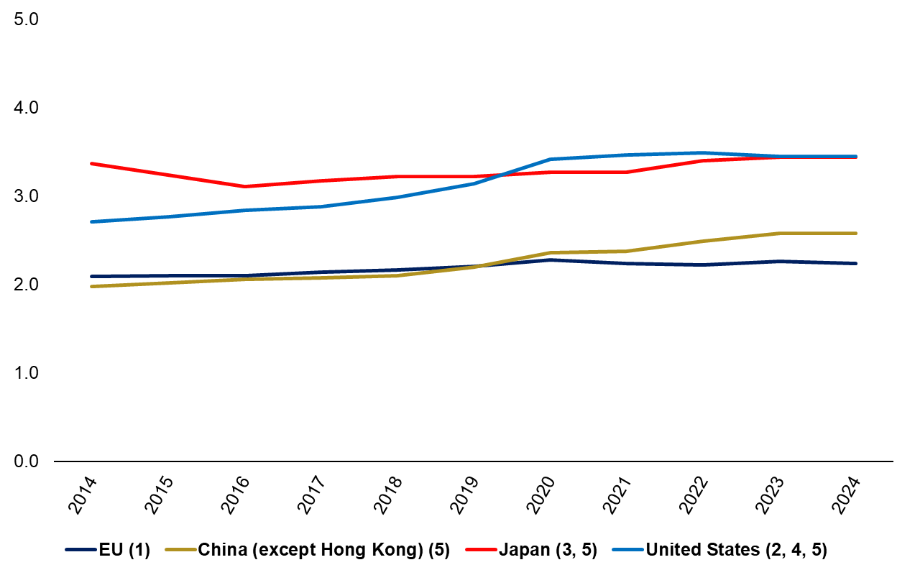
The United States has espoused large-scale industrial subsidies through the Inflation Reduction Act and the CHIPS Act. China spends considerable state resources within targeted sectors, from batteries to artificial intelligence. In contrast, Europe frequently competes only with meaningful fiscal restraint and procedural caution.
Given the fragmented single market, Europe’s economy today needs targeted reform. European firms must all too regularly contend with administrative barriers and national regulations before they can scale across the continent.
The economic costs of fragmentation may be meaningful. The IMF previously estimated that internal EU barriers may be commensurate with an ad-valorem tariff of 44% for manufacturers and 110% for services between EU economies.
The problem may not necessarily be regulation itself. Technically, Europe’s regulatory standards are a strength. The problem may rather lie in repetition, inconsistency and slowness. Too much bureaucracy can become a hidden tax on innovators. If Europe wants to target globally competitive technological firms, defence champions and clean-energy sectors, it ought to simplify the rules and deepen capital markets.
Economic dependencies, too, are relevant. Russia’s 2022 invasion of Ukraine exposed the dangers of depending on geopolitical rivals for crucial resources such as energy. Today, parallel dependencies may exist on China for rare earths and industrial components. China processes around 90% of the globe’s rare earths, and dominates much of the global battery supply chain.
Such strategic reliance within crucial sectors does raise geopolitical sensitivities. The EU may thus have to consider a policy of 'targeted resilience' – diversifying regional suppliers, and seeking to re-onshore select strategic industries while investing aggressively in technologies such as artificial intelligence and advanced energy systems.
Russia’s 2022 invasion of Ukraine exposed the dangers of depending on geopolitical rivals for crucial resources such as energy
At the European level, industrial policy could help to overcome fragmentation between member states. Despite spending between them more than €300 billion annually on defence, EU member states continue to operate dozens of separate weapons systems and procurement frameworks. A joint procurement in defence, common investment funds and integrated industrial planning may generate economies of scale that no single member state could hope to achieve alone.
With Trump 2.0 and a rising China, the age when Europe could rely on benign globalisation may be over. If the EU is to stay prosperous and geopolitically relevant, the bloc needs to move beyond piecemeal reforms and adopt a wholly alternate political economy centring around investment, integration and targeted resilience.
The question is no longer whether Europe can afford such reforms. It is whether it can afford to delay them.




good article and i do agree. seeing how dysfunctional the EU has been i do not think it can reform itself to the point where it can survive.