Evelyn De Simone, Sergio Martini, Federico Russo and Elif Şeyma Şişman find little evidence that Europeans are abandoning democracy. But democratic support often coexists with openness to authoritarian alternatives. This ambivalence is socially structured, with education emerging as the most consistent dividing line
Europeans have not stopped believing in democracy. The problem is that many do not see democracy and authoritarian rule as mutually exclusive. Asking people whether they support ‘democracy’ tells us only part of the story. Citizens may attach different meanings to the term, or endorse democracy while favouring forms of government that conflict with democratic principles.
We looked at democratic and authoritarian preferences together. Using three decades of EVS/WVS data, we examined attitudes towards both democracy and strong, unconstrained leadership in Belgium, France, Germany, Hungary, Italy, Norway, Poland and the United Kingdom.
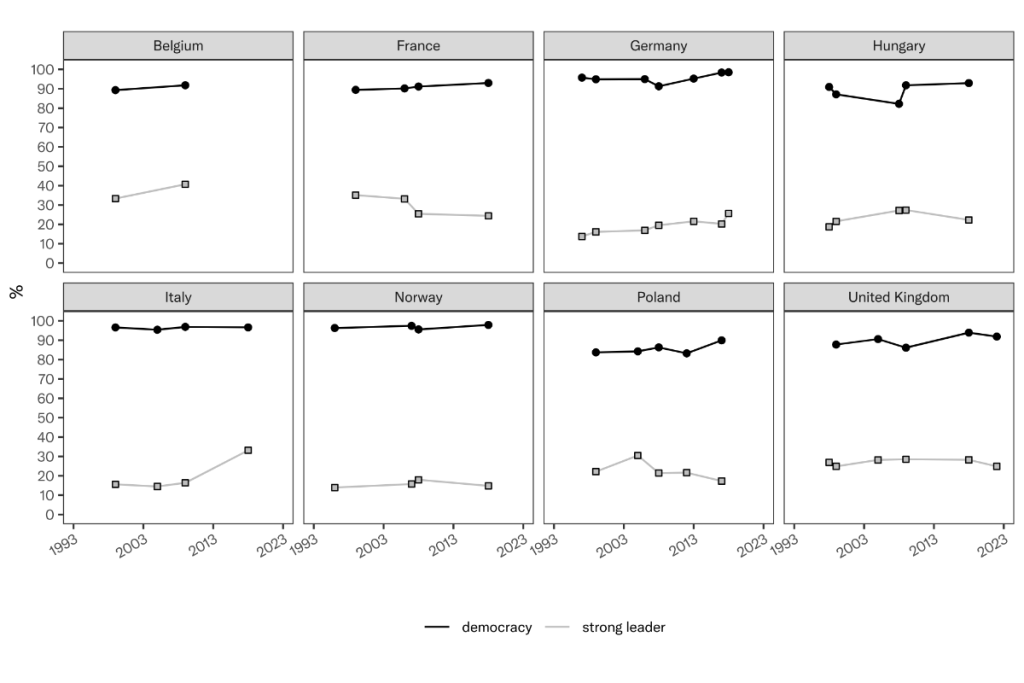
Across these eight European countries, support for democracy has remained remarkably high over the three decades covered by our data. On average, more than 90% of respondents say that having a democratic political system is a good way to govern. Yet more than one in five also view a strong leader who does not have to bother with parliament and elections favourably. This is one face of Europe’s democratic 'disconnect': not outright rejection of democracy, but ambivalence about what democracy requires and what alternatives citizens are willing to tolerate.
There is no common downward trajectory across the eight countries, but this consensus conceals a contradiction. Support for strong leaders remains substantial and, in some countries, has increased. Italy provides the clearest example: support rose by 17.5 percentage points over the period covered by our data, reaching 33.2% in the most recent survey. Europeans therefore overwhelmingly support democracy, but a sizeable minority simultaneously remains open to an authoritarian alternative.
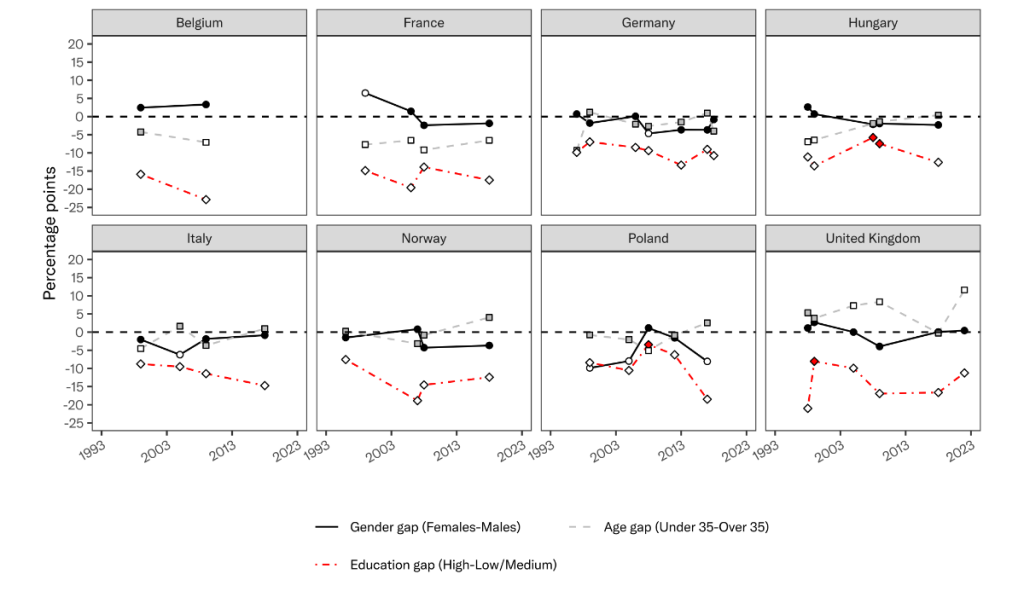
We compared democratic attitudes across three social divides: gender, age and education. More highly educated citizens generally express greater support for democracy than those with lower or medium levels of education. The education gap appears in seven of the eight countries, although its size varies across national contexts.
In the data we analysed, education emerges repeatedly as the most consistent social divide in democratic attitudes
The divide becomes clearer when we ask who supports authoritarian alternatives. More highly educated citizens are consistently less favourable towards strong leaders unconstrained by parliament and elections, with 23 percentage points less support among the more highly educated in Belgium at one point in our series. Age and gender tell much less consistent stories. Younger citizens are less supportive of strong leaders than older citizens in Belgium and France, for example, but the pattern is reversed in the United Kingdom. Gender differences are small when we use these traditional measures. Education, by contrast, repeatedly emerges as the most consistent social divide.
What happens if we stop asking people about ‘democracy’ altogether? We turned to our 2025 REDIRECT survey and a different measure of democratic support. Rather than asking respondents whether they favour democracy as an abstract regime, this measure captures their commitment to concrete liberal-democratic principles, including pluralism, electoral competition, judicial independence and media freedom. The education gap also persists with this alternative measure, with more highly educated respondents showing stronger commitment to these liberal-democratic principles.
Expressing support for ‘democracy’ is not necessarily the same thing as rejecting authoritarian alternatives
The picture becomes more complicated for age and gender. In the pooled analysis, younger respondents and women score lower on the liberal-democracy scale, even though traditional measures reveal little consistent gender gap. This discrepancy matters because who appears most committed to democracy depends partly on what we mean by democratic support. Expressing support for ‘democracy’ is not necessarily the same thing as rejecting authoritarian alternatives or endorsing the institutional constraints that make liberal democracy work.
Why does education matter across such different measures? Our data cannot answer that question directly, but the pattern is difficult to reduce to a simple story in which less-educated citizens merely understand democracy less well. A structural explanation is plausible. European societies have been described as ‘diploma democracies’, in which educational credentials shape access to elite positions and political influence. Citizens without those credentials may therefore experience representative democracy differently from those who benefit from them. Our evidence cannot establish this mechanism directly, yet the fact that the education gap varies across countries makes a purely cognitive explanation less convincing.
The education gap may be more than a socio-demographic difference: it may reveal a structural dimension of the democratic disconnect
This points towards a broader problem for representative democracy. Educational inequalities may concern not only who participates, who gets represented, or who has political influence. They may also extend to citizens’ willingness to accept the rules and constraints of liberal democracy itself. In this sense, the education gap may be more than a socio-demographic difference: it may reveal a structural dimension of the democratic disconnect, rooted in unequal relationships between different social groups and the representative system.
European democracies are not experiencing a uniform decline in support, and that offers some grounds for reassurance. But aggregate stability can conceal vulnerabilities. Would-be autocrats do not need an anti-democratic majority; they need enough citizens who continue to support democracy while also tolerating leaders willing to circumvent its constraints. The democratic disconnect may therefore be less about Europeans abandoning democracy than about what different groups expect democracy to mean – and whether they believe representative democracy works for them.
European democracies are not in freefall. But citizens need not reject democracy in the abstract to become receptive to leaders who promise to govern with fewer democratic constraints. The danger may lie not in democracy losing its supporters, but in democracy losing some of its meaning.