Marius Bales and Max Mutschler argue that precision weapons do not protect civilians. Indeed, in autocratic systems, they can make civilian suffering more targeted. In eroding democracies such as Israel and the US, weakening checks on executive power may also loosen military restraint
It’s before dawn in Mykolaiv, Ukraine. A Kalibr cruise missile arcs across the Black Sea, slamming into a power substation that feeds the city. Within seconds, neighbourhoods go dark. The strike is precise. It obliterates the substation, but surrounding apartment blocks remain standing. And yet, those apartments are still the target. No heat, no light, no water: the aim is not the destruction of a military target, but to break the will of the civilians inside.
For decades, military analysts treated precision weapons as a humanitarian advance. Fewer missed targets would mean fewer civilian deaths. Our research shows that this assumption is wrong. Precision does not create restraint. Political systems do.
Autocratic regimes use precision as a political weapon. Russia’s campaign against Ukraine’s power grid is a clear example. In Nagorno-Karabakh, Azerbaijan's loitering munitions and drone strikes targeted not just military positions but infrastructure vital to civilian survival. Assad and Putin did the same in Syria. These cases differ. But the pattern is similar. Autocratic regimes do not use precision to shield civilians but to apply societal pressure.
The reason isn’t just military technology. In democracies, the politics of civilian protection shapes even unpopular wars. Public opinion matters. Open media means civilian harm gets reported, often accompanied by imagery that shifts public mood, endangers support for the war, and even damages electoral prospects.
Autocratic regimes do not use precision to shield civilians but to apply societal pressure
Autocrats face no such constraints. They need not fear free elections, independent courts or open media as democratic leaders do. State media can hide civilian harm or justify it. Regimes can silence opposition and ignore courts.
That changes the logic of targeting. Liberal democracies often embed precision weapons in rules of engagement, legal review and civilian-harm mitigation. In autocracies, the same technology becomes a tool for delivering coercive punishment with accuracy.
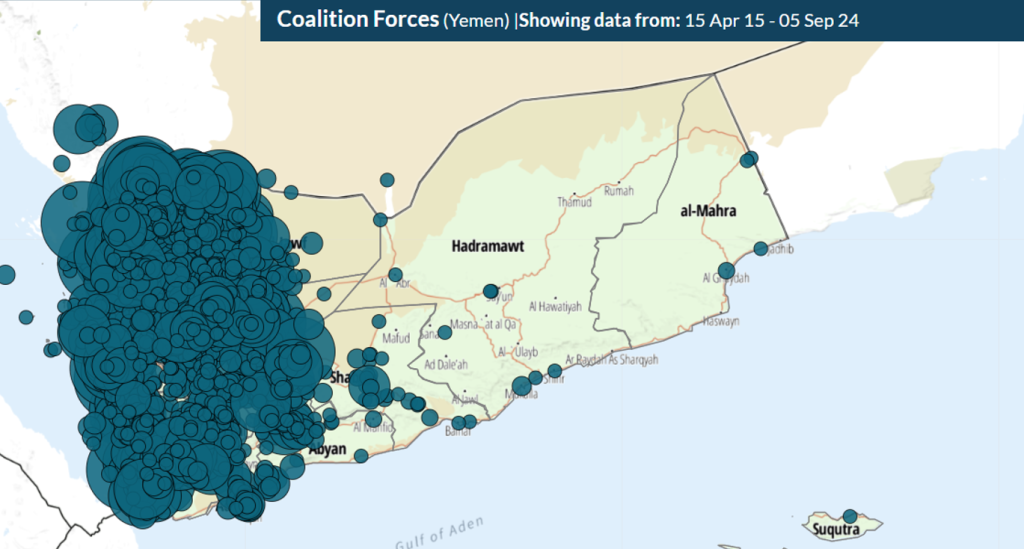
Between 2015 and 2022, Saudi Arabia and the United Arab Emirates (UAE) launched over 25,000 air raids on Yemen. According to the Yemen Data Project, over one-third hit civilian sites (39% of the targets could not be identified). Sites included farms, markets, warehouses, fishing boats, hospitals and water infrastructure – but, as ACLED data reveals, only in Houthi-controlled western Yemen:
These were not accidents but strategy: dismantle the Houthis’ base by making life unliveable in the areas they control. Destroy wells and water treatment plants to create scarcity. Hit farms and fisheries to undermine food supplies. Bomb bridges and roads to isolate communities. Strike schools and hospitals to disrupt education and healthcare. Destroy economic structures. The aim was not only to punish but to force displacement, weakening insurgent recruitment and resilience.
For most of these targets, Saudi and Emirati forces would have judged carpet bombing with unguided bombs a waste of military resources. Precision weapons, however, made such bombing cost-efficient.
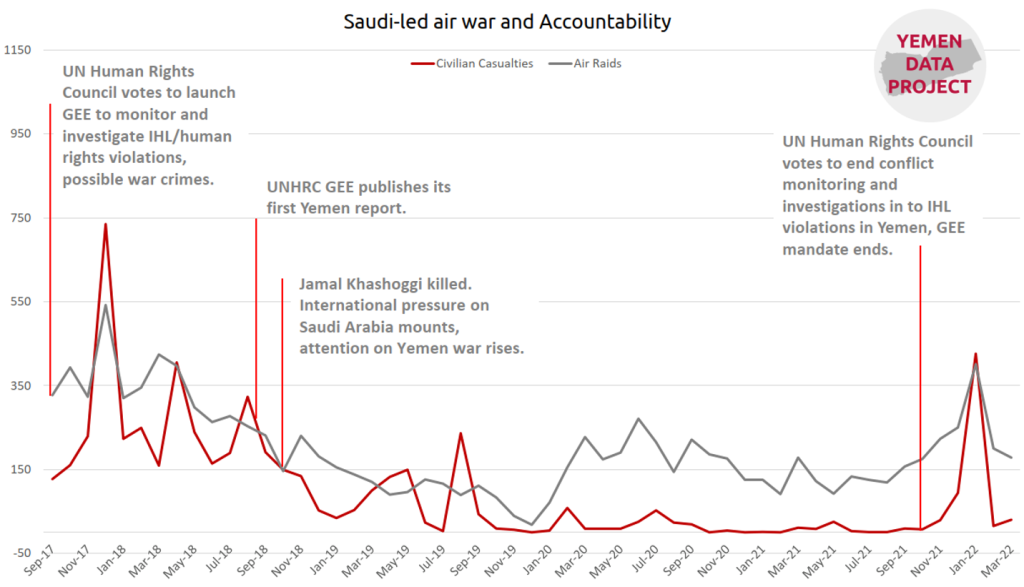
International pressure was the main brake. Domestic outrage was not. After the murder of Jamal Khashoggi, global scrutiny of Saudi and Emirati conduct in Yemen increased. Civilian targeting declined for a time. When UN monitoring weakened, it rose again.
Syria offers a revealing contrast. In the US-led coalition against Islamic State, Saudi and Emirati aircraft operated under American intelligence, targeting rules and operational control. Their strikes focused more narrowly on military targets. The lesson is important. Democratic coalition leadership can restrain autocratic partners – but only while those partners depend on it.
Democracy is not a guarantee of restraint. Israel's war in Gaza shows that democracies can also use precision weapons in ways that cause immense civilian harm. This does not disprove our argument. It sharpens it.
Israel remains a formally democratic state, with elections, courts and a vocal public sphere. Yet under Benjamin Netanyahu, as in the US under Trump, liberal checks and judicial oversight on executive power have come under sustained pressure. V-Dem has downgraded Israel from a liberal to an electoral democracy.
The effect on warfare is not simple. Hamas’ use of dense urban terrain matters. So does the trauma of 7 October 2023. But democratic erosion may help explain why civilian harm has become less of a political constraint – as is currently the case in the US.
Israel's attacks on Hamas operatives' homes and power targets blur the line between defeating an enemy and destroying its environment
Israel presents its Gaza campaign as targeting Hamas leaders, fighters, tunnels, weapons depots and command structures. Yet the category of military value has widened. Attacks on operatives’ homes and so-called power targets – high-rises and public buildings – along with AI-assisted target generation, and high collateral-damage thresholds, blurred the line between defeating an enemy and destroying its environment. The erosion of democratic norms has deepened tolerance for staggering death tolls.
This is not the autocratic playbook in pure form. Israel is not Russia, and operations still use legal language and civilian mitigation measures. But they may point to an illiberal variant of warfare: still legalistic in rhetoric, still technologically exact, but willing to loosen civilian-protection norms. The claim is that civilian protection depends on institutions that make governments answer for civilian suffering. As those institutions weaken, precision weapons serve a different purpose.
The policy lesson is clear. Arms transfers to autocracies with poor civilian-harm records are highly problematic. Advanced weapons do not make partners more restrained. They can make coercion more accurate.
Where democratic states seek cooperation, they need real operational influence. That means shared targeting rules, embedded legal advice and control over intelligence. Otherwise, the leverage that restrains partners disappears.
Advanced weapons do not make partners more restrained. They can make coercion more accurate
A similar warning applies at home. If democracies weaken courts, parliaments, media and military legal oversight, they weaken the institutions that make civilian suffering politically costly. Precision weapons will still hit most of their targets. They will just ask less often who else is standing nearby.
Technology has no conscience. The difference between protection and persecution lies not in ever more precise weapons, but in the polity of those who command them.