Poland’s democratic backsliding was not preceded by voters becoming more extreme, argue Maciej Sychowiec, Oliwia Szczupska and Marta Kołczyńska. Before democratic erosion took hold, Poles’ views were already becoming more tightly connected across issues, and more closely aligned with party choice
When democracies begin to weaken, polarisation is often among the first explanations offered. The idea is familiar. Citizens split into opposing camps, compromise becomes harder, and checks on power start to look less like democratic safeguards than tools used by political opponents.
Poland seems to fit this story. After Law and Justice (PiS) returned to power in 2015, it weakened the courts, the Constitutional Tribunal and public media. Many observers linked this democratic backsliding to a polarised electorate. But that explanation leaves something important unclear: had Polish voters actually become more extreme?
If polarisation means radicalisation, we should look for voters moving toward the edges of individual issues
The answer matters beyond Poland. If polarisation means radicalisation, we should look for voters moving toward the edges of individual issues. If it means political sorting, we should look for something else: opinions on different issues travelling together and becoming easier to predict from party choice. Our recent study, using Polish National Election Study (POLNES) surveys from 1997 to 2023, makes that distinction.
Across fourteen issues and 26 years, we find little evidence that Poles became more radical in their individual opinions. The spread of views on most issues barely changed between 1997 and 2023. On a few issues, views even became slightly less extreme by the end of the period. This means Poland's polarisation did not come from citizens simply moving to the extremes.
What changed was the structure of public opinion. Positions on different issues became more tightly grouped. Someone’s view on EU membership increasingly told us more about their likely view on abortion, immigration or the role of the Church. Those views also became more closely tied to party choice. Knowing who someone voted for revealed more and more about what they thought on many issues.
Polarisation matters beyond elections, shaping protest, mobilisation and wider political conflict
But polarisation matters beyond elections, too, shaping protest, mobilisation and wider political conflict. These patterns stayed broadly flat through the 1990s and 2000s, then rose sharply from around 2009–2011. Economic issues followed a different path. Views on taxation and the welfare state stayed only loosely linked to party choice, which points to a broad consensus on welfare provision.
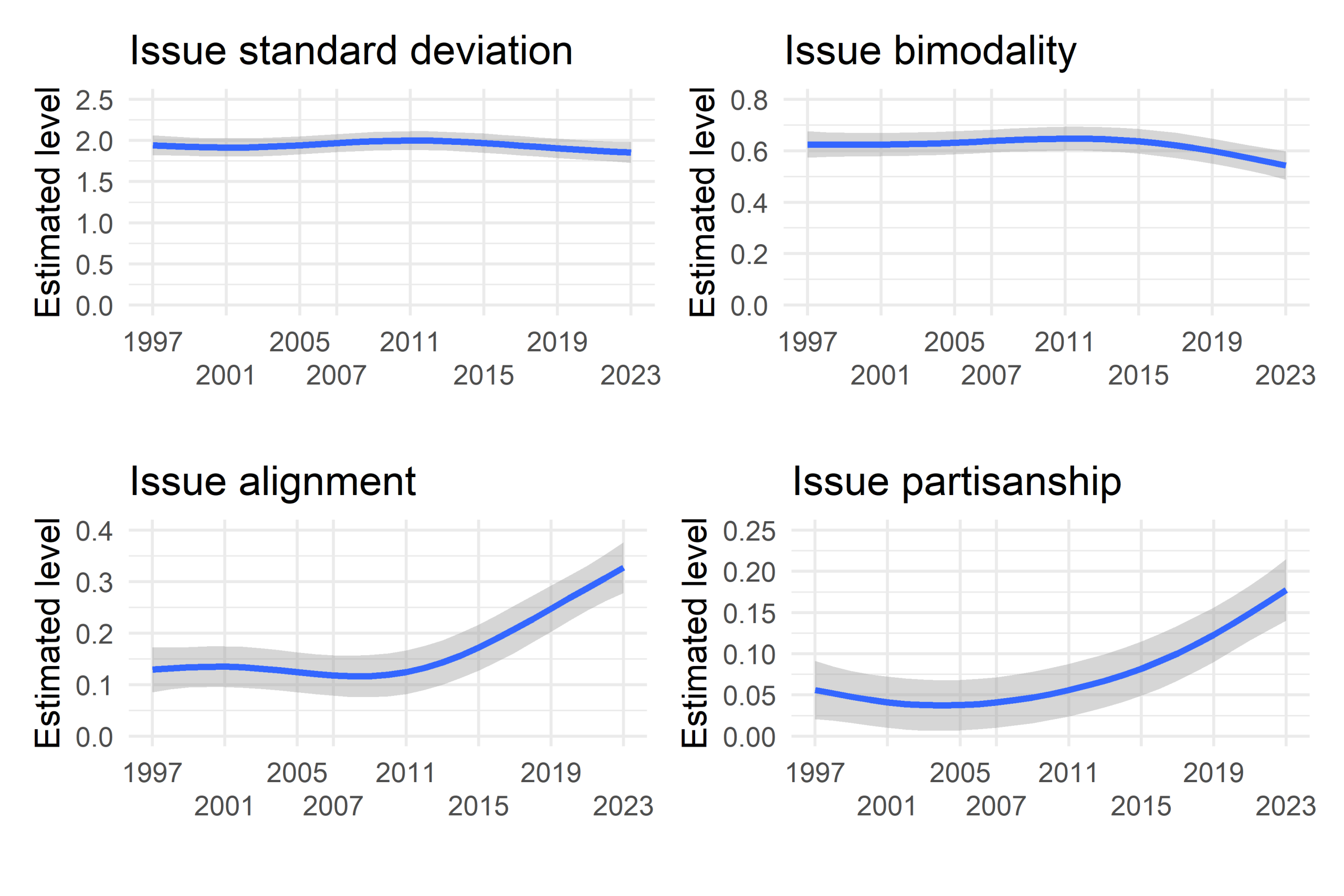
The timing matters. Poland's democratic backsliding is usually dated to 2015, when PiS returned to power. The sorting we identify started several years earlier, around 2009–2011. It emerged as Poland’s party system became more predictable, structured around the rivalry between PiS and Civic Platform, (now Civic Coalition). This does not prove that polarisation was caused backsliding by itself. Other factors mattered too. But the sequence is important.
A more 'sorted' electorate can make it easier for political elites to present checks and balances as tools used by opponents to block the government
A more sorted electorate can make it easier for political elites to present checks and balances as tools used by opponents to block the government. Similar dynamics appear in research on political trust, where support for those in power can make democratic erosion easier to accept.
The Polish case complicates simple narratives about polarisation and democratic decline. Poles did not become a more extreme electorate. They became a more sorted electorate. Views on emotionally charged issues became more closely grouped together and more closely mapped onto party choice.
The broader lesson is that polarisation is not only about extremism. It is also about how opinions fit together, and how closely they track party lines. In Poland, that quieter shift in public opinion began before democratic backsliding became the country's defining political story.