
Italy's new electoral law removes gender quotas where they mattered most: the top-list candidates most likely to win a seat. Francesca Feo argues this new law fits Italian Prime Minister Giorgia Meloni's conservative agenda, and reinforces male dominance in Italian party cultures
On 8 October, after heated debates, the Chamber of Deputies gave final approval to Giorgia Meloni's electoral reform. The law drops gender quotas for list leaders, positions in which parties can place candidates to near-certain seats. It keeps quotas only for seats decided by preference votes, or by a majority bonus that may never be triggered. Two logics explain this retreat: fiercer competition among party elites for fewer seats, and the government's conservative gender agenda.
Under the outgoing Rosatellum electoral law, neither gender could exceed 60% of candidates in single-member districts or at the top of closed lists. Combined with alternation down the lists, this helped women win around a third of seats.
The new system is fully proportional. Each ballot shows a list leader at the top. Below sit six names in gender alternation. Voters may tick up to three, but must include both genders, otherwise the second and third are void. A bonus of 70 deputies and 35 senators, filled from candidate lists with a 60/40 rule, goes to any coalition that reaches 42% of the votes.
For list leaders, the 60/40 rule is gone. Yet they are the main route into parliament, because only parties polling above 8–10% in a constituency will win more than one seat there. The opposition's demand to keep the quota in place for list leaders was rejected. Even women in the majority were 'disappointed, angry, opposed to this law', but voted for it.
This retraction matters more than its technical wording suggests. Even the parties’ own informal projections see women’s share of seats falling from 33% to 15–20%.
The retreat is striking, especially given how hard Italy fought for quotas. Over 100 countries have adopted gender quotas, and legislated rollbacks, such as Georgia in 2024, are rare.
Italy's parliament first adopted quotas in 1993, for municipal elections and the Chamber's proportional lists. In 1995, the Constitutional Court struck them down. It read Article 51 as demanding strict formal equality: gender – at the time – could not be a criterion for candidacy, even to redress discrimination.
Overcoming that ruling meant changing the Constitution itself. In 2003, under a centre-right government, a new sentence committed the State to promote equal opportunities 'with specific measures'. This marked a shift from formal to substantive equality.
Even so, the national electoral law didn't adopt quotas until 2017. In 2018, the first election with quotas, more women entered parliament than ever before – a reminder of what is at stake when quotas are absent.
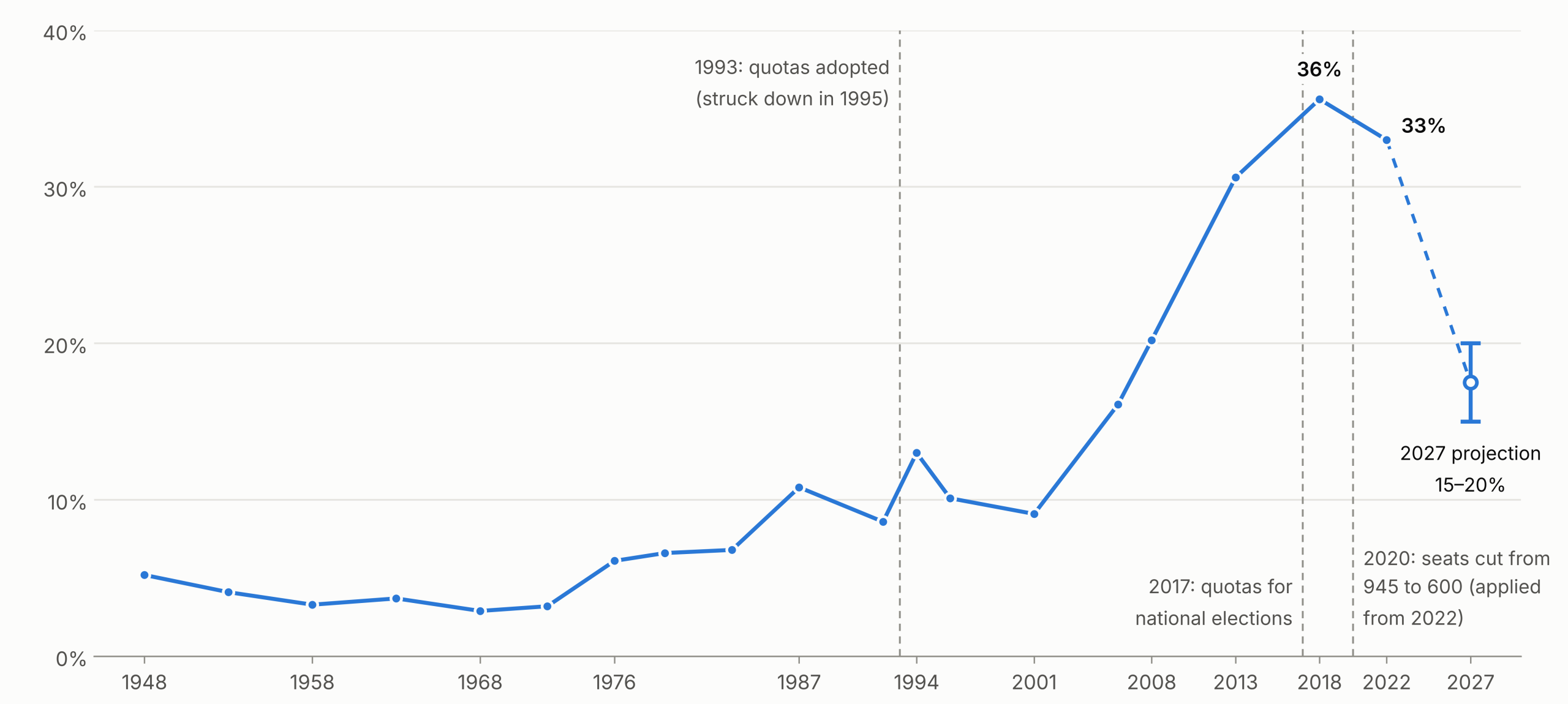
Dropping the quota rule for list leaders hands decisive choices on gender representation back to party leaderships. Timing matters here. In 2020, a constitutional referendum cut the number of MPs by more than a third, from 945 to 600. Safe seats became scarcer, and competition among party elites fiercer. In this climate, removing the quota for list leaders is the party establishment fencing off the few safe seats for those – mostly men – who already hold them.
Opponents of quotas argue that they limit parties' freedom to pick the 'best' candidates, and override democratic selection by members. Neither argument holds well. Both have clear gendered undertones. 'Best' often means 'closest to a male standard'. In Italian politics, women, as the graph above shows, struggle to sit at national, regional and local level. And democratic selection is largely a fiction. Article 49 of the Constitution asks parties to act 'through democratic means'. No law regulates their internal democracy, however, and candidates are generally chosen in informal, small, mostly male leadership circles.
Redistributing party power from men to women is the whole point of quotas – and the reason parties resist them. As feminist research argues, redistribution of power is a necessary process towards 'parity democracy': making gender equality a founding principle of democratic governance.
Clearly, parity democracy is not Meloni’s project. The quota rollback fits the conservative gender agenda of her government, which has close ties to the anti-gender movement.
On women's rights, the government has acted, but selectively. A new law made femicide a separate crime, with tougher penalties. Surrogacy became a 'universal crime' – a framing that echoes part of the feminist debate.
What the government has not done is telling. A bipartisan bill introducing consent into the definition of rape stalled in the Senate, after the majority sought to replace 'consent' with 'dissent'. Sexuality education in schools now requires written parental consent. And the government cut the EU-funded target for new nursery places by over 100,000. These measures reveal a selective approach to gender equality: prioritising punitive interventions, while neglecting policies addressing the structural roots of gender inequalities.
The electoral reform follows the same pattern, yet citizens' committees are preparing to challenge it before the Constitutional Court. Three decades after striking quotas down, the Court may now have to restore them – in name of the constitutional commitment to substantive equality.
Meloni has said she is 'not a fan of quotas', and that parity should not be 'a concession'. In her view, women’s underrepresentation is a challenge for individual women to overcome, not a structural problem for the state to fix. What is at stake, then, is not only how many women will enter Italy’s next parliament. It is whether gender equality remains a responsibility of democratic institutions, or is left to the discretion of parties, whose elites remain overwhelmingly male.


