
Opposition to sustainable transport projects is growing, because of distributive and identity grievances familiar from broader climate policy. Flora Baumgartner looks at how transport policies are contested locally, and how they act as glue for right-wing parties, locally and at a European level
A car stops; the door opens. I close my umbrella and get inside. 'What, no bike today?', my friend smirks in reference to the heavy rain. The two of us frequently tease each other about the vast difference in how we get around. One of us never has owned a car, the other takes his everywhere he goes, even if it replaces a five-minute walk.
As we search for a parking spot in the historic city centre, I question why I didn't take a bus. Then I see a bus behind us; same traffic. We discuss the recent regional elections. 'First time I voted Green!', he says about the relatively conservative regional branch which won the election by an inch. 'Want to know why? They said they would fight that ridiculous combustion engine ban! Now that I can get behind!'
A new antagonism is growing in Europe’s cities. 'More road safety – no useless bike lanes!', reads a poster for the Roman chapter of Fratelli d’Italia, Italy’s ruling right-wing party. Alternative für Deutschland mobilised for the regional election my friend and I discussed with posters reading 'Your car would vote AfD!' In the Czech Republic, a new, right-wing party based entirely around motorist identity entered parliament and government after its first national campaign.
In short: transport policy is becoming marked by increasing disagreement and conflict across Europe. At the core of this development is a strong position on the political right, which, after a stint of green dominance on the topic, is now strongly pushing back on sustainable travel.
There are clear, negative health and environmental consequences of large-scale car usage. Green movements have been arguing to rebuild transport infrastructure for decades, with some success. For instance, the European Union has been quietly working towards a sustainable transport paradigm since the 1990s. Sustainable transport projects go hand in hand with urban renewal. The vision: reducing and shifting traffic from roads to public transport and walking or cycling. Specifically, this can mean replacing parking spots with bike lanes, expanding public transit offers, or making car usage more expensive.
In urban environments, space is scarce, so there is a genuine distributive conflict when deciding between parking, public transport, or cycling infrastructure
Disruptions caused by this project can lead to heated debates, especially at the local level. In urban environments, space is scarce, so there is a genuine distributive conflict when deciding between parking, public transport, or cycling infrastructure. People get attached to their everyday environment. Disrupting it is therefore usually met with trepidation by residents, creating ideal conditions for political disagreements to emerge. Long-held norms about who a city should be for (businesses? residents? commuters?) combine with these distributive grievances to generate a backlash.
Politicians don't always frame sustainable travel as good for the climate. Quite the opposite, in fact. In interviews with local politicians, I found proponents deliberately framed the debate in terms of quality of life. Although they argued with me that changes were necessary for climate reasons, they admit to never campaigning on these grounds any more. The reason? The right.
Opposition to transport policy, much like other climate policy areas such as renewable energy, is common ground for right-wing parties
Opposition to transport policy, much like other climate policy areas such as renewable energy, is common ground for right-wing parties. There may be differences in degree, but in the German example, local party positions on transport show a clear left-right divide. And though there are differences between the centre-right and far right, their positions are not far apart. This development is not just local, either. Climate policy was one of the first areas to see controversial pan-right-wing cooperation in the European Parliament.
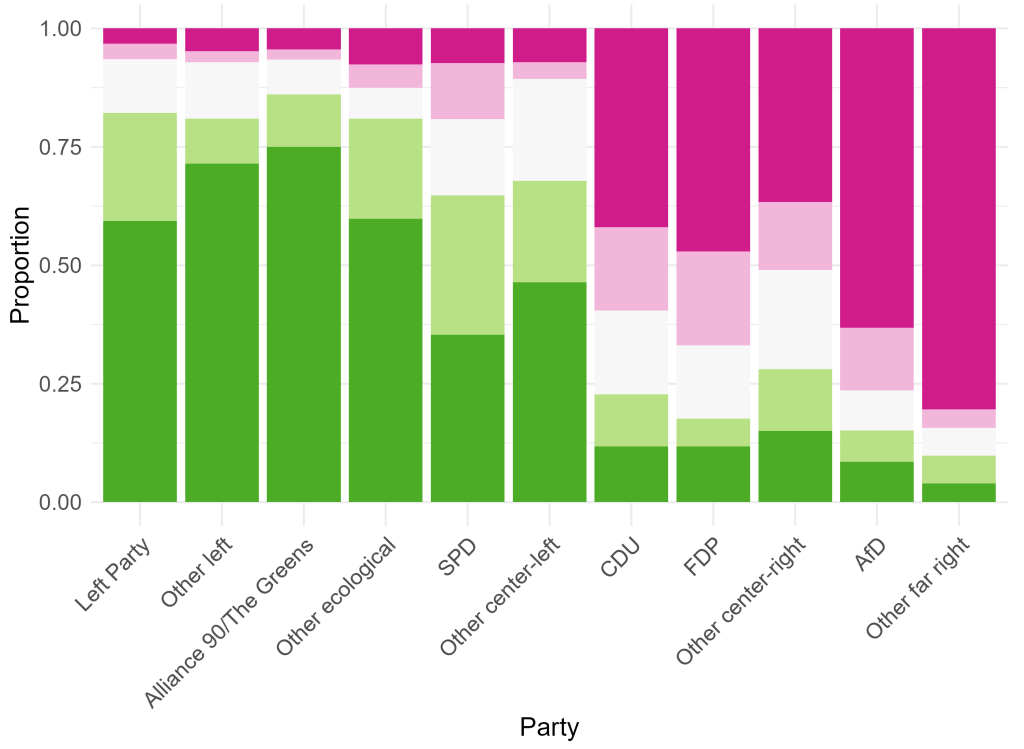
Of course, the reasons for these positions differ. Historically, the centre-right has focused on the economy. Centre-right parties therefore argue in defence of industrial interests and local businesses. The far right, which has lately become more proletarian, spins a tale of ordinary working people inhibited and punished by a detached, green elite – simply for driving a car. The lines, however, are blurry. In Berlin, the centre-right won the 2023 city-wide elections after a heated anti-green campaign in favour of motorists.
Not all is as black and white, though. While sustainable transport projects are prone to backlash, once completed, public approval often sharply improves as people see the benefits. Compensating residents for their economic losses minimises their willingness to punish their leaders for implementing such projects.
Right-wing parties are harnessing local grievances about public transport to challenge the urban strongholds of the left
However, we will likely see continued mobilisation against sustainable projects from the right. Too strategically useful is the opportunity to combine local grievances and resistance to change to challenge the urban strongholds of the left. Transport policy is localised climate policy. As global warming worsens the heat domes over our cities year on year, conflicts over this topic will gather even more steam in the future.





I agree with the important role of identities in political polarisation about environmental issues like climate change. Local everyday life experiences are important. These are part of the wider polarisation of identities linked to different valuations of spaces. I develop that argument further in my recent book: A Political Geography of Polarising Identities: Contested Iconic Places
https://www.routledge.com/A-Political-Geography-of-Polarising-Identities-Contested-Iconic-Places/Terlouw/p/book/9781032706665