Maike Bernhard-Rump argues that citizens’ trust in elections is shaped less by actual risks than by how they imagine them. Drawing on evidence from Germany and Austria, she shows why perceptions of voting security – not digital threats – play a decisive role in shaping electoral confidence
Citizens do not judge election integrity based only on facts. They rely on narratives about how elections might be manipulated. This matters because trust in elections underpins democratic legitimacy.
Across many democracies, claims about fraud and interference now dominate political debate. Even countries with strong electoral systems are affected. Germany’s 2025 federal election shows how quickly doubts can spread. After the vote, Bündnis Sahra Wagenknecht challenged the result and called for a recount. At the same time, misleading videos about ballot manipulation circulated online.
Digital networks amplified these claims. Automated accounts boosted content linked to far-right party Alternative für Deutschland. Together, political contestation and online misinformation created the impression that the election might have been compromised.
My research examines how citizens in Germany and Austria perceive electoral integrity. Both countries have highly professional electoral administrations. Safeguards against fraud are strong.
I use survey data to analyse three key factors: perceived fraud risks in voting, support for populist parties, and economic insecurity. The results point to a clear pattern.
Citizens do not base their judgements primarily on concerns about foreign interference or social media manipulation. Instead, they focus on the act of voting itself. People who believe that fraud is likely – whether in postal voting or in-person voting – are much more likely to doubt elections overall.
My research found that citizens who believe that electoral fraud is likely are much more likely to doubt elections overall
This is striking. In both countries, the risk of manipulation in vote casting and counting is extremely low. Yet perceptions do not follow these institutional realities.
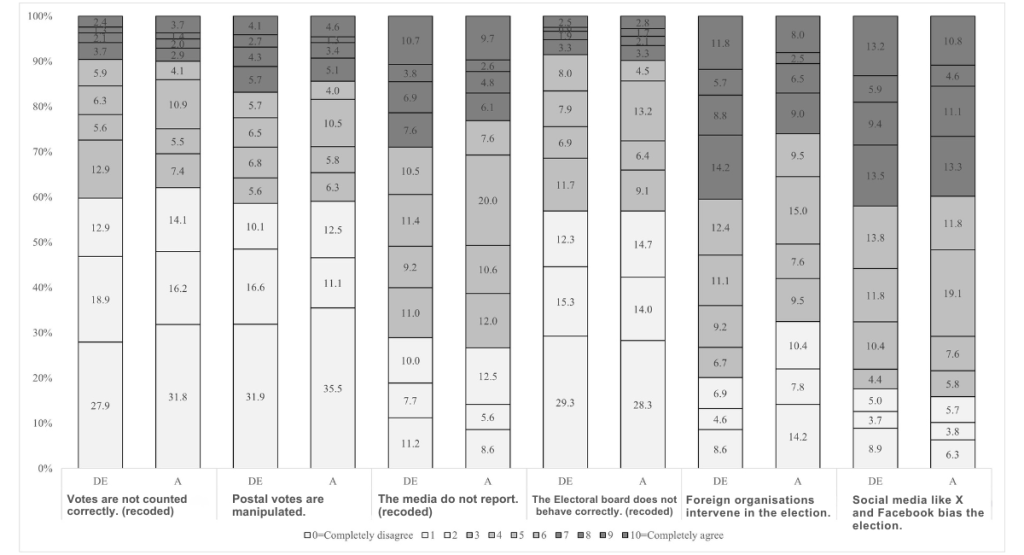
At first glance, survey responses suggest that citizens worry most about the information environment. Many express concern about biased media, foreign interference, and social media manipulation.
But this is only part of the story. Statistical analysis shows that these concerns are less important for overall trust. Instead, doubts about the mechanics of voting have the strongest effect.
Citizens are worried about misinformation and interference, but are more concerned about whether votes can be cast and counted securely
In other words, citizens recognise new digital threats. But when they evaluate elections, they fall back on a simpler question: can votes be cast and counted securely?
This creates a gap. Public debate focuses on misinformation and interference. Citizens, however, anchor their trust in something else.
This mismatch has important consequences. In countries like Germany and Austria, the technical integrity of elections is well protected. The bigger risks often lie elsewhere – in the digital information environment.
Yet citizens’ trust depends on how they imagine fraud could occur, not on expert assessments of what is likely. This makes electoral confidence more fragile than it appears.
For electoral authorities, this creates a difficult task. Of course, authorities must ensure that elections are secure. But they also have to convince citizens that they are secure.
These findings open up a deeper question: how does distrust in elections actually develop?
A new research project builds on these insights by examining how citizens form their views about electoral integrity. It shifts the focus away from institutions alone and looks at how people experience and interpret elections in everyday life.
Using qualitative interviews and focus groups, the project explores how citizens encounter information about elections. It examines how they make sense of competing claims about fraud and fairness. It also looks at how these interpretations shape trust – or distrust – in democratic institutions.
To understand electoral trust, we need to understand how citizens navigate the conversations, media exposure, and personal experiences that form their perceptions
This approach recognises that perceptions do not emerge in a vacuum. They are formed through conversations, media exposure, and personal experiences. To understand electoral trust, we therefore need to understand how citizens navigate these different sources of information.
Trust in elections is not only earned through good performance. It is also shaped by belief. Citizens need to feel that the process is safe, even when the real risks lie elsewhere.
If democracies want to protect electoral legitimacy, they cannot focus on procedures alone. They must also address the narratives that shape how citizens see them.
In the end, elections are only as trustworthy as people believe them to be.