Nigel Farage, the leader of Reform UK, dominates headlines as the face of the party’s populism. However, Tutku Zengin's analysis of 1,108 statements from all five Reform UK parliamentarians elected in the 2024 general election reveals that Farage is not the most populist among elected Reform UK politicians
Nigel Farage is one of the most recognisable populist politicians in British politics. Yet my research on Reform UK's communication on social media platform X during the 2024 general election paints a different picture. It is not Farage, but Rupert Lowe, who left the party in March 2025 following accusations of workplace bullying, who accounted for the highest proportion of statements with populist content.
Populist ideas appeared more frequently in Lowe's tweets than in those of any other Reform UK parliamentarian, including Farage. Simply put, Reform UK's populism extends well beyond its most famous face.
Reform UK is not a passing political moment. It has already surpassed the highest vote share, and the number of seats won, of its predecessor, UKIP. In the 2024 general election, Reform UK won five seats and achieved a remarkable surge in vote share.
Since then, its electoral appeal has only deepened. Farage himself declared that Reform UK is 'now the main opposition party to this government'. YouGov surveys show voter intention remains consistently above 20%, and the 2025 local elections confirmed Reform's growing reach across Britain, with the party taking control of 10 councils for the first time in its history. The 2026 local elections solidified this even further, with Reform leading the results once again by securing 1,451 seats.
Each successive election seems to be bringing Farage's road to 2029 vision closer to reality. No longer can we easily dismiss his prediction that 'Reform will be the next opposition, then government awaits' as a mere a campaign slogan. Now, it looks more like a credible roadmap.
Support for Reform UK has surged, yet its communication strategies have received little scholarly attention. Why?
However, despite this trajectory, Reform UK’s political communication has received surprisingly little systematic scholarly attention. This piece draws on my recent master's thesis to begin filling that gap.
To systematically study Reform UK's political communication, I collected and analysed 1,108 statements from the personal X accounts of all five elected Reform UK parliamentarians: Lee Anderson, Nigel Farage, Rupert Lowe, James McMurdock, and Richard Tice, during the 2024 general election campaign. I assessed each statement for three core elements of populist ideology: speaking in the name of the people, attacking elites, and demanding that power return to the people.
My results challenge the assumption that Farage drives Reform UK's populist communication. Rupert Lowe produced the highest proportion of statements containing at least one populist element, at 50.4%. Richard Tice followed in second, with Farage coming third. Lee Anderson recorded the lowest proportion, at 28.4%. In other words, more than half of everything Lowe tweeted during the campaign carried one of the three elements of populism. Farage's output, meanwhile, though consistently populist, ranked third among his own colleagues.
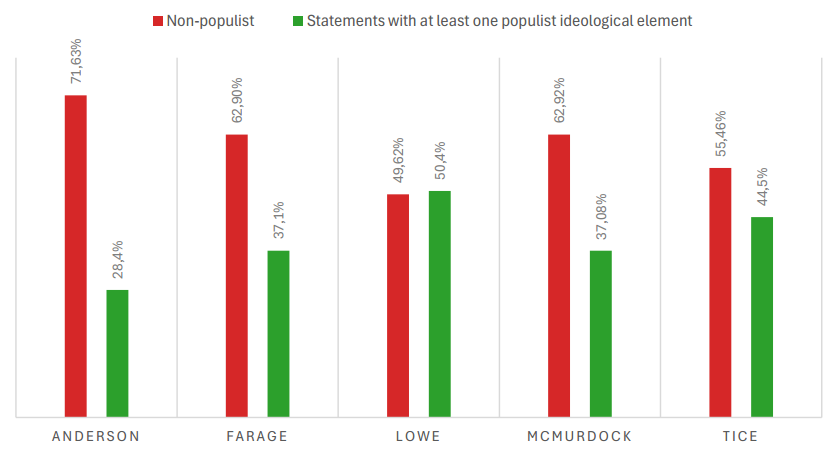
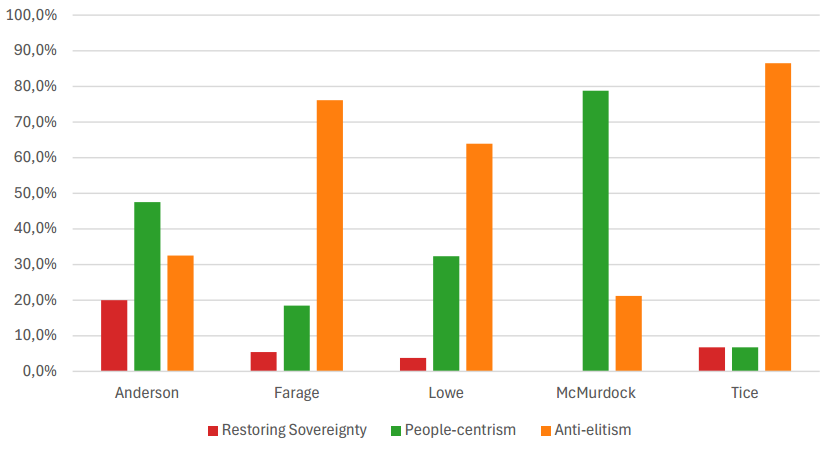
Based on the presence of all three elements across their communication, four out of five politicians qualify as populists. The exception is James McMurdock, whose statements contained no messages about popular sovereignty; they did not claim that power belongs to the people.
Reform UK's populism contains four distinct political voices, each deploying populist ideology in their own way
Reform UK's four populist parliamentarians differ not only in how often they use populist content but also in which elements they emphasise. Tice's communication is overwhelmingly anti-elitist. Populist statements targeting political and media elites comprised 86.5% of his output. Lowe, by contrast, is the most people-centrist among the five, frequently claiming to speak 'in the name of the people'. Farage presents the most balanced profile, drawing relatively equally on all three elements, but without leading in any of them. My research reveals that Reform UK's populism contains four distinct political voices, each deploying populist ideology in their own way.
Farage is Reform UK's most recognisable face, but not its most prolific populist voice. My study reveals that the party's populist communication is bigger than any one voice. Reform's populist messaging is more wide-ranging than headlines suggest, and deeply woven into how its parliamentarians speak to the public. Analysing the total output of all five politicians, statements containing at least one populist element never fell below 20%. Clearly, populism is not something Reform UK simply turns on for big moments; rather, it is a constant.
Nigel Farage may be Reform UK's most recognisable face, but his is not the party's most prolific populist voice
At the heart of this communication sits anti-elitism. Political and media elites were consistently targeted across Reform UK’s campaign, specifically on issues the British public cared about most. According to surveys by YouGov, Verian and Ipsos, these issues were immigration, the National Health Service, and the economy. This is not incidental. It is the engine of Reform UK's appeal. As Labour suffers historic losses at the ballot box and the Conservatives struggle to recover, Reform UK's anti-elitist rhetoric is finding fertile ground.