Alia Qaim Bukhari argues that Pakistan's merger of its Federally Administered Tribal Areas did not replace older land authority. Legal procedures, customary shares, oral histories and British records have accumulated, leaving the state to determine which forms of evidence should count when competing claims collide
What counts as proof of land ownership when the state encounters communities whose claims rest not only on documents, but on lineage, customary shares, collective use and memory? Pakistan's 2018 merger of its Federally Administered Tribal Areas (FATA) into the province of Khyber Pakhtunkhwa made that problem of state-building immediately practical. During fieldwork in the former FATA, I put a question to a senior bureaucrat involved in the transition. If land is central to market integration, I asked him, how can the merger succeed when land is embedded in lineage, honour, collective claims and territory, rather than treated as a liquid asset?
His response: the merger and land settlement could simply proceed side by side.
That assumption exposes the central flaw of the post-merger project. Land settlement is not parallel; it is the ground on which the merger must stand. Courts, police, and provincial departments now operate where ownership, use and authority are recognised through lineage, jirga (council of tribal elders), nikat (customary shares) and local memory, while the state increasingly demands documentary proof. The 2018 merger did not create the land question. It made it unavoidable.
Digital records are necessary, but land in the former tribal areas is not simply undocumented property. It is ancestry, nang (honour), water, forests, grazing, minerals and political authority. Earlier scholarship, including Faheem Mohammad's 2012 doctoral study, warned against development approaches that bypass local arrangements.
Land in the former tribal areas is not simply undocumented property. It is ancestry, honour, water, forests, grazing, minerals and political authority
Akbar S. Ahmed's distinction between nang and qalang helps explain why. Nang was tied to honour, autonomy, lineage and collective claim; qalang to taxation, landed elites and state penetration. FATA was never a monolith, and the distinction captures an essential point: land has never meant the same thing everywhere.
In many areas, land is organised through nikat (tribal shares); shamilat (collectively governed land such as forests, mountains and grazing areas); and barkha (an individual's recognised share within a wider collective order). The problem is not the absence of rules but that these rules rarely translate neatly into bureaucratic title. While the state asks who owns a parcel, locals ask who belongs there, who grazes there, whose lineage has recognised rights and whose memory carries weight.
There is no singular FATA land story. Kurram is not Waziristan, and Bajaur is not Khyber. The claim that 'there are no land records in FATA' is misleading. Some areas experienced British settlements, others codified custom, while elsewhere sale deeds accumulated in political agents' offices. Documentation existed, but became another layer rather than displacing older authority.
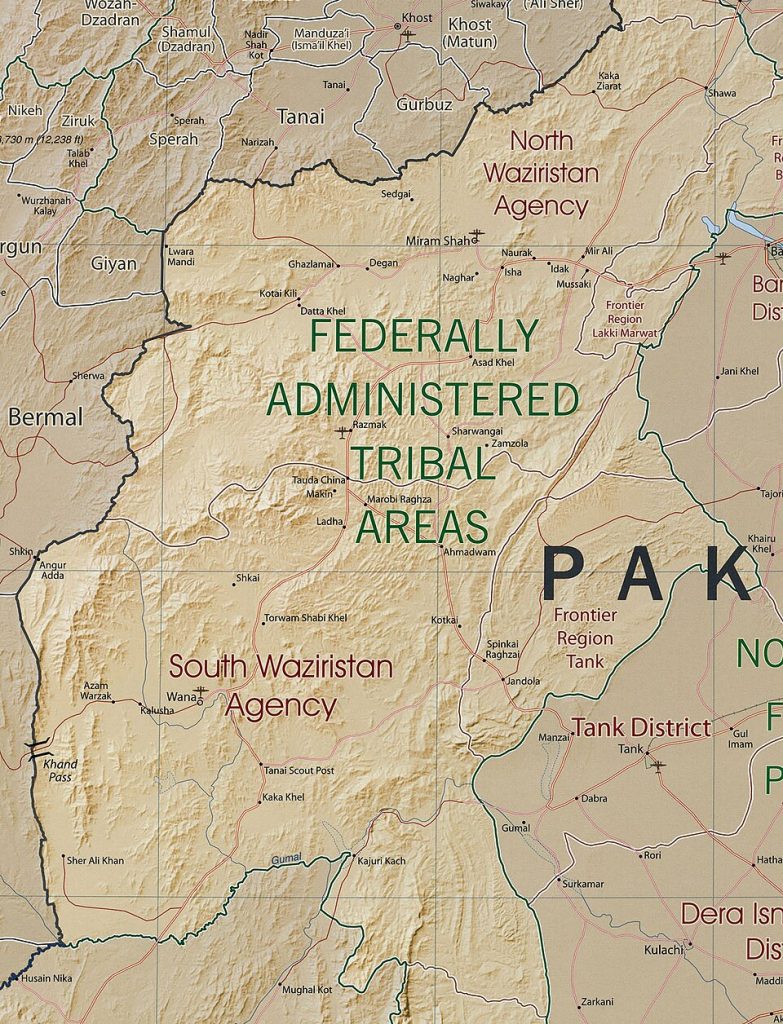
Events in the district of Kurram show why documentation cannot settle competing claims. British officials completed a land settlement in 1893 as part of a political bargain with the Shia Turi tribe. Turizuna, a written compilation of Turi rewaj (custom), sought to make jirga decisions more consistent. Once written down and used administratively, the boundary between formal law and custom blurred. Many commentators attribute violence in the districts of Boshera, Balishkhel and Sadda to sectarian identity, yet disputes over land, forests, water and access continue beneath it.
The Tochi Valley followed another path. The 1902–03 British settlement distinguished agricultural land from ghair-tankai, or communal lands, yet disputes around Mir Ali draw on settlement records, revenue history, nikat, ancestral grazing rights, jirga precedent and collective memory. These are competing archives of legitimacy: ways of remembering, recording and verifying land rights. They overlap and contradict; people mobilise them selectively. One side may invoke paper records and cultivation; another lineage, customary shares and remembered access. Each rest on a different understanding of proof.
The town of Khar in Bajaur district offers a third variation. Colonisers never settled there, yet sale deeds were deposited with the political agent for security. Records accumulated without replacing customary authority. I call this layered continuity: documentation added another basis for claims rather than displacing what came before.
Mining makes these tensions contemporary when land gains value. Under Khyber Pakhtunkhwa's legal framework, the surface may belong to an individual, lineage or tribe, while the minerals beneath belong to the state. On paper, this is straightforward. On the ground, it is not.
Land may belong to an individual, lineage or tribe; the minerals beneath to the state. On paper, this is straightforward. On the ground, it is not
Before the merger, extraction depended on negotiated consent through lineages, malikana (ownership rights) and customary authority. Provincial mining law has collided with those expectations. Opposition to the Khyber Pakhtunkhwa Mines and Minerals Bill 2025 therefore concerned more than revenue: it raised the question of who can speak for land, resources and community consent.
A mountain is rarely just a mineral deposit. It can be shamilat, grazing land, forest, ancestral boundary and political claim at once. If people continue to contest what lies on its surface, they will also contest claims over what lies beneath it.
We cannot reverse the sequence: the merger came first. The challenge now is how to verify accumulated claims within the order the merger created.
Successive political interventions leave behind practices, forms of authority and archives that remain usable: another example of layered continuity. Layered verification is one practical response to the evidentiary problem this creates: an applied method for testing evidence produced by different layers against one another rather than treating any single archive as authoritative. Oral histories, nikat, jirga decisions, British settlement records, later documentation, cultivation, lineage, memory and present use may all matter, but none is politically innocent.
Where competing archives of legitimacy have accumulated, formalisation cannot treat the newest document as the final word
The problem extends beyond FATA. State-building, land formalisation and resource extraction all require governments to decide which claims become legally legible and enforceable. Where competing archives of legitimacy have accumulated, formalisation cannot treat the newest document as the final word. The merger changed Pakistan's constitutional map. Now, a durable political settlement depends on recognising that the evidence through which land and resources are governed must itself be read across these layers.

Alia holds a PhD from Royal Holloway, University of London.
Her work focuses on political economy, economic development, state formation, and South Asian borderlands.
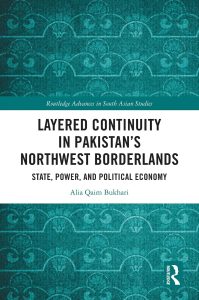
Layered Continuity in Pakistan’s Northwest Borderlands: State, Power, and Political Economy
Routledge, 2026
Alia's book develops the 'layered continuity' framework to explain how new laws, funds, reforms, and political openings are absorbed into older arrangements, reshaping how people claim resources, negotiate access, and make authority workable in practice.
Her writing is undertaken in a personal capacity; the views expressed are her own and do not represent the position of the UK government.