Mexico has adopted rules requiring broadcasters to flag programmes that mix news and opinion. Julio Alberto Barajas Servin argues that these labels should be judged by whether the people they are meant to help notice and understand them. A legal duty matters little when viewers cannot use the signal to distinguish news from commentary
Mexico has settled one part of a long argument over audience rights. Broadcasters must now tell people when a programme mixes news and opinion. For this particular right, the rule relies on disclosure. Officials do not classify each sentence in advance. The rule's democratic value still depends on a practical question. Does the audience understand the cue?
Disclosure rules are common because they leave room for editorial choice. The broadcaster speaks and the audience receives extra context. The same logic now appears in warnings for synthetic media and political advertising. Yet regulation often stops at the screen. It specifies what must appear, then records whether it appeared. That says little about what the viewer understood.
Mexico's Telecommunications Regulatory Commission (CRT) published its final audience-rights guidelines in the Official Gazette on 28 August 2026. They take effect 30 days later. Article 11 of the guidelines requires television services to use captions, bumpers, on-screen messages, or another visible element. Radio services must use an audio cue. These signals appear at least at the beginning and end of a programme. They identify programmes that combine news and opinion, as well as programmes devoted mainly to opinion.
Mexico requires television and radio services to use signals to identify programmes that combine news and opinion, as well as programmes devoted to opinion. This has triggered accusations of censorship
The proposal triggered accusations of censorship. The final version expressly protects editorial freedom and bars prior censorship. It also emerged from a public consultation that drew 8,889 submissions. Those revisions improved the legal design. They left one issue unresolved: a signal may comply with the rule and still pass unnoticed.
The chosen unit is the entire programme, which is easier to administer but problematic where boundaries shift quickly. A host can report an inflation rate, explain it, and praise a government policy in under a minute. Instead of tagging specific assertions, the rule mandates opening and closing notices warning that the host 'expresses opinions and news without distinction'. As the media scholar Raúl Trejo Delarbre has noted, this blanket disclaimer certifies the mixture instead of helping audiences untangle it.
Viewers must first notice a label. Then they must interpret it while the programme unfolds. Either step can fail. A recent Loop article by James Rice on synthetic media highlights a similar dynamic. It notes that provenance systems, while imperfect, improve audiences' ability to distinguish authentic from synthetic content when presented clearly.
Viewers must first notice a label. Then they must interpret it while the programme unfolds. Either step can fail
Two US experiments by the Center for Media Engagement, with 1,697 participants in total, show why presentation matters. Researchers tested labels such as news, analysis, opinion, and sponsored content. In the first experiment, 45% of participants reported that they had not noticed whether the article carried a label. In the second, 58% of those shown a conventional label above the story could not say whether it was labelled, and only 24% recalled it correctly. Correct recall rose to 66% when a short explanation appeared inside the article. Neither format increased trust.
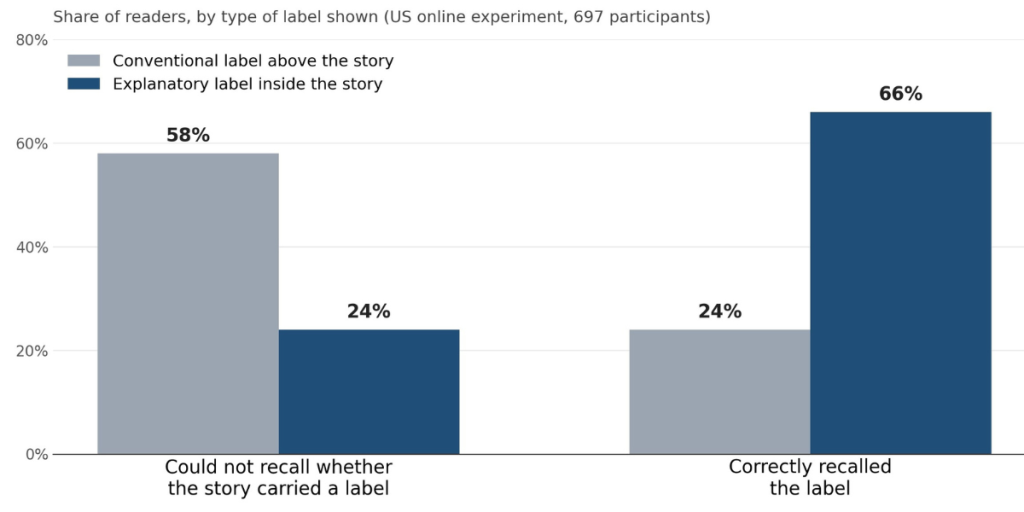
The experiments used written articles in the US, so they cannot predict how a Mexican television audience will respond. Their contribution is narrower but useful. The existence, placement and wording of a label produce different levels of attention and recall. That finding matters because Mexico places its notices at the start and end of a programme. Memory becomes more important as the distance between cue and claim grows. A notice shown at 8pm has to survive in the viewer's memory until the contested statement arrives at 8:20pm.
The CRT can test its chosen design without turning itself into an editor. Different groups could watch the same news segment with one feature changed: a cue at the beginning and end, a persistent marker, or a brief signal when the presenter moves into commentary. The regulator, the broadcasters' audience ombudsmen or an independent research team could then measure whether viewers noticed the cue and classified particular statements correctly. A later question could test how long the effect lasts.
Trust and agreement should remain separate outcomes. A viewer may distrust a programme yet understand that a claim was presented as news
Trust and agreement should remain separate outcomes. A viewer may distrust a programme yet understand that a claim was presented as news. Political identity also shapes classification. In a 2018 Pew Research Center survey of 5,035 US adults, people more often treated statements as factual when those statements favoured their political side. Mexican tests should therefore examine whether the same cue works across groups with different levels of political knowledge and media trust.
This evidence would help choose the least intrusive design that produces measurable comprehension. It would also reveal when a label adds little because viewers already recognise the difference. Communication testing would complement the legal debate over the guidelines with evidence that legal analysis cannot provide.
The regulation assumes a viewer who arrives at the start and stays until the end. Many people now encounter a broadcast as a short clip on social media or a messaging service. An opening cue can disappear when someone extracts 30 seconds from a longer programme. Even within conventional television, viewers change channels or join halfway through.
Evaluation should reproduce those habits. It should include viewers who enter late and people who see an excerpt without the opening titles. The findings could guide broadcasters when they publish their own clips, even where the regulation cannot control every third-party upload.
The new rule in Mexico tells broadcasters what must appear on screen or air. How people watch should shape its next revision. When a notice satisfies the broadcaster's checklist but disappears from the viewer's mind, audience rights remain largely on paper.