As security tensions rise in the Gulf, Kuwait's Al-Arfaj flower has emerged as a symbol of resistance, unity, and resilience. Eiman Alabdulghani explains how the bloom has quickly become a focal point of public sentiment, galvanising citizens and residents in a powerful display of solidarity with the forces tasked with defending Kuwaiti sovereignty
The Al-Arfaj flower (Rhanterium epapposum) is a hardy desert plant that flourishes in challenging environments. Kuwait’s national flower since 2008, Al-Arfaj has bright yellow flowers and a network of thorny branches.
The botanical characteristics of the Al-Arfaj mirror Kuwait's historical capacity to thrive in adversity. Often appearing on badges and in digital imagery, the flower is instantly recognisable throughout Kuwait as an emblem of national solidarity. Historically, the Al-Arfaj served as high-protein grazing for camels and a clean-burning firewood. Its root systems also helped stabilise shifting desert sands. Today, the Al-Arfaj symbolises Kuwait's capacity to flourish under extreme pressure.
This symbolism is particularly resonant in the context of recent security threats. Kuwait is heavily affected by the Iran-US confrontation. The country occupies a strategic position at the edge of the Arabian Peninsula, bordered to the north and west by Iraq and to the south by Saudi Arabia. Since the 1990 Iraqi invasion, Kuwait has hosted US military bases.
Iran is targeting Gulf infrastructure to pressure the United States, drawing Kuwait into the conflict. The country's air defence systems have managed to intercept most incoming threats, yet missile and drone salvos have nonetheless struck Kuwaiti airports, apartment blocks, and oil terminals. This heightens security risks, and raises fears of strikes near the US embassy. For Kuwaitis, this will revive memories of the 1990 invasion.
Despite the best efforts of Kuwait's air defence, Iranian missiles and drones have struck Kuwaiti airports, apartment blocks, and oil terminals
Kuwait is a small nation in a strategically vulnerable position. To maintain national unity, ensure economic stability, and manage the psychological impact of regional hostilities, its people have therefore developed a profound capacity for resilience.
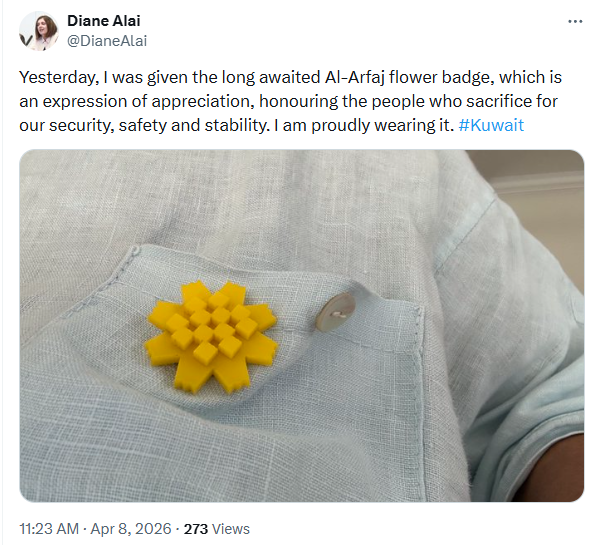
Adoption of the Al-Arfaj as a national symbol was driven by a grassroots initiative to create a unifying emblem honouring those dedicated to protecting Kuwait's safety and sovereignty. The flower reflects those on the front lines, showing a deep appreciation for the military, medical, and emergency personnel who sacrifice for Kuwait's security.
The initiative rapidly gained traction. Now, citizens, businesspeople, expats, and diplomats all wear their yellow badge with pride. Kuwait's national flower is now a sought-after collector's item and a powerful symbol of loyalty.
A crucial aspect of the movement's success is its non-commercial nature. The symbol is free to distribute, and 3D-printable files are readily available so people worldwide can produce their own badges. This open-source approach fosters organic dissemination. It strengthens a sense of collective ownership and solidarity that transcends geographical boundaries and economic strata.
During the current conflict, the Al-Arfaj has therefore played a critical psychological role. Collective identifiers help citizens manage anxiety by providing a focal point for national pride and endurance. The badge, often displayed alongside the Kuwaiti flag and accompanied by prayers for the nation's security, reinforces a shared sense of identity and purpose. It consolidates national unity in the face of external aggression. This collective expression serves not only as a morale booster but as a visible deterrent. It demonstrates the Kuwaitis' unified front against perceived threats.
Wearing the Al-Arfaj flower badge is a morale booster and a visible deterrent, demonstrating Kuwaitis' unified front against perceived threats
Despite the wail of air raid sirens and the threat of ballistic missile attacks, the people of Kuwait have refused to abandon their daily routines. Instead, they have shown a collective determination to endure. The flower-badge campaign helps allay Kuwaitis' deep-seated psychological fears amid profound stress. It has reduced feelings of helplessness, and symbolised sacrifice and resilience through the most difficult times. And it has fostered national cohesion against systematic infrastructure attacks.
By wearing the badge, citizens and residents signal their belonging to a united community.
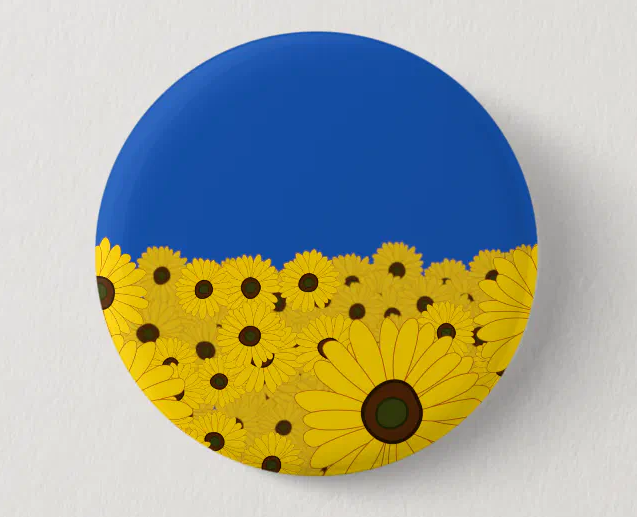
The Al-Arfaj initiative recalls other global social media-driven campaigns that use national emblems to express solidarity in times of crisis. Ukraine's sunflower, for example, has become a worldwide symbol of Ukrainian resilience since Russia’s military invasion.
Both movements use a bright yellow flower to symbolise resilience, national identity, and civilian solidarity in the face of armed conflict. Both achieved success through wearable pins and massive social media participation.
Any movement seeking social reform risks exposing internal social and class divides. But focusing on an organic national symbol, such as the Al-Arfaj or the sunflower, helps transcend any such differences.
The organic dissemination of the Al-Arfaj badge means that every strata of Kuwaiti society can get involved in the initiative. It has achieved a unifying effect that emphasises collective defence. Grassroots movements and digital engagement are playing an increasing role in shaping Kuwait's socio-political landscape.