Matthew E Bergman reveals how so-called valence populism (populism focused on competence and good governance rather than ideology) has a potential electoral disadvantage. While non-ideological messages that focus on good governance may broaden electoral appeal, lacking an ideological core can also cost votes. The fortunes of Italy’s Five-Star Movement offer a cautionary tale
Founded in 2008, Movimento 5 Stelle – M5S – positioned itself as a movement beyond left and right. The party emphasised the corruption of established mainstream parties across the political spectrum. Its message focused on anti-corruption, anti-elite rhetoric, and five broadly popular issues: water, environment, transport, connectivity, and development. These themes lacked a traditional ideological orientation, enabling M5S to attract left- and right-leaning voters, including many who did not identify with any particular party.
A broad, nonideological base is characteristic of valence populists, whose appeal rests on universally desirable goals such as trustworthiness, competence, and good governance
My research shows that in 2018, more than 25% of M5S voters declined to place themselves on the left–right scale. That's more than twice the rate of any other party. The graph below shows how those M5S voters who did place themselves not only cluster near the ideological centre but display the widest ideological dispersion among major Italian parties. This broad, nonideological base is characteristic of valence populists, whose appeal rests on universally desirable goals such as trustworthiness, competence, and good governance. Mattia Zulianello, in this 🔮 series, explains how valence populist parties differ from other populist parties, by adopting clear ideological stances.
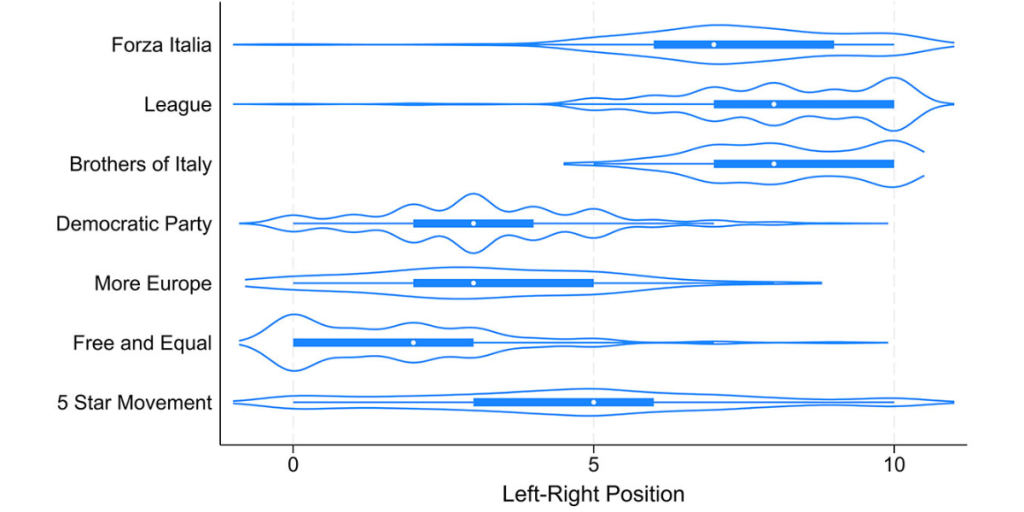
M5S won the largest vote share in the 2013 and 2018 elections. Breaking with previous pledges not to join a coalition, it then joined three: first with the right-wing Lega (Conte I), then with the centre-left Partito Democratico (Conte II), and finally in a broader centrist coalition (Draghi). Despite, or because of, this governing experience, the party fell to third place in the 2022 election.
My research complements previous Future of Populism blog posts, including Martin Bull’s piece examining splits among party elites. It also looks at individual voters and asks whether this decline stemmed from ideological ambiguity. Were voters projecting coalition partners’ positions or policy outputs onto M5S? For example, Jan Philipp Thomeczek examines whether left-wing populists moderate once in office. Or was the decline of M5S the result of incumbency-related dissatisfaction with leadership and policy performance?
In March 2018, the ITANES (Italian National Election Study) interviewed respondents about that year’s election. It reinterviewed this cohort in September 2020. I classified respondents who identified with M5S in 2018 into three outcomes: 51.8% remained loyal, 29.2% deserted to other parties, and 19% disengaged from party politics. The deserters split between left-wing (9.9%) and right-wing (14.7%) alternatives.
Voters unable to place M5S ideologically in 2020 were 24% more likely to disengage; disappointment with M5S leadership increased the likelihood of desertion by ~15%
Several factors predicted these shifts. First, voters unable to place M5S ideologically in 2020 were 24% more likely to disengage. Next, disappointment with M5S leadership increased the likelihood of desertion by ~15%. Still significant, dissatisfaction with government performance increased desertion by ~6%. Myth no.3 in Giorgos Venizelos’ contribution to this series examines whether populists remain in power because of their policies.
These findings suggest that once in power, valence populists face heightened scrutiny. Without an ideological core to anchor supporters, voters rely heavily on performance evaluations and perceptions of leadership competence.
Hungary’s emerging TISZA party, led by Péter Magyar, shares notable similarities with M5S in its pre-electoral phase. Kinga Korányi documents Magyar’s political rise and agenda-setting abilities. Magyar, a former Fidesz insider, has accused Hungary’s ruling elites of corruption, nepotism, and oligarchic control. Attesting to neither left or right placement, he chastised the country’s ruling right-wing Fidesz party, and its centre-left opposition parties, as corrupt.
Magyar’s actions bear comparison with M5S which, prior to 2018, pledged it wouldn’t form political coalitions. In a typical populist frame, Magyar made the case that he alone – an outsider – could save Hungary from its crisis of corruption. Only he could fix Hungary's broken system.
Rather than push an ideological agenda, Magyar's main policy arguments involve improving public services – another echo of M5S. In particular, he has advocated for spending to improve education, healthcare, housing and energy. Such good governance matters are typical of valence populists. Magyar has also made efforts to stem corruption, with plans to join the European Public Prosecutor’s Office and strengthen anti-corruption laws.
Magyar has attracted a broad ideological voter base. Supporters range from disenchanted Fidesz loyalists to left-wing voters; and many smaller and left-wing (green and formerly governing socialist) parties have intimated that their voters should vote TISZA for tactical reasons.
Hungary’s TISZA party leader Péter Magyar doesn't push an ideological agenda. This has won him a broad voter base, from disenchanted Fidesz loyalists to left-wingers
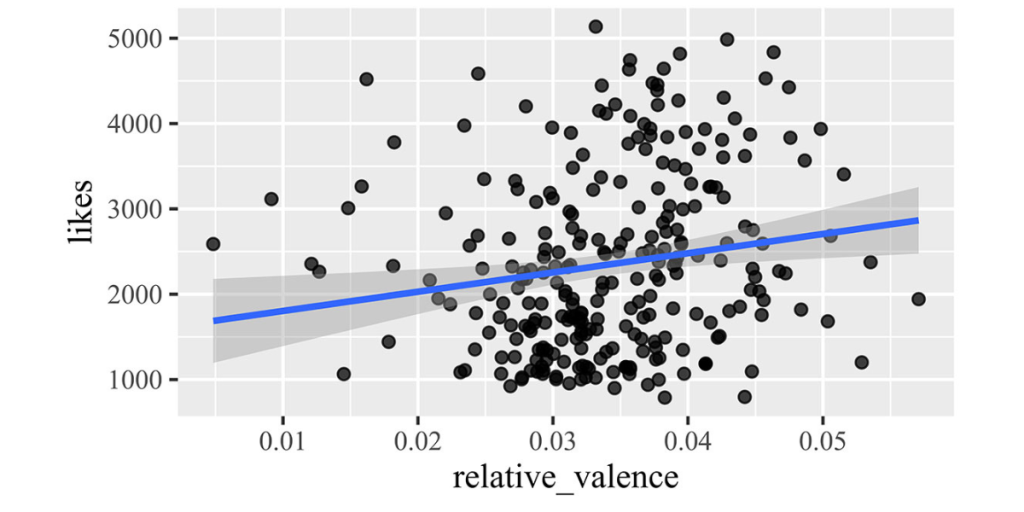
As the earlier graph showed, this ideological ambiguity is similar to the place that M5S found itself. It also seems Magyar’s attraction is mainly one of valence. The graph below shows the variance in 'likes' received by Magyar's YouTube livestreams, for posts of varying valence-heaviness. The trendline suggests that engagement with his content is indeed related to his valence-based messaging.
Yet my M5S research suggests that failure to follow through on policy, or being perceived as ‘ideological’ as opposed to ‘valence’, does not benefit such populist parties at the ballot box. The lack of an ideological core is a double-edged sword. It can, unparadoxically, attract support from the left, right, and previously unaffiliated. Yet without these core policy-driven supporters, short-term performance-based heuristics dominate once these parties enter power.
Slovakia’s OL'ANO (Ordinary People and Independent Personalities) party led two governments, from March 2020 to May 2023. But voter support dropped 64% after their governance was deemed ‘chaotic’, with ineffective leadership and policy friction between coalition partners. Similar rises and falls have affected Czechia’s ANO 2011 party and Bulgaria’s GERB party – also classified as valence populists. Both parties swing between anti-corruption electoral success and ineffective, corrupt leadership once in power.
The volatile contexts that lead to the rise of valence populists can just as quickly lead to their downfall under pressure of delivering on promises. Onlookers and supporters of valence populists should take note.