Drawing on a systematic review of 2,401 scientific articles, Hugo Bonin shows how 'liberal democracy' has shifted from a contested analytical concept to a defensive catchphrase. The more the term circulates, the less scholars examine it. But examining the term is crucial for how we think about democracy's future
'Liberal democracy is under threat.' The phrase has become so familiar it barely registers. It appears in op-eds, political speeches and keynotes at conferences. But when did scholars stop asking what liberal democracy is and start taking for granted what it defends against? And what does it mean when a concept quietly shifts from object of enquiry to rhetorical shield?
These are the questions behind a literature review published in the International Political Science Review. The review tracks how scholars have used the term 'liberal democracy' across 2,401 English-language scientific articles indexed in Web of Science between 1990 and 2025. Its findings offer an intellectual history of political science, and a provocation worth sitting with.
References to 'liberal democracy' in scientific journals rise gradually through the 1990s and 2000s, then accelerate dramatically after 2015. Even after controlling for the general expansion of academic publishing by normalising yearly counts against the number of indexed journals, the surge holds. Something genuinely changed in how scholars engaged with the term.
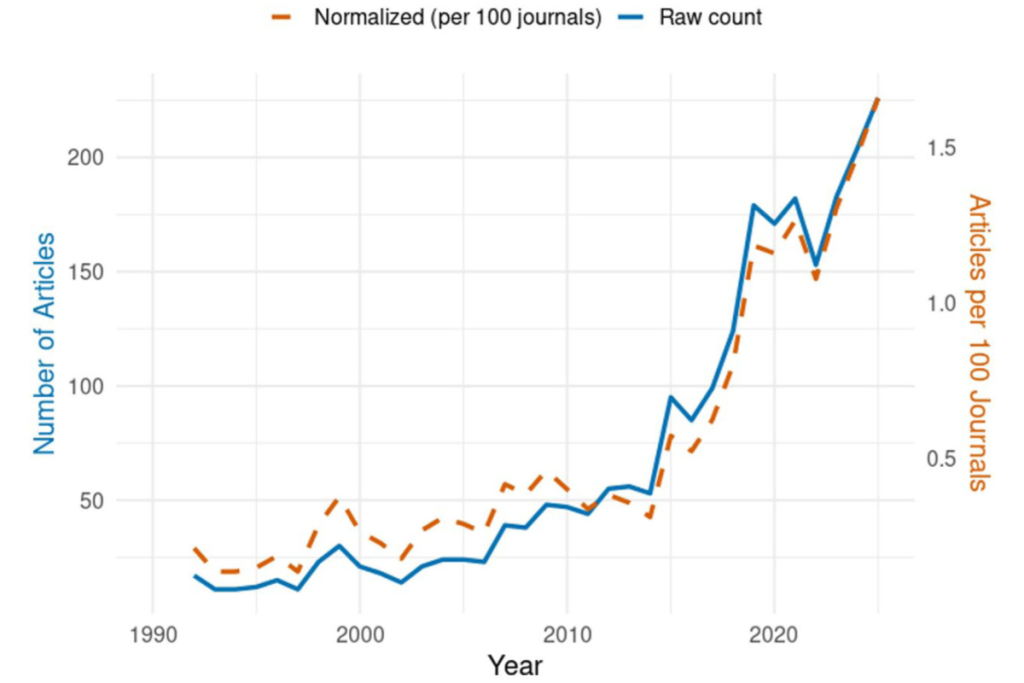
The timing is not coincidental. Brexit, the first election of Donald Trump, the consolidation of Viktor Orbán's Hungary and Jarosław Kaczyński's Poland: the mid-2010s brought a wave of events widely narrated as a crisis of liberal democracy, and scholars responded. The annual number of articles explicitly invoking the concept more than doubled within a decade, peaking at over 200 in 2025.
As usage of the term 'liberal democracy' exploded, serious engagement with its meaning contracted
But here is the twist. As usage of the term exploded, serious engagement with its meaning contracted. The more 'liberal democracy' circulated, the less scholars theorised it. This is especially clear when we focus the analysis on the political science subcorpus (n=879).
In the 1990s and 2000s, political scientists treated 'liberal democracy' as a problem to be debated. What exactly did it mean? How should we measure it? Kenneth Bollen spent considerable effort distinguishing its liberal and democratic components, and proposing multidimensional indices to capture each. Mikael Wigell and others debated the proper relationship between electoralism and constitutionalism in hybrid regimes. Political theorists like David Miller engaged the concept critically, treating it as an aggregative model that deliberative alternatives might transcend. They contested, refined, and argued over the concept, which are exactly the kinds of reactions that serious concepts in a discipline are supposed to invite.
After 2015, most political science journal articles treat 'liberal democracy' as a given, not a category whose meaning bears examination
The qualitative analysis of the 30 most cited articles of the subcorpus tracks this evolution. In the earlier period, the majority of leading contributions explicitly defined the term, asking what it comprised and how to measure it. Among the post-2015 cohort, that impulse is largely absent. Twelve of the 16 most-cited articles published after that year treat 'liberal democracy' as a given: a norm invoked to frame threats (populism, autocratisation), not a category whose meaning bears examination. Seventeen of the 30 coded articles overall adopt a defensive stance toward the model; only 7 are somewhat critical.
A related development amplifies this trend: the institutionalisation of the Varieties of Democracy (V-Dem) Democracy Indices. Founded in 2014, the V-Dem Institute produced a rigorous, multidimensional dataset distinguishing electoral, liberal, participatory, deliberative and egalitarian forms of democracy. It formalised the liberal component (defined by rule of law, checks and balances, and civil liberties) as a measurable variable embedded in the infrastructure of comparative research.
As political scientist Jonas Wolff has observed, from 2017 there was a significant shift in V-Dem's own orientation: from mapping the varieties of democracy to effectively defending a single model. 'Liberal democracy' became not a contested space but a quantified variable, a metric to be tracked, its erosion documented in index points. This is a methodological achievement, but also a kind of closure: what once demanded conceptual labour now arrives pre-packaged.
None of this happened in a vacuum. Political science reflects, as well as analyses, the world it studies. The literature's defensive turn echoes broader anxieties about democracy, especially in Europe.
But there are costs worth naming. When a central concept becomes primarily a contrast term, defined by what it stands against (populism, illiberalism, authoritarianism) rather than by what it affirmatively is, it loses analytical grip. The question of what, precisely, is worth defending and why becomes harder to ask. The voices historically critical of liberal democracy's limits, such as a tendency to privilege formal rights over material equality or its compatibility with (neo)colonial governance, find themselves structurally marginalised in a literature organised around protection rather than interrogation.
When 'liberal democracy' becomes defined by what it what stands against (populism, illiberalism, authoritarianism) rather than by what it is, it loses analytical grip
The data capture this too. Research on the Global South almost disappears from the most-cited literature. In earlier decades, Latin America, sub-Saharan Africa, and Southeast Asia, were all represented. Now, the corpus has become preoccupied with European democratic backsliding and the health of Western institutions. 'Liberal democracy' has increasingly become a North Atlantic concern.
Political scientists do not simply observe the world: they help shape the categories through which it is interpreted. When 'liberal democracy' hardens from a contested concept into a defensive normative category, that shift carries consequences. It affects which questions get asked, whose experiences get centred, and which alternatives to the status quo get taken seriously.
I believe we should recover the concept of liberal democracy as an object of genuine inquiry. But rather than dissolving it into relativism, we should ask again: what do we actually mean by liberal democracy? Who has access to it, and on what terms? What are its conditions of possibility, and what are its structural limits?
Answering those questions, rather than simply defending the concept against its enemies, may in the end be the more honest form of democratic commitment.