
Philipp Noetges argues that Sachsen-Anhalt's record vote for the far-right AfD party is less about German exceptionalism than a widening gap between what policy now requires and what any electorate can realistically evaluate: a gap populism exploits faster than evidence-based politics can close
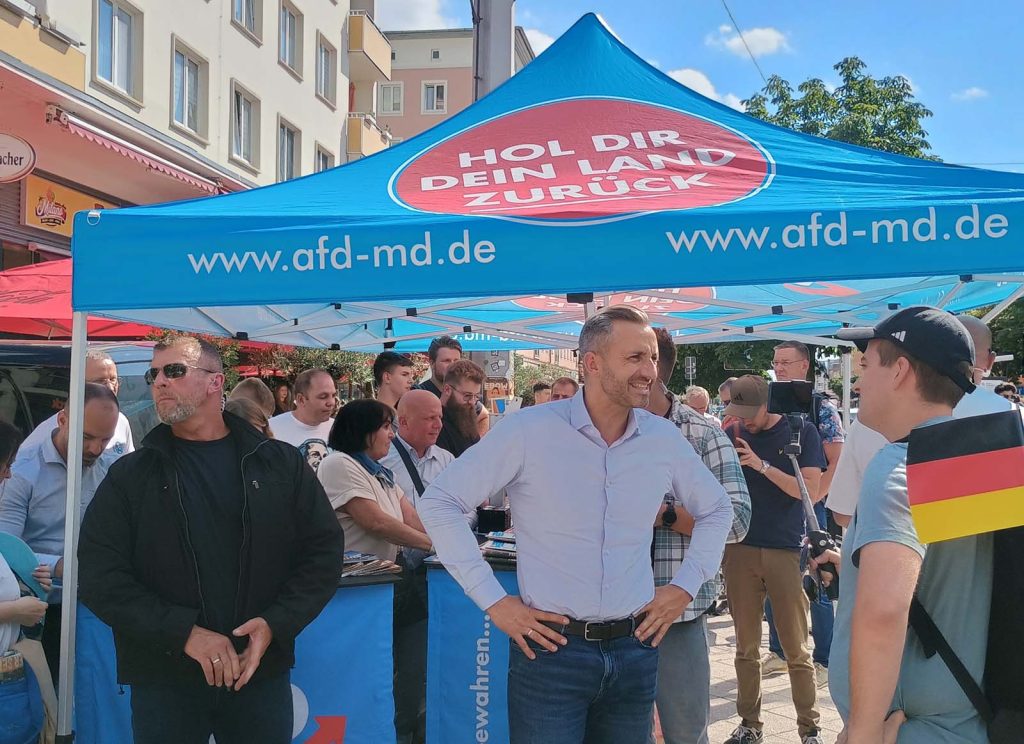
On 6 September 2026, Sachsen-Anhalt handed Alternative für Deutschland (AfD) its strongest result ever recorded in a German state election: 43.8% of the vote. The centre-right CDU, which had won the 2021 election, collapsed to 17.2%, less than half its previous score. Turnout reached about 78%, a post-reunification record. The number is regional, but the pattern is continental. As policy problems grow more technically demanding, that gap widens further. Simple, loss-framed populist narratives fill it faster than evidence-based alternatives can.
Part of the explanation is cognitive, and none of it is fully correctable. The availability heuristic lets vivid events crowd out slow-moving trends, exactly the profile of climate change. Loss aversion means loss-framed messages reliably beat gain-framed ones. Motivated reasoning filters evidence through identity, and since one vote almost never changes an outcome, staying uninformed is individually rational. Considered reasoning is slow, and compressed decision cycles push publics toward fast, heuristic judgment, regardless of education or goodwill.
A less discussed mechanism deserves equal weight. Simple-policy parties often gain and hold power by trading invisible long-term risk for visible short-term relief. This trade is self-stabilising until it isn't. Building energy dependency on an unreliable supplier, or halting carbon pricing schemes like the EU Emissions Trading System, lowers costs now, while deferring the cost of coercive leverage or irreversible ecological damage later. Concentrated, immediate benefits are politically visible; diffuse, delayed costs are not, so office-seeking actors outweigh the former. This is not unique to populist parties. Germany's dependency on Russian gas was built under a cross-party consensus from Gerhard Schröder's SPD to Angela Merkel's CDU.
Russia's 2022 invasion made gas dependency costly, and voters did punish the parties associated with it. But by the time a risk is punished at the ballot box, the underlying damage is often irreversible
What distinguishes populist parties is the addition of ideological denial, of the kind Naomi Oreskes and Erik M. Conway traced in the tobacco and fossil-fuel lobbies in their book Merchants of Doubt. This removes the residual doubt that might otherwise generate caution. Visible relief produces satisfaction, satisfaction produces electoral reward, and the trap holds only while the deferred risk stays latent. Russia's 2022 invasion made gas dependency visible and costly almost overnight, and voters did punish the parties associated with it. But by the time a risk is punished at the ballot box, the underlying damage is often irreversible.
Status anxiety compounds this, and it has empirical backing. Prosperity does not proportionally raise satisfaction, because hedonic adaptation and social comparison dominate. Positional goods such as housing location or educational prestige explain why growth fails to resolve status anxiety once relative position stagnates. Perceived status decline, independent of actual income, robustly predicts support for the radical right.
The near-zero real growth many high-income European economies now face raises the salience of zero-sum thinking: believing life is a zero-sum game correlates strongly with support for redistribution, opposition to immigration, and political polarisation, plausibly because when the pie stops growing, one group's gain more easily reads as another's loss.
Policies that internalise externalities, such as carbon pricing, or advance social justice, such as gender equality, impose genuine, and at times real, losses of power on specific groups
Not all of these losses are merely perceived, either. Policies that internalise externalities, such as carbon pricing, or advance social justice, such as gender equality, impose perceived, and at times real, losses of power on specific groups. Online male subcultures such as the incel community illustrate the mechanism. A felt loss of relative status produces reactance, the tendency to respond to a perceived restriction of freedom with intensified opposition, regardless of whether the underlying change is, on balance, beneficial or harmful.
A further mechanism deserves brief mention: we can decompose every policy into a basic value judgment and an empirical claim about what best realises it. As policy grows more complex, it becomes harder to discern which values a given choice still serves, and evaluation requires a fuller grasp of its effects.
Rather than escaping these mechanisms, Switzerland channels them differently. Concordance government means no single election could flip executive control the way Sachsen-Anhalt's might. The Swiss People's Party has governed for decades, weakening its outsider claim even at large vote shares.
Federalism shortens the perceived distance between voter and policymaker, and direct democracy plausibly improves losers' consent. But direct democracy sits in real tension with the pattern described above. Party-centred systems let voters delegate value-realisation and technical design to a trusted agent, at the risk that institutional trust erodes when that agent disappoints. Swiss-style direct democracy removes that intermediary but not the underlying complexity, handing technical judgment on matters from pension reform to EU relations directly to voters. Switzerland has not solved the complexity trap so much as chosen which failure mode to carry.
For other systems, the transferable pieces are institutional rather than rhetorical. Consensus mechanisms, proportional executives and grand coalitions lower the stakes of any single election. Subsidiarity brings decisions closer to citizens than persuasion campaigns can. Deliberative mini-publics, or citizens' assemblies by sortition, as used in Ireland on abortion and climate, force sustained deliberation that ordinary election cycles cannot.
Higher science literacy and numeracy widen polarisation on climate risk, because more capable reasoners are also better at motivated reasoning toward identity-protective conclusions
Education remains the obvious lever, but its limits should be stated plainly. Higher science literacy and numeracy widen, rather than narrow, polarisation on climate risk, because more capable reasoners are also better at motivated reasoning toward identity-protective conclusions. The constraint is motivational, not informational, which favours redistribution, place-based investment, and pacing mechanisms such as cooling-off periods, over expecting voters to override their own cognitive limits.
None of this closes the gap between democratic legitimacy and policy complexity. But given self-stabilising policy myopia, a widening space between values and the choices meant to serve them, and status losses that are not always merely perceived, the problem is not that voters are failing democracy; it is that current institutional designs are not yet built to survive the mismatch. Switzerland's mixed record suggests there is no clean fix, only a choice of trade-offs to manage deliberately, rather than by default.





_AfD_Ulrich_Siegmund_160704907.jpg)