For decades, European democracies have celebrated rising gender equality in parliaments, cabinets, and party leadership. These gains matter. But if we look only at elite politics, argue Catherine Bolzendahl and Hilde Coffé, we miss a quieter, equally consequential story: how ordinary women and men take part in democratic life
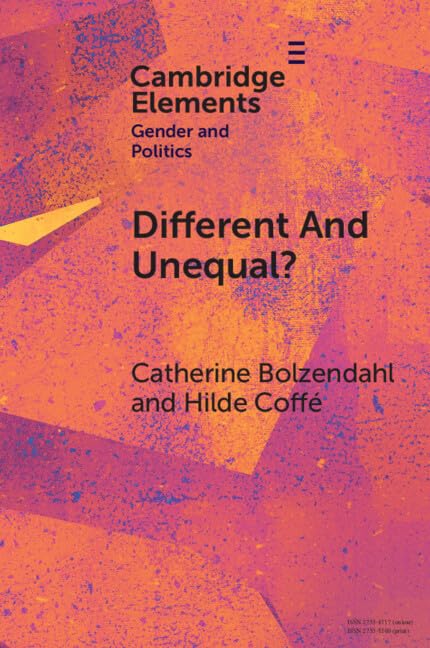
Our new open‑access monograph, Different and Unequal? Gendered Political Participation in European Democracies, uses nearly 20 years of European Social Survey data across 26 democracies to map eight common forms of political participation among men and women, from voting to petitioning, from demonstrations to digital posting.
The result challenges one of the most persistent myths in political commentary: that women participate less. While they do engage less in some forms of participation, they participate just as much – if not more – in others. In short, women do not participate less than men; they participate differently.
Public discussion often frames women as less politically engaged, less interested, or less willing to take part. This framing misses the complete picture. When we examine a wide range of political activities, we find gendered differentiation, not simple deficiency.
Across Europe, women are as likely or more likely than men to vote, sign petitions, and boycott products for political reasons
Across Europe, women are as likely or more likely than men to vote, sign petitions, and boycott products for political reasons. Men, in contrast, dominate activities that require direct confrontation with institutions: contacting politicians, working for a party, or joining formal organisations. When we take women’s lower levels of political interest into account, women also meet or exceed men’s rates of demonstrating and posting political content online.
The conclusion is clear: women participate robustly, but in different ways than men.
Democratic health depends not only on whether citizens act, but how they act. When certain forms of participation are consistently undervalued, the voices expressed through them are more easily ignored.
Petitions and political consumerism, for example, are sometimes dismissed as 'low‑cost' or 'informal'. Yet, these are precisely the actions millions of Europeans take to express their priorities, and women are disproportionately represented in these channels, which means democratic institutions that overlook them risk overlooking women’s democratic voice.
When certain forms of participation are consistently undervalued, the voices expressed through them are more easily ignored
Conversely, the forms where men dominate – institutional contact, party work – often shape the policy agenda more directly. This is not evidence of greater civic virtue; it is evidence of unequal access, unequal risk, and unequal social expectations.
As suggested above, one of the most striking findings in our research is the power of political interest. Our own findings mirror past research showing that women report lower interest than men – a gender gap that often accounts for much of the inequality we see in activities where women tend to participate less. Yet we also find that higher levels of women's political interest are associated with even greater participation in areas where they are already overrepresented, widening women’s advantage in those activities.
But what surveys measure as 'interest' often reflects the topics, styles, and arenas that political institutions prioritise – and those priorities have long aligned more closely with traditionally masculine experiences and partisan politics.
This raises important questions:
Even today, people do not experience political participation equally. Time, income, caregiving responsibilities, workplace flexibility, and digital safety all shape who can afford to participate – and how safely.
Women across Europe still carry a disproportionate share of domestic care work and the mental load. They face higher risks of harassment online and in public demonstrations, and are disproportionately targeted by forms of political intimidation that aim to push them out of civic spaces. Under these conditions, it is rational – not apolitical – to prefer participation that is less visible, lower‑risk, and compatible with daily responsibilities.
Our data reflect this reality. So does lived experience across the continent.
The most hopeful finding in our book is also the simplest: where societies are more gender‑equal, political participation rises – for everyone, but the effect is especially strong for women.
In more gender‑equal societies, political participation rises for everyone, but the effect is especially strong for women
Countries with higher women’s representation in parliament and higher women’s labour force participation consistently show smaller gender gaps and higher democratic engagement overall. Gender equality is not a niche concern; it is democratic infrastructure. When women have political and economic power, they use it, and their communities become more participatory, not less.
If democracies want to sustain legitimacy and responsiveness, they need to take seriously the many ways citizens express political agency. That means:
Women are not less political. They are political in ways our institutions have too often overlooked.