Eytan Ellenberg uses Israel’s fragmented party system to ask four questions often collapsed into one: can a new party enter parliament, enlarge its political bloc, improve its chances of governing, and reconfigure the alliances through which a majority becomes possible?
Israel’s Knesset has 120 seats. Forming a government requires 61. A party must clear a 3.25% electoral threshold before its votes produce representation. Amcha Yisrael, associated with former general Ofer Winter and activist Yoseph Haddad, provides the case. Suppose it wins five seats. Has it brought its bloc five seats closer to government? Not necessarily.
The simulation separates four questions: electoral viability — does the party enter parliament? Net bloc contribution — does it add seats rather than redistribute them? Coalition contribution — does it raise the probability of reaching 61? And system reconfiguration — does its entry alter pre-electoral coordination or the coalition configurations available afterwards? A headline seat count answers only the first.
Imagine an existing bloc polling at 57 seats. A new party enters and wins five. If most of its voters previously backed parties inside that bloc, the result may still be about 57. Representation has been redistributed, not enlarged.
If a new party enters a bloc, wins five seats and most of its voters previously backed parties inside that bloc, representation has been redistributed, but not enlarged
Now imagine those seats come from voters who would otherwise support parties outside the bloc. The bloc can grow. Near the threshold, however, a new list may also push an ally below 3.25%, destroying useful votes. The party’s score can therefore be identical while its net contribution is positive, negligible or negative.
Election-night totals obscure this counterfactual. The relevant comparison is not five seats versus none, but the bloc with and without the new list under the same electorate.
I tested this distinction through a Monte Carlo sensitivity analysis, treating four contemporary polling snapshots as separate environments and running 50,000 simulations for each. The environments drew on reports from Kan 11, News 12, News 13 and Channel 14. For the cross-environment comparison, I applied the same deliberately favourable stress test: a coordinated new-party configuration with a six-percentage-point advantage in reaching voters outside its bloc.
The simulated probability of reaching 61 was 48.6% in Kan 11, 14.7% in News 12, 5.4% in News 13 and 100% in Channel 14. Channel 14 already placed the bloc in majority territory, so the intervention was redundant. In Kan 11 it approached a kingmaker role. In News 12 and News 13 it was useful but insufficient.
This is a sensitivity analysis, not an election forecast. It keeps polling environments separate, uses synthetic anchors where complete vote shares are unavailable, and tests counterfactual outcomes rather than political intent.
The same party can have different level effects. This figure shows a Kan 11 environment five-point alliance sensitivity process:
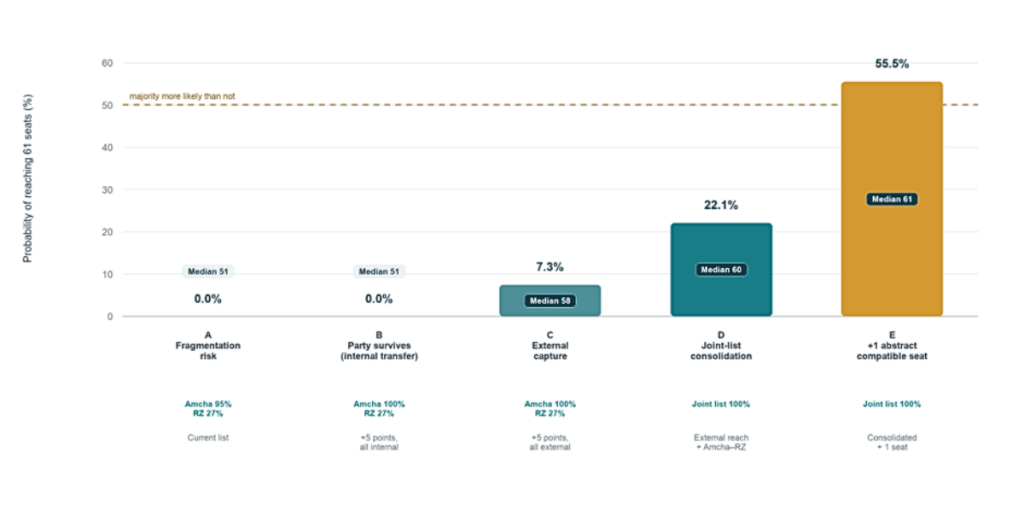
The new party’s contribution depended on the bloc’s starting size, threshold losses, distribution of support, and the set of coalition configurations allowed in the simulation. The same intervention produced different coalition value because the surrounding systems began in different states.
The party has not necessarily changed. The system around it has. A party can therefore be electorally viable, useful but insufficient, decisive, redundant or harmful. These roles cannot be collapsed into a single seat count.
A party can be electorally viable, useful but insufficient, decisive, redundant or harmful. Its value depends on the system around it
Three mechanisms create the difference: survival at the threshold, net seat creation, and coalition compatibility. Reconfiguration adds a fourth layer because a party’s entry can change neighbouring parties’ survival and alliances.
I then reversed the question. Instead of asking how large the new party must become, I asked what else must change before its contribution produces a probable majority.
Pre-electoral coordination can change contribution without increasing underlying support. A joint list may reduce threshold losses and convert the bloc’s existing votes into more seats. Under the six-point external-reach assumption, the model still needed the equivalent of three additional coalition-compatible seats before a majority became more likely than not across all four environments. Five were needed to reach a 90% benchmark.
That shift matters because identical electoral support may produce different parliamentary leverage after consolidation. The intervention acts on the conversion of votes into governing capacity, not only on voter choice.
How does a party's entry into government — and the alliances it induces — change the set of possible governing majorities?
These are abstract seats, not a prediction that any named party will join a government. Inverse coalition analysis exposes the structural gap: how does a party’s entry — and the alliances it induces — change the set of possible governing majorities?
Israel makes this problem unusually visible, but it is not unique. In proportional systems, electoral performance and governing value can diverge; Israel’s own unusual coalition arrangements show why compatibility matters as much as arithmetic.
This experiment grew from FAIR, a framework developed for multifactorial causal attribution. FAIR asks how much one factor contributes when several determinants interact. Applied here, it distinguishes a factor’s presence from its contribution to the final outcome. The transfer is conceptual, not a claim that political systems obey a medical model.
Return to the five-seat party. It may add almost nothing if it merely replaces allied seats. It may become pivotal if it closes a narrow gap. And its contribution may change again when alliances alter the surrounding system.
Crossing the electoral threshold is a property of the party. Its contribution to a governing majority is a property of the system.