Recent wars in Ukraine and Iran have raised the South Caucasus's strategic value to the EU. Murad Gafarov argues Brussels should move beyond engaging Armenia, Azerbaijan, and Georgia case by case, building a permanent strategy around the region's shared interdependence instead
The war in Ukraine has cut Europe off from Russian energy and transit routes it relied on for decades. This year's war involving Israel, the United States, and Iran added a further complication, closing off routes through Iran. Together, these developments have raised the importance of the one region that bypasses both: the South Caucasus, part of the 'Middle Corridor' linking Europe to Asia. In July 2026, European Commission President Ursula von der Leyen travelled to Azerbaijan and Armenia, announcing a South Caucasus-specific package worth up to €200m in EU grants for regional transport, energy, and digital projects. This joint approach was made easier, if not possible at all, by the ongoing peace process between Armenia and Azerbaijan, which for the first time in decades is allowing goods to move between and through both.
The wars in Ukraine and Iran have raised the importance of South Caucasus as an EU trade route, but engagement with the region should now become a permanent EU strategy
Member states have also stepped in. France signed a joint declaration with Armenia in May 2026, largely centred on defence. Germany and Azerbaijan signed a strategic partnership in July, shortly after Von der Leyen’s visit, centred on energy. Both, in their own way, reflect the same circumstances driving Brussels, with Germany seeking alternatives to Russian gas, and France deepening ties with a country moving away from Russian influence. But this attention shouldn't depend on the wars and shifting alliances that produced it. Deeper engagement with the South Caucasus should become a permanent EU strategy, not merely a response to circumstance.
Formally, the three countries in the South Caucasus stand in very different places with the EU. Georgia has held candidate status since 2023, though the process has since stalled. Armenia adopted an accession law in March 2025 but has received no concrete membership perspective. Azerbaijan has remained largely absent from any accession conversation. However, their political alignment with the EU is only one measure.
Regardless of the pace each country is at with Brussels, the region is inevitably interdependent. Geography ties their infrastructure and economies together, as many transport or energy links running through the region physically cross more than one country. The benefit of approaching the South Caucasus as one region, involving all three countries in economic and strategic partnerships, is that it could contribute to long-term stability and make the region a reliable partner for the EU.
Involving Armenia, Georgia and Azerbaijan in economic and strategic partnerships could contribute to long-term stability and make the region a reliable partner for the EU
This logic does not mean that we can or should ignore the political conditions. The course taken by Georgia’s ruling party has significantly damaged Georgia’s standing with the EU. However, political conditions are what define the accession process, whereas economic and strategic cooperation can run alongside that political track. Georgia is central to major regional infrastructure, including the long-operational Baku-Tbilisi-Ceyhan pipeline and the newly agreed Black Sea Submarine Cable.
Moreover, some political goals are indeed better achieved through economic cooperation. Without lasting peace, the region will remain unstable and prone to external influence. Russia has historically exploited conflict between Armenia and Azerbaijan to maintain its influence over both. By engaging the region as a whole, the EU can contribute to its integration. Given the peace process between Azerbaijan and Armenia, that is for the first time a possibility.
This logic was at the core of the European integration project. The framers of the first European institutions, Robert Schuman and Jean Monnet, saw economic integration as the best structural guarantee against the reemergence of conflict. By tying Western European economies together, they sought to make war 'not merely unthinkable, but materially impossible'. It was not that political conditions did not matter, but that shared democratic values alone could not be trusted to achieve a lasting peace.
The EU has an opportunity to apply the same logic to help consolidate peace in the South Caucasus and support the region's economic integration. It is telling that the EU has named its recent package for the South Caucasus 'Peace through Connectivity'. But a package is not yet a strategy. A more connected region makes energy diversification and alternative trade routes achievable for Europe, but only if the EU commits to the region as a whole, appreciating its interdependence and complex geopolitical position.
A more connected region makes energy diversification and alternative trade routes achievable for Europe, but only if the EU commits to the region as a whole
The task is not simple, and this approach has no straightforward path to implementation. Russia, despite being weakened, remains a significant actor in the region, with a military base in Armenia legally entitled to operate until 2044, and continued control over roughly 20% of Georgian territory in Abkhazia and South Ossetia. All three countries have little choice but to carefully balance between competing major powers. A more integrated region, however, has the potential to become more independent of that external influence.
The effects of deeper economic and strategic engagement reach further than any one government's time in office. While peace does not guarantee partnership, integration, and economic development, none of it is possible without peace. As European history suggests, we cannot always achieve lasting peace through political means alone.

Murad's research focuses on the history of European integration and the challenges of balancing economic and strategic interests against normative commitments.
His general research interests include EU enlargement, the development of supranational institutions, and the history of European political thought.
Murad co-authored the chapter 'The Evolution of Legislative Oversight in the European Union' in:
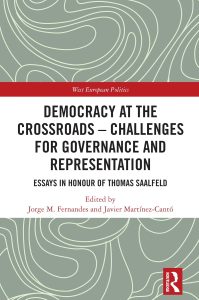
Democracy at the Crossroads: Challenges for Government Representation
Routledge, 2026