
Right-wing and far-right leaders have won recent elections in several Latin American countries. Against the backdrop of a history of US intervention in the region, these developments raise concerns about the resilience of democratic institutions, (neo)colonial influence, and the prospects for Latin American integration. Nayara F. Macedo de Medeiros Albrecht examines this changing political landscape through key political science concepts, including democracy and populism
When Donald Trump won the US presidential election in 2016, several political scientists tried to explain his victory. In 2019's Cultural Backlash, Pippa Norris and Ronald Inglehart argued that Trump’s victory was driven by a counterreaction to progressive values on gender, race, and sexuality, among other issues. Since then, 'far-right populism' has become an increasingly popular term in our field of research.
Authors Steven Levitsky and Daniel Ziblatt, and scholars including Cas Mudde and Cristóbal Rovira Kaltwasser, have addressed the relationships between far-right movements, populism, and democracy. Populist leaders from both ends of the ideological spectrum have shaped the politics of Latin America. This makes the region particularly valuable for examining key concepts in political science.
According to Mudde and Kaltwasser, populism is a thin ideology based on 'the pure people' versus a 'corrupt elite'. Historic Latin American leaders often claimed to represent marginalised groups, such as Indigenous peoples and working classes.
Emerging populist leaders use a similar rhetoric. However, they represent groups with social and economic characteristics that differ from the earlier movements. As the map below illustrates, recent elections in Bolivia, Costa Rica, Chile, Colombia, and Peru have again turned the political map of Latin America rightward.
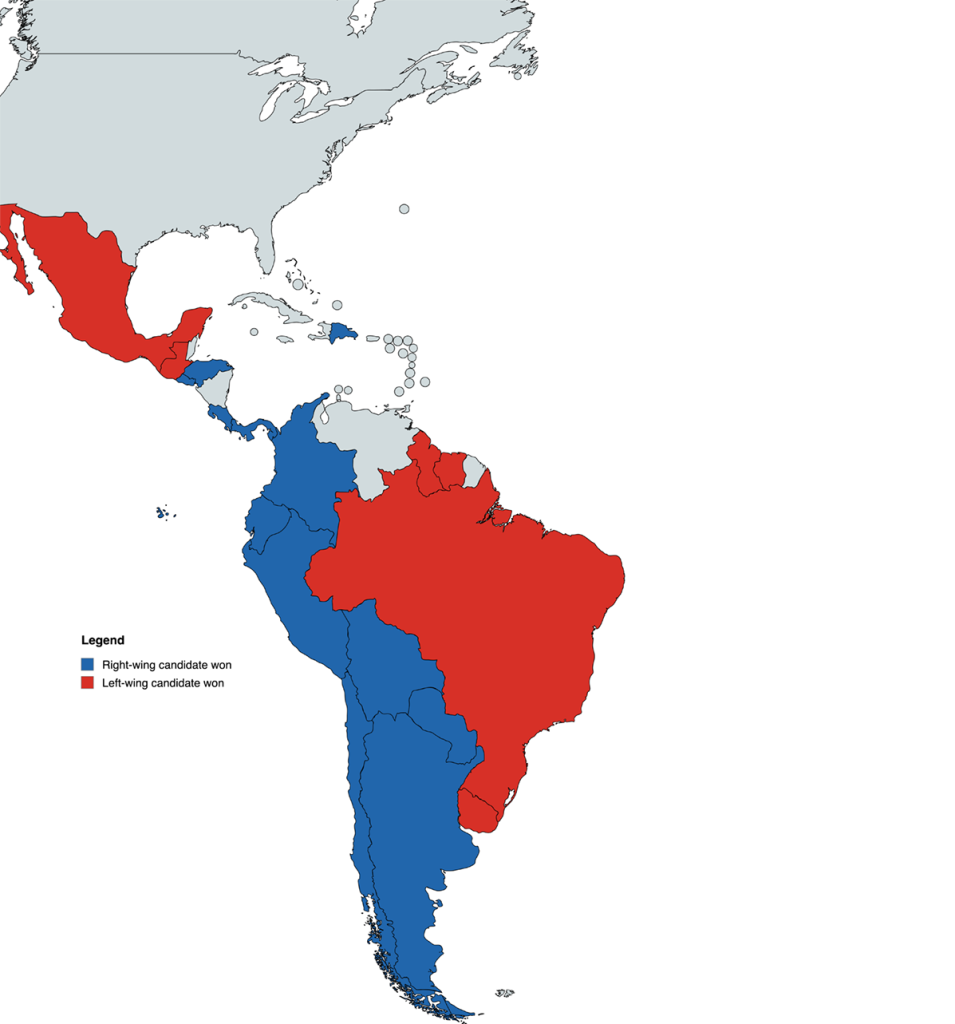
Despite their differences, the new presidents share several characteristics. These include political agendas centred on anti-corruption measures and public security, and close ties with the US.
From colonial exploitation to the assertion of US influence under the Monroe Doctrine, Latin America has been a target of external interventions which have profoundly shaped the region. Colonial rule devastated Indigenous communities, dispossessed them of their lands, and concentrated land and resources in the hands of a privileged few: the 'friends of the King'. International powers have continued to promote or impose neoliberalism, austerity, and New Public Management, often disregarding local needs.
The new crop of Latin American presidents share agendas centred on anti-corruption measures and public security, and close ties with the US
That is nothing new. However, centuries after the end of the colonial era, international powers are still trying to interfere. Their actions include invading sovereign territories and the alleged use of big tech companies to influence electoral outcomes. The new far right might be emboldened by the cultural backlash against identity politics – far-right leaders worldwide often engage in anti-feminist discourse, for example. But the recent crop of far-right leaders is changing the global order for the benefit of neocolonial power relations.
We commonly associate colonialism with expropriation of Indigenous resources in pursuit of the interests of the metropole. Modern practices still reflect colonialism in several ways, including the assumption that Global North countries are superior. For years, Latin Americans have looked to the US as their lifestyle role model. Recently, however, politics – domestic politics in particular – has more explicitly reinforced (neo)colonialism.
Latin Americans traditionally looked to the US as their lifestyle role model. Recently, however, domestic politics has reinforced (neo)colonialism
The Trump administrations have directly supported many right-wing and far-right Latin American leaders. These include Abelardo de la Espriella in Colombia, Keiko Fujimori in Peru, José Antonio Kast in Chile, and Daniel Noboa in Ecuador. In Brazil, the January 2023 attack on Congress, the Supreme Court and the presidential palace by supporters of former president Jair Bolsonaro echoed the January 2021 storming of the US Capitol by Donald Trump supporters.
Last year, Bolsonaro's son Eduardo asked for higher US tariffs on Brazilian goods in retaliation for the legal proceedings against his father. On 18 October, at a rally in São Paulo supporting Eduardo's brother Flávio Bolsonaro, protesters carried an inflatable missile inviting Trump to 'nuke Brazil'. Flávio narrowly led incumbent President Lula in the first round of Brazil's presidential elections on 4 October, but lost the runoff on 25 October. After losing the elections, Flávio left for the US, where the Trump administration said it would grant visas to him and his family.
Tariff leverage and US financial support for Argentine President Javier Milei reinforce economic dependence and inequalities, prioritising imperial interests over local needs. This is particularly alarming given Latin America’s historical dependence on the United States and the history of US political and military intervention.
This relationship poses a huge threat to the region’s autonomy, and to old dreams of integration. But it also poses significant challenges to the global order. Previous leftist leaders have spent years challenging US power in the region. Their resistance risks getting lost in the increasing expansion of US interests into domestic political systems.
Lula may have won in Brazil, but the rightward turn in other Latin American states is concerning not only for the region, but for its potential repercussions elsewhere. The United States’ contentious role in international affairs, including its involvement in the genocide in Palestine, makes the country's rightward shift particularly worrying.
Recent electoral outcomes in Latin America underscore the challenges of building a shared understanding of democracy in diverse societies
Latin America highlights the complex relationships between populism, colonialism, and democracy. Democracy and populism may both invoke 'the people' – but who, exactly, are these 'people'? Recent electoral outcomes underscore the challenges of building a shared understanding of democracy in diverse societies. Leaders such as Jair Bolsonaro, who support torture and military dictatorships, came to power through democratic elections. Certain sections of civil society accept and even defend them. Coloniality, meanwhile, remains embedded in the acceptance of US supremacy.
These developments remind us that democracy and civil rights are never guaranteed – not even in so-called 'consolidated democracies'. Coloniality of power persists in the minds and practices of those who have been colonised.
No.52 in a thread on the 'illiberal wave' 🌊 sweeping world politics


