Clareta Treger examines whether political identities dominate policy preferences in Canadians' political decision-making process. Her recent work finds that even in an era of prominent partisan and ideological competition, Canadian voters continue to evaluate electoral candidates on what they propose to do – not simply on the labels they wear
As democracies become more polarised, many assume that voters increasingly make political decisions based on party loyalty or ideological identity rather than policy. Political commentators often argue that elections have become battles of identity. People vote first and foremost for 'their team'. Common wisdom is that party labels, ideological identification, and political tribes matter more than what politicians propose.
My research suggests that in Canada, however, it's a different story.
Even in an era of heightened partisan hostility and stronger ideological competition, Canadian voters continue to evaluate candidates primarily on the policies they propose – not simply on the partisan or ideological labels they wear. That is important for anyone worried that democratic politics has become little more than tribal competition.
Every voter faces an impossible task. No one has time to read every party manifesto or compare every candidate. This becomes even more difficult in multi-party systems where, on the one hand, some parties are close to one another ideologically, making it difficult to differentiate them, and on the other, new parties emerge over time, making it difficult to keep up with new political information.
Many voters turn to shortcuts or heuristics to solve this problem.
No one has time to read every party manifesto. Descriptive shortcuts such as 'left-wing' or 'Conservative' are thus especially helpful when more detailed information is too effortful to obtain
If voters are evaluating a candidate described as left-wing, right-wing, or a member of a given party, say Liberal or Conservative (in the Canadian case), these labels alone convey important political information to voters, including about policy, and may simplify their decision-making task. This is especially helpful when more detailed information is unavailable or effortful to obtain. Moreover, research shows that as partisanship becomes part of one’s identity, the reliance on such partisan or ideological cues becomes a form of in-group cheerleading or is driven by motivated reasoning, thereby making the actual policy content the parties and candidates promote secondary to voters’ decision-making.
My colleagues and I wanted to test whether such labels also dominate policy-based decision-making in Canada – a multi-party, polarising political system.
The first study, co-authored with Sarah Lachance, focused on ideology. We asked whether Canadians use left-right ideological labels as substitutes for policy information when evaluating electoral candidates. The answer was yes – but only in the absence of such information.
When respondents knew only a candidate's ideological position, they used it to infer where the candidate probably stood on issues such as immigration, climate policy, government spending, and Covid vaccine mandates. Ideological labels served as useful informational cues.
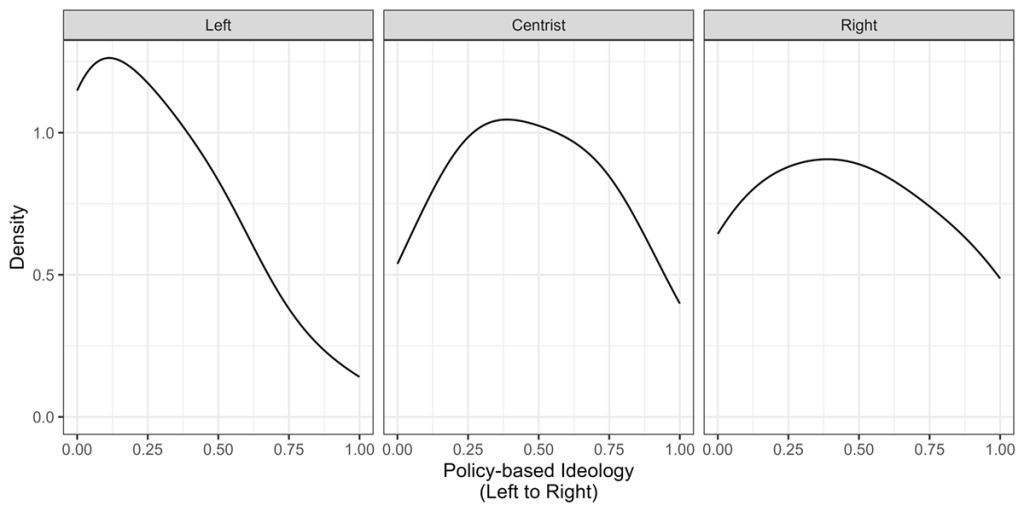
Our research found that Canadian voters often supported a combination of positions associated with both left- and right-leaning ideology, particularly among voters identifying as right-wing
At the same time, we uncovered an important puzzle. Many Canadians did not organise their own policy preferences consistently with their own left-right identification. Their views often combined positions traditionally associated with both ideological camps, particularly among voters self-identifying as right. Therefore, voters do not rely on ideological labels to determine policy congruence through ideological proximity with candidates.
In sum, relying on left-right ideological cues helps voters navigate political choice to some extent in the absence of policy information. However, voters do not use it to gauge policy alignment between voters and candidates. Thus, it is not a perfect substitute for policy, and when policy information is available, voters consider it too.
The second study, co-authored with Thomas Bergeron, Thomas Galipeau, Sarah Lachance, Natasha Goel, Mujahedul Islam, Blake Lee-Whiting, Beatrice Magistro, and Peter J. Loewen, turned to an even stronger political shortcut: partisanship. We examined whether party labels and policies that respondents strongly associate with parties drive voters’ evaluation of candidates. Again, the evidence pointed in the same direction.
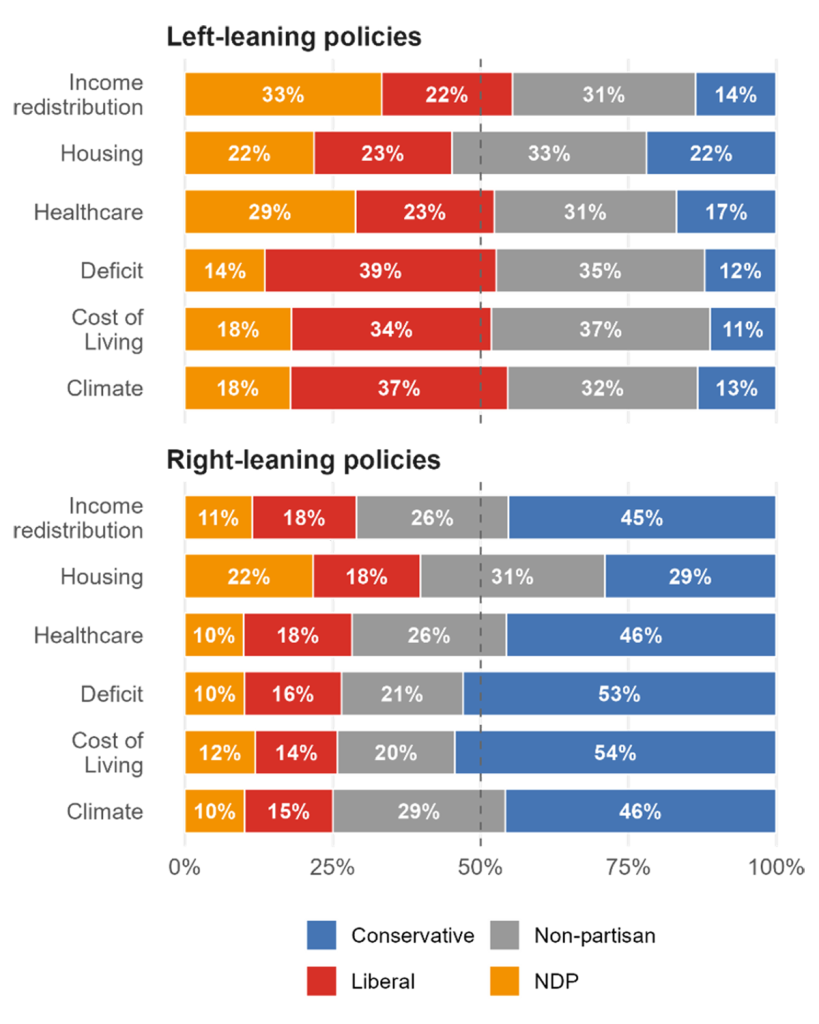
Canadians often associate specific policies with political parties. Yet, here too, for every policy we tested, we found substantial disagreement among voters about which of the three largest Canadian parties – Liberal, Conservative, New Democratic Party – these policies are associated with.
Even when candidates were explicitly affiliated with a particular party, voters still carefully considered their policies when deciding who to support, rewarding policy agreement
At any rate, these implicit party associations had little influence on candidate evaluations. Canadians cared more about policy congruence than the inferred partisanship of the candidate promoting the policy. More importantly, even when candidates explicitly displayed their party affiliation, it did not eliminate the role of policy considerations in the voters’ decision-making process. Voters continued to reward policy agreement rather than political branding. Thus, rather than replacing policy, party labels functioned mainly as another source of information.
Across both experiments, we found that Canadians consistently rewarded candidates whose policy positions matched their own.
Our findings challenge the common assumption that voters are simply driven by partisan identities. In Canada, once policy information is available, voters consider it in their decision-making, in addition to partisan or ideological cues.
Democracy works best when elections are contests over ideas rather than team jerseys.
Canadian voters remind us that these are not mutually exclusive. People may wear partisan colours, use ideological labels, and identify with political camps. But when they know what candidates stand for, they remain remarkably willing to judge them on substance.
That is an encouraging reminder that, even in an age of partisanship and polarisation, policies still matter.