
Anastasiia Kudlenko argues that a corruption scandal that toppled yet another Prosecutor General in Ukraine offers Ukrainian society and international partners an opportunity to reinvigorate reforms aimed at dismantling state capture in the system of law enforcement
On 15 September 2026, Ukraine's Parliament voted to dismiss Ruslan Kravchenko, appointed less than fifteen months before, from his position as Prosecutor General. Before the dismissal, there was a confrontation with the National Anti-Corruption Bureau of Ukraine (NABU) which, alongside the Specialized Anti-Corruption Prosecutor’s Office (SAPO), exposed a criminal organisation within the Prosecutor General’s Office (PGO).
The investigation, dubbed Operation Carthage, did not implicate Kravchenko directly, but alleged that a senior PGO official, identified in the media as Serhii Kropyva, covered up a sprawling network of fraudulent call centres and millions in laundered assets. Many more prosecutors around the country are alleged to be involved.
Denying any wrongdoing, Kravchenko left Ukraine on 14 September, then launched an attack on NABU Director Semen Kryvonos. NABU and SAPO accused Kravchenko of a 'systemic attack on their independence'.
This is one of many corruption scandals to have shaken Ukraine recently. Only several weeks prior, NABU charged former presidential Deputy Chief of Staff Iryna Mudra for money laundering. The case was linked to a $100 million corruption scheme at the state nuclear monopoly Energoatom. Before, there were also corruption charges against Zelensky’s former Chief of Staff Andriy Yermak and former Deputy Prime Minister and Ambassador Olha Stefanishyna.
The many corruption scandals that have shaken Ukraine recently are signs of the effectiveness of the country's new anti-corruption bodies
We can interpret these, and other examples, as a sign of the effectiveness of Ukraine’s new anti-corruption bodies. They also tell a story about state capture and the difficulty of dismantling it.
State capture allows narrow interest groups to use public policy and institutions for personal gain. The concept, coined to describe developments in the post-Soviet space in the 1990s, is now applicable to a variety of cases, from Jacob Zuma’s South Africa to Hungary under Viktor Orbán.
From the early years of independence, corrupt actors manipulated Ukraine’s state institutions to protect the interests of select groups of oligarchs and politicians
From the early years of independence, corrupt actors manipulated Ukraine’s state institutions to protect the interests of select groups of oligarchs and politicians. When Viktor Yanukovych took presidential office in 2010, he subordinated all state systems to his inner circle, 'the Family'. In just three years, they established a pyramidal system of state capture.
The Revolution of Dignity ousted Yanukovych and created opportunity for reform, which Ukrainian society and Ukraine’s international partners were quick to seize. Such windows are incredibly rare, and often wasted by incoming administrations due to the enormity of the task in front of them.
Unsurprisingly, Ukraine’s anti-corruption reforms, implemented after 2014, had a mixed record. The system of law enforcement illustrates this uneven progress particularly well. Given its central role in Yanukovych’s regime, law enforcement emerged as a key priority for Ukraine’s fifth President, Petro Poroshenko. The reform saw remarkable success, including the creation of an effective Patrol Police and the establishment of NABU and SAPO. But the National Police, which substituted the militsiya, a remnant of the Soviet system, and the prosecution service – prokuratura in Ukrainian – retained most of their questionable practices.
The scandal surrounding Kravchenko’s departure as Prosecutor General in light of unfinished anti-corruption reforms teaches us several lessons about the challenges of the post-capture period:
Why is this important? Because if we look at the Kravchenko-NABU row not as an individual case, but as a symptom of a much larger problem of continuing corruption in the system of law enforcement, it could be a catalyst for change. As part of its commitment to the rule of law, within the so called Kachka-Kos plan, the EU requires Ukraine to reform the Prosecutor General’s Office and establish a competitive selection process for the post.
Brussels must now increase pressure on Kyiv to establish a competitive selection process for the prosecutor general
Now is the time for Brussels to increase pressure on Kyiv to adapt the new law, which would make these changes possible. For this to work, civil society should also increase domestic pressure on Zelensky. The President is reluctant to support the reform because it would take away his power to appoint and dismiss the Prosecutor General. Nonetheless, it could still benefit his image, currently tarnished by the many corruption scandals in his inner circle.
The main beneficiary will still be Ukraine, because this change could revive the stalled reforms in the law enforcement system. If the reform is not implemented, however, there is a real danger of history repeating itself, with yet another prosecutor general leaving office on corruption-related charges in short order.


Anastasiia specialises in the societal resilience and security of Wider Europe, with a geographic focus on the countries of the Eastern Neighbourhood and the Western Balkans.
She currently works on the Building resilience to state capture project, investigating the challenges of anti-corruption reforms in Ukraine after the Revolution of Dignity.
Previously, Anastasiia worked as Research Fellow at the University of Warwick on the Horizon project SHAPEDEM-EU, focusing on local practices and perceptions of democracy in the Eastern Neighbourhood.
While at Warwick, she completed her first independent project as a PI on resilience during war.
Anastasiia has also worked at the University of Oxford, the University of Kent and SOAS, among other institutions.
Her research has been published in Contemporary Security Policy, Comparative Southeast European Studies, Journal of Contemporary European Studies, International Peacekeeping and other academic journals.
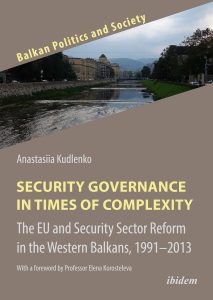
Security Governance in Times of Complexity: The EU and Security Sector Reform in the Western Balkans, 1991–2013
Columbia University Press/Ibidem Verlag, 2023


