
Anti-gender politics does not only attack rights. It attacks the knowledge that makes those rights intelligible. Massimo Prearo argues that anti-gender politics is an epistemic conflict as much as a political one. This conflict generates political fatigue among researchers engaged in feminist and queer work. We must address such fatigue through distance, care and collective reflection
Across Europe and beyond, anti-gender actors increasingly portray gender studies, feminist research, and queer scholarship as ideology rather than science. Beyond undermining rights, anti-gender discourses, mobilisations, and policies target the concepts, methods and communities that make gender and sexuality research possible.
Concepts such as gender, intersectionality, sexual orientation and gender identity are no longer simply activist, institutional, academic, or legal terms. Anti-gender actors now use these concepts in propaganda. They frame the relationship of gender studies, queer theory, feminist research and LGBTIQ+ scholarship with activism and social movements as a threat to children, women, families, and freedom. Politicians, parties, and moral entrepreneurs weaponise these so-called threats, as do activists and academics appropriating radical feminist theories in anti-gender, anti-LGBTIQ+, and anti-trans terms.
As scholars studying anti-gender politics have already described, we are facing not only an opposition to equality policies but an attack on the forms of knowledge that render these claims intelligible and possible. The epistemic conflict concerns what knowledge we have access to, who is excluded from it, and whose experiences are allowed to matter in public debate.
Such attacks challenge who is entitled to produce and legitimise knowledge about gender and sexuality. They also call into question whether ideas, concepts and fields of study related to gender and sexuality are truly scientific. Critics label feminist and minorities’ perspectives as ideological, and illegitimate. Their goal is to replace feminist epistemologies with religiously oriented but strategically secularised knowledge or renewed forms of sex-based essentialism. Sex, family, nation, and citizenship become natural categories that governments and laws should protect against critical theories.
Where anti-gender politics has become institutionalised, gender researchers are no longer simply observing a hostile field from a distance. Many scholars, activists and communities are also inhabiting it day to day.
Where anti-gender politics has become institutionalised, many scholars experience political fatigue
In September 2025, I delivered the keynote lecture at the midterm conference of the Sexuality Research Network of European Sociological Association in Palermo. In it, I described the consequences of such attacks as political fatigue. This fatigue is not just 'ordinary' tiredness related to the desperate material conditions under which scholars are forced to work, and the precariousness of academic labour. Rather, the fatigue is caused by the exhaustion of working in a public arena in which critics constantly question and target concepts, methods, research participants, and communities. Researchers’ personal lives have even become objects of public stigma and institutional attacks.
Faced with anti-gender discourse, a tempting response is to engage and debunk. And while this may indeed be a necessary step, it is probably not enough, and not always necessary.
'Gender ideology' is not a scientific concept. We need to understand how this label works politically, who uses it, where it circulates, what it mobilises and which alliances it enables. We also need to trace how it moves from churches to parliaments, from media campaigns to school boards, and from activist networks to governments and ministries.
Studying anti-gender politics requires distance from the emotions involved. Creating distance is a way to refuse the terms of engagement imposed by anti-gender actors
But, in anti-gender times, studying anti-gender politics also requires distance. We need to distance our bodies and our research from the immediate emotional reactions provoked by the violence of anti-gender discourse. Note that distance is not indifference. Rather, it is a way of refusing the terms of engagement imposed by anti-gender actors.
Constantly responding to attacks, correcting distortions, and defending the legitimacy of one’s own field of research can result in intellectual burnout. By distancing ourselves, we can shift the analytical gaze from the attack itself to the conditions that make it possible and effective.
The question for researchers is not merely how to analyse this phenomenon. It is also how to sustain the epistemic conditions that make such analysis possible in the first place.
Studying anti-gender politics often means reading, listening to, and archiving violent claims day after day. It means being pulled into the same public conflicts one is trying to analyse. After ten years of my own research on anti-gender campaigns, maintaining analytical and physical distance has become not only an act of resistance but, increasingly, a condition for survival. Collective reflection and mutual support is vital to preserve our research field, and our mental health.
In anti-gender times, defending feminist and queer scholarship, and ensuring that institutions actively protect this research, and those who produce it – within and beyond academia – is a political responsibility.
This is why doing feminist and queer research in anti-gender times requires more than producing knowledge about vulnerable communities. It means taking responsibility for the conditions under which we generate knowledge and for how that knowledge circulates. Scholars must protect the people and communities whose lives are already exposed to public hostility. We must also ask what visibility may do to us, to these people, and to these communities.
Every concept scholars use contributes to the conditions under which we debate gender and sexuality. So does every dataset we build and every public explanation we offer. Together, they shape how social realities become intelligible.
Every concept we use contributes to the conditions under which we debate gender and sexuality. If we retreat from public debate, anti-gender actors gain more space
Silence does too. When we retreat from public debate, anti-gender actors gain more space to define 'truth' and 'common sense'. Silence also allows such actors to deny the concrete reality of gender identity, homophobia, or transphobia. Recognising this does not imply that scholars should become political actors. Rather, it highlights that academic knowledge is already shaping public debate. The question is therefore not whether research has political effects; of course it does. Rather, it is how scholars choose to engage and deal with these effects.
Overcoming our political fatigue can strengthen our research, and enrich public debate. It can help us express care for the people and communities we work with, and for our research communities.
Taking responsibility, and conquering political fatigue, exceed the boundaries of deontological duty. Defending feminist and queer scholarship is not only about protecting academic freedom, but protecting democracy itself. It is about preserving the democratic conditions under which different forms of knowledge, experience and identity can become publicly visible and politically meaningful.


Massimo holds a PhD in Political Studies from the School for Advanced Studies in the Social Sciences, Paris.
He is Scientific Coordinator of the Research Centre PoliTeSse (Politics and Theories of Sexuality).
His research focuses on LGBTIQ+ politics and anti-gender mobilisations.
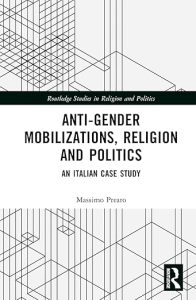
Anti-Gender Mobilizations, Religion and Politics: An Italian Case Study Routledge, 2024


