Four years after it cut all ties with Afghanistan, the Indian government’s strategy towards the Taliban regime is undergoing a transformation. Sonia Sarkar argues that India's deteriorating relationship with Pakistan appears to have prompted this, and suggests it damages India’s pluralist reputation
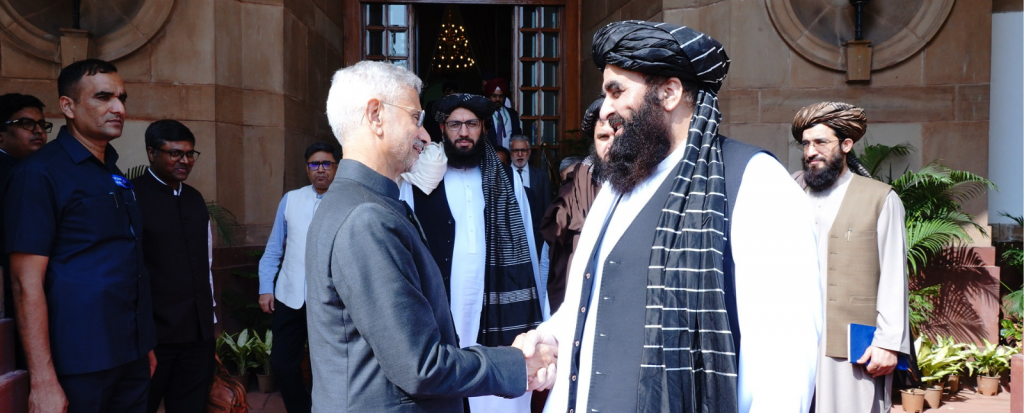
In October 2025, Taliban-ruled Afghanistan's foreign minister Amir Khan Muttaqi called a press conference in the Indian capital, New Delhi. Women journalists were not invited. After a backlash, the Taliban held a further meeting, this time allowing women to take part. Journalists grilled regime leaders over their suppression of women’s rights in Afghanistan and the 2021 killing of Indian journalist Danish Siddiqui.
Noticeably, however, India's foreign ministry remained silent over the Taliban’s brazen rejection of women journalists on Indian soil. Nor did the official joint statement issued afterwards make any reference to the Taliban’s responsibility to safeguard women’s rights. But, four years after severing all ties with Afghanistan following the Taliban takeover, India did reopen its embassy in Kabul.
The message was loud and clear: India, led by the Hindu nationalist Bharatiya Janata Party (BJP), is now openly engaging with the extremist Taliban regime.
The Taliban's traditional ties with Pakistan’s military and intelligence agency, the ISI, meant that India had long viewed the Taliban as hostile. In the 2001–2021 war with the US and its allies, India backed the Northern Alliance and, later, NATO-supported governments. The Taliban, likewise, saw India as its enemy. Between 2009 and 2013, it attacked Indian diplomatic sites and a guesthouse frequented by Indians, killing several Indian nationals.
Yet since the Taliban regained power in 2021, relations with Pakistan have been tense. Pakistan accused the Taliban of sheltering Tehreek-e-Taliban Pakistan (TTP) fighters, who have reportedly escalated attacks against Pakistan, with India's support. Although the Taliban denied such allegations, cross-border violence between Pakistan and Afghanistan has increased.
On 11 November 2025, the TTP detonated a suicide bomb in Islamabad, killing at least 12 people. The attack came just a day after a deadly blast in Delhi that killed 13 people. In September, 19 Pakistani soldiers died fighting TTP attackers and, according to the Armed Conflict Location & Event Data Project, the TTP has carried out at least 600 attacks on Pakistan over the past year.
Since the Taliban regained power in 2021, relations with Pakistan have been tense, and cross-border violence has increased
Meanwhile, on 25 November, the Taliban accused Pakistan of killing a woman and nine children in air strikes in Khost province. Between 10 and 16 October, at least 18 civilians were killed and 361 injured in Afghanistan. While Muttaqi was establishing friendly relations with India, explosions rocked Afghan cities including Kabul and Paktika, and heavy fighting took place between Taliban security forces and the Pakistani military in Kandahar.
While the Afghanistan-Pakistan relationship grew more tense, India launched a small mission to Afghanistan for trade, medical, and humanitarian aid. In 2024, the Taliban appointed an envoy in New Delhi and an acting consul general in Mumbai. Muttaqi met Indian foreign secretary Vikram Misri for talks in Dubai.
The Taliban condemned the April attack in Pahalgam, Indian-administered Kashmir, which India alleged had been orchestrated by Pakistan. A joint Taliban-India statement, signalling respect for India’s sovereignty and challenging Pakistan’s disputed territorial claim, referred to Kashmir as 'Jammu and Kashmir, India'.
India's nationalist media has vocally supported India’s engagement with the Taliban, arguing that the strained Taliban-Pakistan ties will now free the Taliban from its over-dependence on Pakistan
In India, nationalist media and pro-BJP analysts have vocally supported India’s engagement with the Taliban. They argue that the strained Taliban-Pakistan ties will now allow the Taliban to carve out an identity free from its over-dependence on Pakistan. The Hindu nationalist ideological parent body Rashtriya Swayamsevak Sangh-linked Vivekananda International Foundation even hosted a talk by Muttaqi.
Trusting the Taliban based on its current rift with Pakistan would be a mistake for India, however. After 9/11, Pakistani military action against the Taliban triggered retaliatory attacks, straining ties between them. Later, mutual dependence forced both parties to reconcile. Pakistan sought strategic depth, while the Taliban relied on Pakistan to regroup and remobilise its fight against foreign forces.
Taliban factions differ on the value of ties with India. The Haqqani Network, which partners with the current Taliban-led government, historically remained close to Pakistan’s ISI and al-Qaeda. The Quetta Shura, meanwhile, has links with terrorist groups including Jaish-e Mohammad and Lashkar-e-Taiba that operate from Pakistan and have carried out attacks on Indian soil. Ethnic and religious affinities keep the Taliban aligned with Pakistan.
Mediation between Pakistan and the Taliban has already resumed after the recent clashes. In October, both sides agreed on a ceasefire and met in Istanbul to establish a truce.
Maintaining diplomatic ties with a Taliban regime that is responsible for gender, ethnic, and religious apartheid would undermine India’s professed pluralist image. Recognising the Taliban as Afghanistan's legitimate representative would trivialise, even normalise, its atrocities against women and ethnic minorities, especially Tajiks, Uzbeks and Hazaras.
Maintaining diplomatic ties with a Taliban regime would undermine India’s professed pluralist image and risks undermining the nation’s security
After closing its embassy in Kabul, in flagrant disregard for its historical friendly ties with the Afghan people, India selectively facilitated the evacuation of Afghan Sikhs and Hindus, leaving many Afghan Muslims in the lurch. Instead, India deported an Afghan nationalist woman parliamentarian seeking refuge, and denied visas to Afghan students who had been granted admission to Indian universities.
Ideally, India should grant scholarships to Afghan women, who have been denied education at home. It should offer long-term visas to persecuted communities seeking asylum. And India should assure its taxpayers that it will not risk undermining the nation’s security through engagement with extremists.