
In a remote area of the Pacific Ocean, apple-sized metallic lumps on the seabed are gaining international attention. Thiago Thierry examines how these lumps could reshape our approach to energy transition, and how the legal framework for deep-sea mining may be putting the marine environment at risk
In the late 1970s, little lumps of mineral concretions were discovered on the seabed in the remote Clarion-Clipperton Zone (CCZ) of the Pacific. Now, these lumps are hogging the spotlight in energy transition debates. Why?
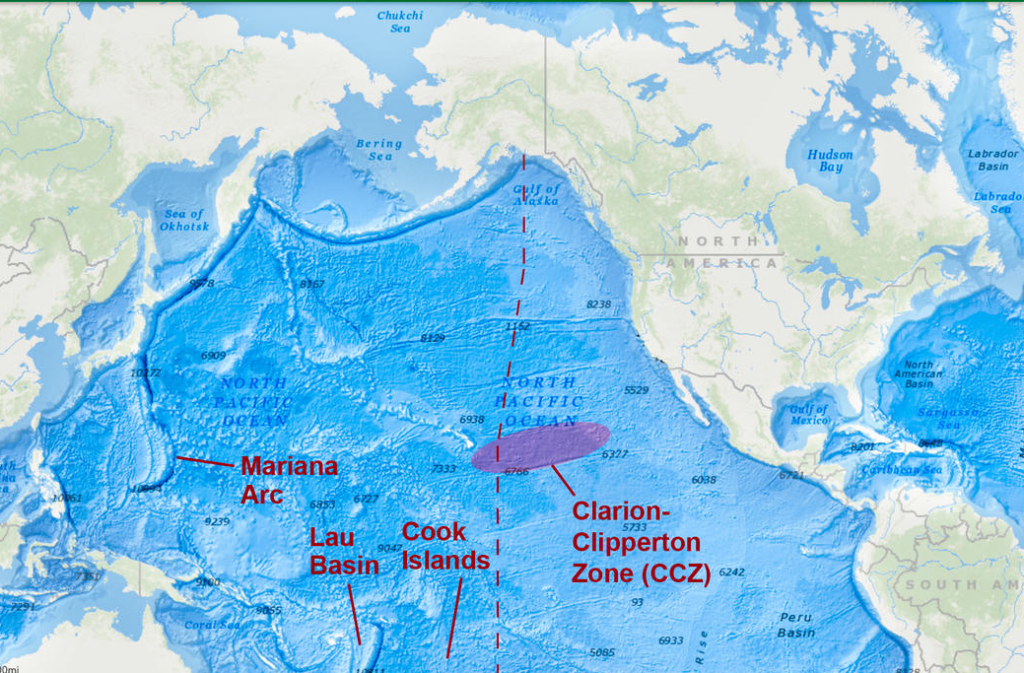
These lumps are polymetallic nodules (PMNs) composed of minerals crucial to the green energy transition. Some are used in everyday items, such as cell phones and electric car batteries, others in military jet engines. There is even potential to use PMNs in wind turbine generators.
But if PMNs were discovered in the '70s, why has it taken so long for the world to take notice? And is it even possible to harvest matter that lies approximately 4,000m deep?
Using advanced marine exploration technology, scientists have discovered life forms living directly on PMNs. These life forms depend on solid matter to live, and PMNs are the perfect host in terms of density.
PMNs contain iron, lithium, cobalt, nickel and manganese, all of which are essential for the world's transition to green energy. This is why PMNs are now attracting international attention.
The iron, lithium, cobalt, nickel and manganese in polymetallic nodules are essential for the world's transition to green energy
Scientists warn that harvesting PMNs could mean destroying the life forms that depend on them – life forms we do not yet fully comprehend. The United Nations Convention on the Law of the Sea (UNCLOS) is intended to prevent any such destruction. Despite this, the international community has yet to implement regulations on sustainable deep-sea mining.
The international legal framework on deep-sea mining begins on UNCLOS Article 136: The Common Heritage of Mankind. It states that any resources found in international waters – such as PMNs – should benefit all UNCLOS signatory countries. The International Seabed Authority (ISA), an arm of UNCLOS, was created specifically to handle deep-sea matters.
Today, the ISA, which is responsible for regulating sustainable deep-sea mining, has divided the CCZ into several exploration areas, each of which holds 15-year contracts with countries and private companies. But is the ISA truly protecting the environment? Or is it prioritising the economic exploitation of natural resources?
Harvesting polymetallic nodules requires robots to vacuum them up from the seabed, causing massive environmental damage
Harvesting PMNs requires robots to vacuum them up from the seabed. This kills off the life forms that depend on PMNs, and causes massive environmental damage. The robots also generate sediment plumes that spread vertically and horizontally through the ocean. Moreover, they bring noise and light pollution to environments that have remained dark and quiet for millennia.
One of the most controversial companies operating in the CCZ is the Canadian The Metals Company (TMC). An enterprise formed after the failure of similar ventures, TMC seems to be exploiting a legal ISA loophole.
ISA is obliged to distribute its financial gains among several countries. To prevent widening economic disparity, ISA therefore gives priority to developing nations over developed ones. This guarantees that developing nations will benefit financially from deep-sea exploration sites even if they lack the technology to do so.
Despite being a Canadian enterprise, TMC has access to exploration areas reserved for the developing countries Tonga and Nauru. Under UNCLOS rules, any state-sponsored private company must operate under the supervision of that state. In reality, however, neither Tonga nor Nauru seems to have much control over TMC's operations. Indeed, many would like to see greater transparency between states and private companies.
Under UN rules, state-sponsored private mining firms must operate under the supervision of that state. In reality, developing nations have little control over such companies' operations
Today, TMC is also operating in association with the US. But the US is not a UNCLOS member, so TMC does not need to comply with UNCLOS rules. TMC, moreover, is a Nasdaq open capital company. Its investors are eager for financial returns, and this, of course, influences the whole process.
So, is it possible to harvest PMNs while protecting the marine environment? And is TMC a threat or an ally when it comes to the green energy transition?
TMC is desperately pushing the ISA to regulate deep-sea mining. Yet they are not doing so to protect the environment, but to insure themselves against any damage they might cause while harvesting PMNs. If sustainable mining regulations are rushed through regardless of scientific knowledge, TMC can claim they were 'just following the guidelines’, and the damage is not their fault.
The marine environment, scientific knowledge, energy transition and capitalism are all travelling at different speeds. If we disregard that, we should be ready to face the consequences.





Thank you soo much for this info . It was really helpful
Well explained!