Donald Trump's presidential campaigns have used immigration as a wedge issue. To understand why anti-immigrant sentiment translates so powerfully into Republican votes, Matt Polacko argues that we need to look beyond the rhetoric and focus instead on the economic conditions that make people receptive to it
New research I published with colleagues Giacomo Di Pasquale and Emma Lofstedt, in Political Research Quarterly, shows that rising income inequality is an important driver of anti-immigrant attitudes and Republican voting in the United States.
Using data from the American National Election Studies (ANES) spanning nine presidential elections from 1988 to 2020, we tracked how immigration attitudes and partisan voting have shifted alongside rising economic inequality.
The trends are striking. Over this period, the US Gini coefficient, a standard measure of income inequality, rose from roughly 0.49 to 0.63 at the state level, a nearly 30% increase. Inequality has now reached levels last seen during America's Gilded Age.
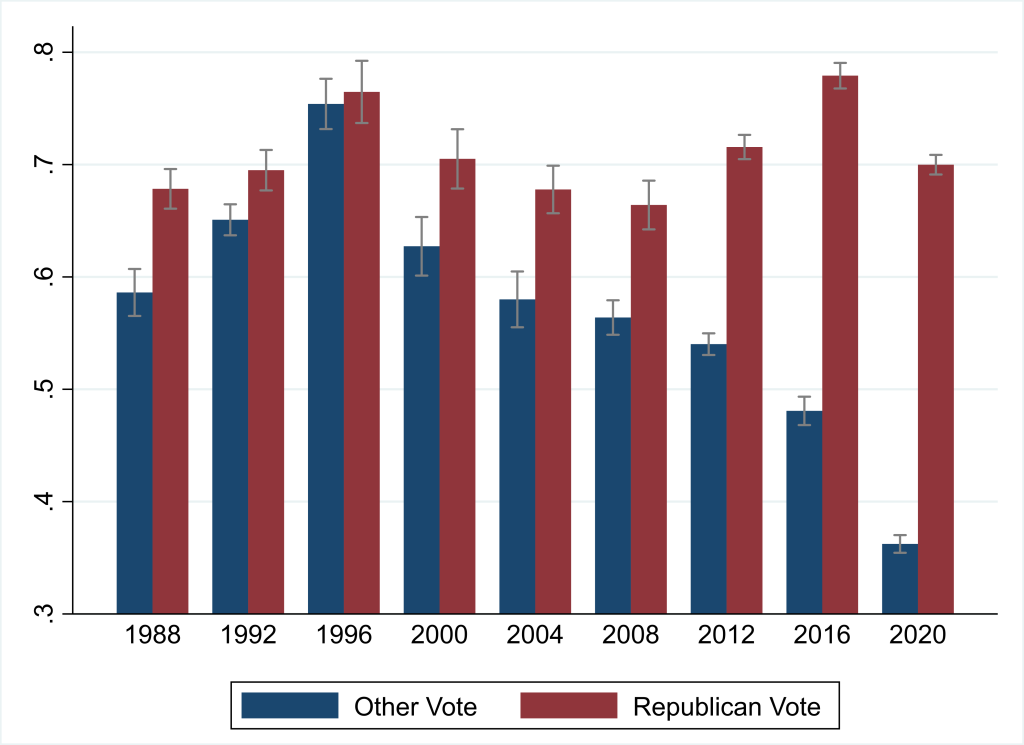
At the same time, the partisan gap in immigration attitudes has grown dramatically. From 1988 to 2008, Republicans were more restrictionist than other voters, but they only differed by roughly 10 percentage points. By 2020, that gap had widened to a massive 33 percentage points, with Republican voters nearly twice as restrictionist as everyone else.
Higher state-level inequality is associated with more negative views toward immigration, even after accounting for individual characteristics like education, gender, race, and partisanship.
Moving from the lowest to the highest levels of inequality shifts immigration sentiment by roughly eight percentage points in the restrictionist direction. That is a significant effect for a contextual variable.
The mechanism is not simply that inequality makes people poorer. Rather, it intensifies what researchers call relative deprivation — the sense that one is falling behind compared to others. This, of course, heightens zero-sum thinking about who deserves scarce jobs, housing, and public services.
Inequality thus creates a psychological climate in which the framing of immigrants as economic competitors or cultural outsiders can find more fertile ground.
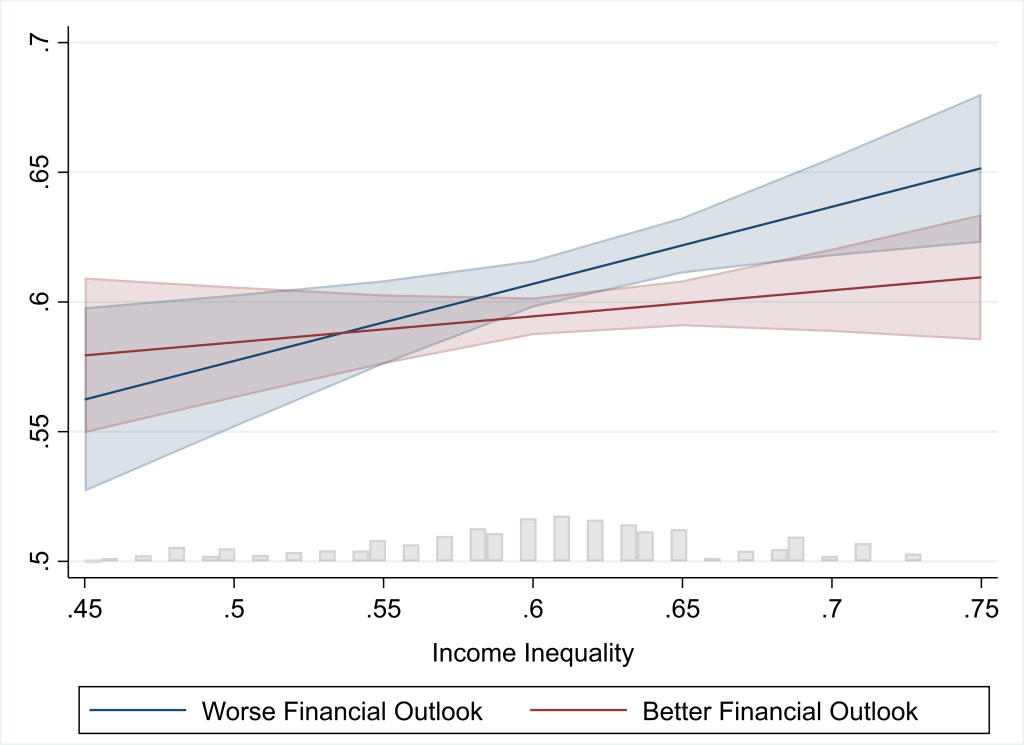
The effect is not uniform across the population. Individuals who expect their personal financial situation to worsen are significantly more likely to hold negative views toward immigration, and that inequality amplifies this relationship.
At low levels of inequality, people with pessimistic financial outlooks are somewhat more anti-immigrant than optimists. As inequality rises, however, that gap widens considerably. The pessimistic group's immigration sentiment shifts by roughly eight percentage points up the restrictionist scale as inequality increases, compared with just three points for those with a brighter financial outlook.
This finding aligns with a growing body of evidence showing that subjective economic perceptions drive political attitudes. It is not only those who are materially struggling who respond to anti-immigrant frames. It is those who feel insecure, especially when inequality makes that insecurity feel more threatening.
The link between anti-immigrant attitudes and Republican voting is well established. What our research adds is a key contextual amplifier: inequality.
When we examine the relationship between immigration attitudes and state-level inequality in predicting Republican vote choice, the result is clear and statistically robust. Moving from the most pro-immigrant to the most anti-immigrant position, on a 0–1 scale, is associated with a full percentage point greater likelihood of voting Republican in high-inequality contexts than in low-inequality ones.
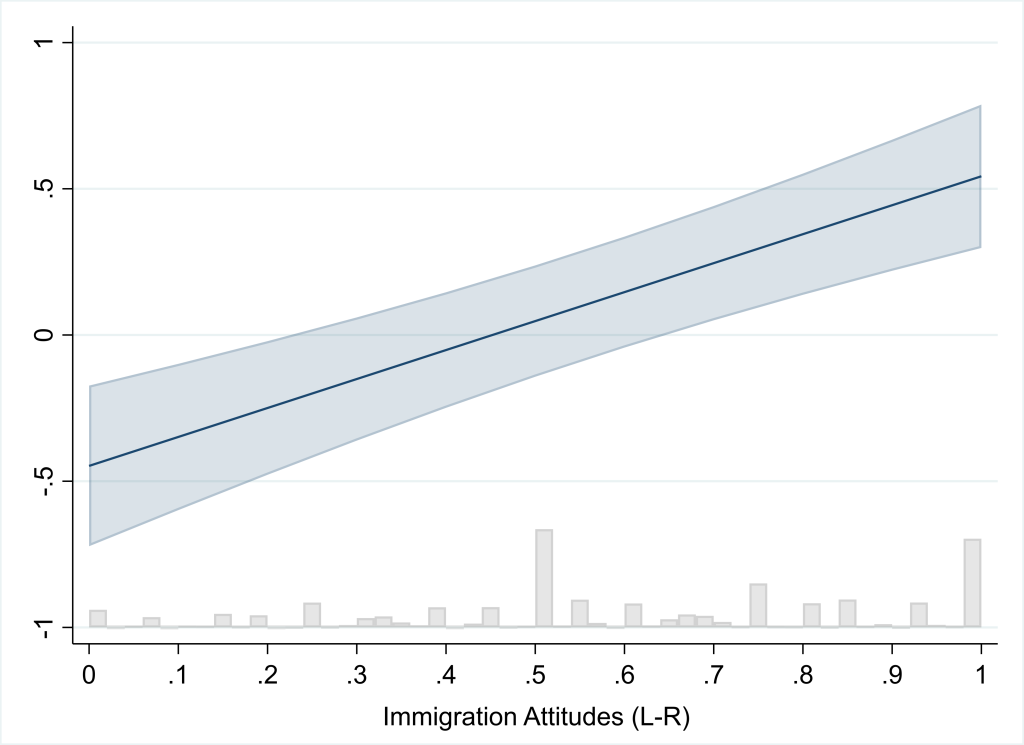
Inequality does not merely produce anti-immigrant attitudes; it makes those attitudes more electorally consequential, because it strengthens the translation of cultural grievance into partisan behaviour.
This helps explain a puzzle in American politics: why the partisan realignment of white non-college voters toward the Republican Party has been so durable, and why immigration has become such a consistent anchor of that coalition.
A long-running debate in political science pits economic explanations of populism against cultural ones. Did Trump voters respond to job losses and wage stagnation, or to status anxiety and demographic change?
This is a false choice.
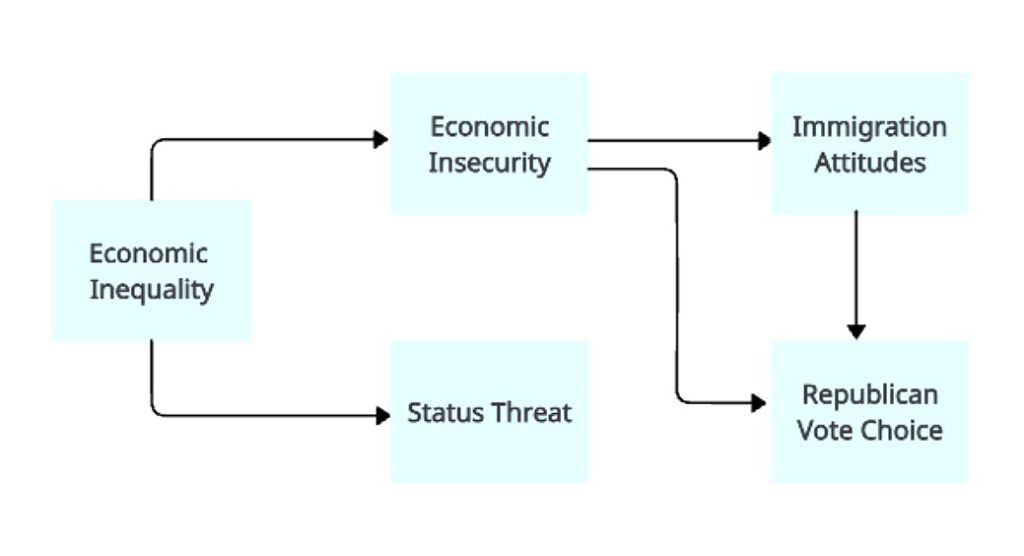
Inequality shapes both channels simultaneously. It heightens material insecurity by increasing the proportion of people who feel economically vulnerable. But it also intensifies status threat, the perception that one's cultural position is eroding as others gain ground. Both feed into anti-immigrant sentiment and then into Republican support.
As Pippa Norris and Ronald Inglehart argue in their cultural backlash thesis, populism tends to gain traction when economic grievances and cultural anxieties reinforce each other. Our research provides systematic empirical support for this claim in the American context, across more than three decades.
The implications for democratic politics are sobering. US income inequality has continued to rise, and there is little sign of meaningful reversal.
Reversing this trend requires more than electoral strategy. It demands policies that reduce inequality and address the structural insecurities that make exclusionary political appeals so resonant.
As long as inequality remains at historically high levels, politicians who fuse economic grievance with anti-immigrant sentiment will find a ready audience. The walls go up not just because of the rhetoric, but because of the economic conditions that make the rhetoric resonant.