Young people in Europe and, by extension, the West, are increasingly disengaging from electoral politics. Academic studies are still trying to understand the phenomenon. But Kevin Meyvaert argues that without a moral narrative of justice and fairness, we will never succeed in reconnecting all citizens to democratic life
Older citizens often remain loyal to electoral democracy despite – sometimes heavy – frustrations. But younger generations appear less willing to give democracy the benefit of the doubt. This growing scepticism has prompted extensive scholarly debate about whether young people in Western societies are turning away from traditional democratic institutions.
Some academics echo Robert Foa and Yascha Mounk’s bleak deconsolidation thesis, which suggests that young people are becoming increasingly intolerant, even antidemocratic. Others adopt a more hopeful perspective. They see youth disillusionment not as a rejection of democracy but as a form of heightened democratic awareness; evidence that young people are becoming critical citizens even more keenly preoccupied with the quality of democracy.
Much of the scholarship on democratic dissatisfaction suggests it is rooted in economic problems. In newer democracies, for instance, weak economic performance undermines citizens’ faith in the system. In established democracies, stagnating or declining economic prospects do the same. For young people in established democracies, the contrast with earlier generations is particularly stark. Their parents and grandparents could climb a sturdy social ladder; that ladder now appears shaky, if not broken entirely.
This leads many to suggest that the cure for democratic malaise lies in economic renewal. If societies can expand opportunity and restore upward mobility, the assumption is that support for democracy will follow.
But is this the only element we should consider when assessing democratic dissatisfaction? Or is there something other than mere economic factors at play?
As part of the Horizon Europe REDIRECT project, I conducted research with 18–30-year-olds from Brussels’ Croissant Pauvre district. My findings reveal a further, often-overlooked layer of democratic disillusionment, which is particularly salient for socially and economically marginalised groups.
The young people in my research described democracy as operating with double standards – rules and rights appear conditional upon who you are and where you come from
Across six focus groups with young adults raised in this poor, ethnic minority area of the Belgian capital, a recurring perception emerged: democratic principles are applied unevenly across society. Participants described democracy as operating with double standards – rules and rights appear conditional upon who you are and where you come from.
Disconnection, then, is not only vertical, between political elites and citizens. It is also horizontal, between societal groups – and is influenced by perceptions of unequal treatment. This shows how efforts at re-engaging young people from urban areas like the Croissant Pauvre must extend beyond institutional and political reforms such as youth participation incentives or political assemblies. Luca Verzichelli’s introductory piece for this series urged the exploration of informal circuits and values. Just as important is the construction of a democratic narrative affirming convincingly that democratic rules and protections apply equally to all.
Across the focus groups, two main critiques recurred. First, young people expressed the view that politics 'does nothing to change or solve problems in our neighbourhoods'. Second, many described democracy itself as illusory, on the grounds that 'not everyone enjoys the same democratic rights'.
Many young people in the focus groups described democracy as 'illusory'. As they see it, not everyone enjoys the same democratic rights
For many participants, the only politicians who elicited a minimal sense of representation were those perceived as delivering concrete outcomes on issues directly affecting their daily lives. A Brussels State Secretary responsible for social housing, for instance, was repeatedly cited because 'she is one of the few good ones for what she fought for, for us, for the social housing against the people who didn’t want it in their rich neighbourhoods'. Similarly, participants referred positively to a local alderwoman who organised initiatives for young people from precarious family backgrounds: 'My mother even receives letters from her'.
While visible and locally tangible policy outcomes surfaced as a crucial condition for political legitimacy, material improvements alone did not suffice. Alongside outcome-based evaluations, participants voiced profound concerns about the way the Belgian authorities implement democracy. They criticised what they perceived as unequal freedom of expression: 'you can make jokes about Islam and Muslims, but not about Jews; then suddenly there is no freedom of expression anymore', as well as inequality before the law. As one participant put it: 'we all know someone who received a very harsh sentence, while others can buy themselves out of justice and never go through what people like us go through'.
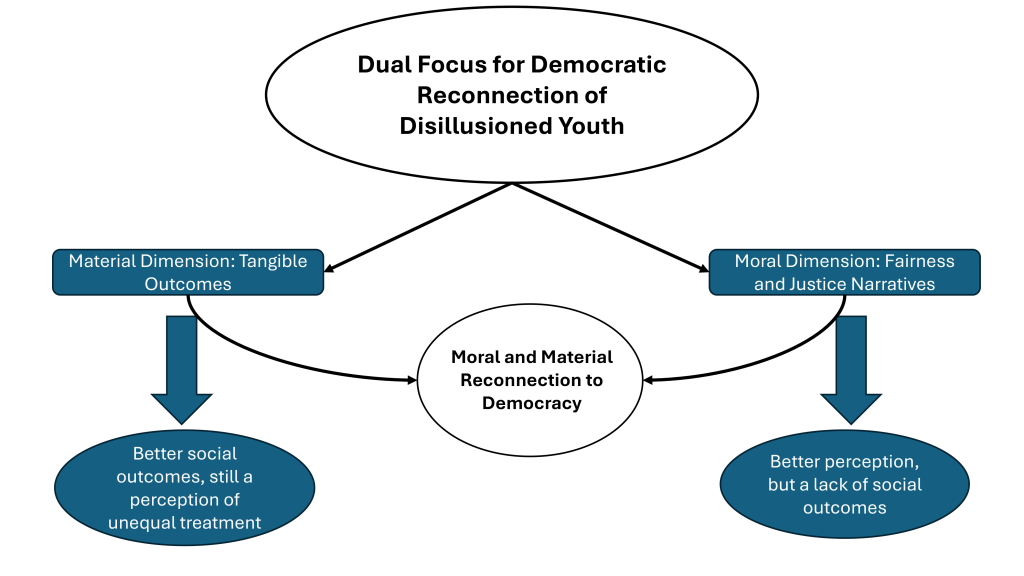
The graphic below illustrates why a dual reconnection strategy is essential to achieve democratic reconnection. Disillusioned youth in disadvantaged areas will reconnect with democracy only if their living standards improve and the government can persuade them that democracy is indeed fair and just.
Policies that seek to restore trust by emphasising fairness may improve perceptions of injustice. But they will never compensate for the absence of tangible economic improvement in young people's lives
Policies that focus exclusively on material benefits – improving housing, education or employment opportunities – may generate a sense that social conditions are improving, or at least that new opportunities are appearing. Yet even if material standards improve, a persistent belief may remain that democracy operates according to double standards.
Policies that seek to restore trust by emphasising fairness or equality before the law are equally problematic. While such policies may improve perceptions of injustice and recognition, they will never compensate for the absence of tangible social and economic improvements in young people’s lives.
Clearly, we cannot understand democratic disengagement among young people in disadvantaged contexts solely in terms of apathy, anti-system attitudes or declining civic norms. Disengagement also reflects a coherent – if not deeply critical – evaluation of how representative democracy performs, materially and morally.
When democracy fails to deliver visible improvements, or convince citizens that its rules apply equally to all, disengagement is not a democratic anomaly but a rational response. Recognising this is essential if representative democracies are to rebuild legitimacy among generations for whom political disengagement is not an exception, but the norm.