
Based on a 67-year arc of reporting by British magazine The Economist, Lucas Schramm analyses the European Council, a key institution of the European Union. He shows how that coverage explains why the European Council was created, how it evolved, what it does, and why its dominance is both useful and unsettling
For many people, an EU summit means leaders holed up in a windowless room, finally emerging at 3am with a deal. For The Economist, those summits have been regular story fodder since the mid-1970s. I analysed 97 articles published between 1958 and 2025 that explicitly mention 'European Council' or 'intergovernmental summits'. My findings reveal a quiet institutional revolution. What began as a pragmatic talking shop for national leaders has turned into the EU’s top institution, the place where almost every major and controversial question ends up.
In the 1970s, European integration was not short of ambition, but it was short of movement. The Economist’s early reporting treated the European Council as a response to stalemate elsewhere in the then European Community: when national ministers could not agree, only leaders could unblock the system.
A line from 22 November 1975 captures the mood:
As the main forum to provide impetus for Community development, only on that level could issues be solved
In other words, if you want momentum, you call the people who can make the political calls.
At the start, the European Council was not meant to draft laws. It was supposed to give impetus and broad direction; resolve deadlocks; and reflect political reality. Ultimate authority still sat with national governments. Observers and members thought of the European Council as a board meeting that would be strategic, occasional, decisive.
But The Economist spotted the catch early. Summits can accelerate decisions, yet they can also tempt ministers to dodge responsibility by pushing issues 'upstairs' to leaders. That habit, which marked an escalation by default, would later reshape the EU’s institutional balance.
Over time, The Economist’s language changed, and that shift is telling. What was once an occasional and informal gathering became a central actor in European treaty politics, constitutional engineering, and crisis management.
By the 1990s, the magazine portrayed the European Council as mapping the agenda for the entire Union. Summit conclusions started steering legislative and policy priorities across sectors. This already sat awkwardly with the rulebook: the 2009 Lisbon Treaty later stressed that the European Council 'shall not exercise legislative functions'. Yet, in practice, leaders increasingly set priorities that others had to translate into law and implementation.
Formalisation followed politics. Successive treaty reforms strengthened the European Council’s role, and Lisbon turned it into a fully-fledged EU institution. It also created a permanent President with the intention of improving continuity and visibility.
In The Economist’s coverage of the 2000s and 2010s, one theme dominates: crises push power upward. Monetary integration, the euro-area turmoil, and the Covid-19 pandemic reinforced the belief that only heads of state or government can deliver 'history-making decisions'.
In the 2000s and 2010s, monetary integration, the euro-area turmoil and the Covid pandemic revealed how crises push power upward
That logic has become self-fulfilling. The more the European Council is treated as the only forum capable of decisive action, the more issues migrate there. Today it sets overall political priorities, brokers grand bargains, and signals unity (or disunity) to the outside world.
The Economist’s reporting about the European Council is not just about formal powers; it is also about summit mechanics. Negotiations rely on seclusion, personal pressure, and exhaustion. Keep leaders in the room long enough, narrow the options, and agreement becomes the least bad exit.
This can work. It can also produce messy outcomes. Leaders are often too far from technical detail to deliberate effectively. The result is a familiar EU pattern: sprawling package deals and lowest-common-denominator compromises.
The magazine’s archive does not read like a victory lap. A recurring concern is what summit-dominance does to the EU’s institutional balance. Most prominently, it challenges the agenda-setting power of the European Commission.
Formally, the Commission retains the sole right of legislative initiative. But in a 23 October 1999 piece, The Economist suggested its role was increasingly reduced to 'draftsman' and 'executor of priorities' defined by national leaders. That is a shift from supranational engine to intergovernmental service provider.
When unresolved issues that should be dealt with by the Council of Ministers are routinely kicked upstairs, ministers lose autonomy and leaders get overloaded
The Council of Ministers also loses out. When unresolved issues are routinely kicked upstairs, ministers lose autonomy and leaders get overloaded. An institution created to intervene occasionally starts doing the daily firefighting.
The Economist also points to deeper problems that come with summit-centred governance. One concerns transparency and accountability. Deals forged through seclusion and fatigue raise questions about deliberation: who argued what, and why this compromise? Unanimity and late-stage bargaining can reward obstruction, encourage brinkmanship, and produce outcomes that satisfy everyone just enough.
Another self-imposed shortcoming is a presidency with one hand tied behind its back. The Lisbon Treaty’s permanent President was supposed to add coherence, yet national leaders constrained the office on purpose. When they chose the first holder in 2009 (Herman Van Rompuy), The Economist portrayed the decision as a deliberate preference for a low-profile broker over a heavyweight political figure. The result is a role that is symbolically important yet structurally limited.
Taken together, The Economist’s long view supports a clear conclusion: the European Council has become the EU’s power centre. It sets strategy, arbitrates conflict, and makes the deals that define Europe’s response to shocks.
But its success exposes a structural tension in EU governance. Summitry can be effective in emergencies. However, it is not automatically well suited for steady, transparent, accountable policy-making.
That trade-off is the real story, and it is why debates about the EU’s future keep circling back to the same question: how much Europe do you want to run from the top?


Lucas holds a PhD in Social and Political Sciences from the European University Institute in Florence.
His research interests concern the history and theories of European integration, European Union crisis politics, the European Council, and Franco-German political relations in the EU.
Lucas has published in leading academic journals, including European Political Science Review, Journal of European Public Policy, Journal of Common Market Studies, Comparative European Politics, and West European Politics.
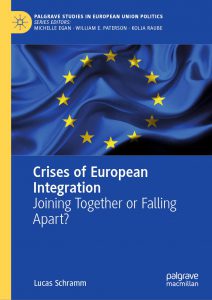
Crises of European Integration – Joining Together or Falling Apart?
Palgrave, 2024


