
The world order is not simply shifting from unipolarity to multipolarity, but undergoing a deeper struggle over political authority. Who has the right to make binding global rules, through which institutions, and with what legitimacy? Fulvio Attinà argues that multipolarity helps explain today’s stalled reforms, institutional paralysis, and fragmented alternatives
It has become commonplace to describe the post-Second World War world order as being 'in transition'. What remains less clear is what this transition actually consists of. Much commentary frames today’s turbulence as a crisis of US leadership, a shift towards multipolarity, or erosion of the liberal international order. These perspectives capture important aspects of change, but they miss a defining feature of contemporary conflict: the struggle increasingly centres on institutional authority.
Current disputes are not, in the main, about whether global cooperation should exist. They are about who has the right to decide, under what rules, and on whose behalf. Voting rights, veto powers, representation, dispute settlement, and reform of the world policymaking institutions — the IMF, WTO, and UN Security Council — have become focal points of contestation. Reform initiatives repeatedly stall, while alternative projects fail to consolidate. To understand why, we need to rethink what world order is, and how it changes.
We often reduce world orders to distributions of power. Yet power alone does not generate order. Order depends on recognised authority: the accepted capacity of institutions to make binding decisions on collective problems.
The postwar order that emerged from the Bretton Woods, San Francisco, and Geneva settlements was built around this principle. A predominantly Western coalition identified three world-scale problems: financial instability, military aggression, and trade conflict. The coalition created international organisations mandated to address them through multilateral policymaking. These institutions were empowered to adopt binding framework policies and rules while delegating implementation to national governments.
The postwar geopolitical order was built around the principle that order depends upon institutions' capacity to make binding decisions on collective problems
This arrangement represented a historical innovation. Governments no longer exercised political authority primarily through ad hoc great-power coordination, but institutionalised it in international organisations. The postwar order therefore functioned not merely as a balance of power, but as an authority-based system for managing global collective problems.
Today’s transition does not resemble earlier episodes of order change, which were resolved through major wars and post-conflict settlements. Instead, it is protracted, uneven, and unresolved. The reason lies in a growing mismatch between institutionalised authority structures and changing coalition configurations.
Decision-making rules in key global institutions — especially unequal voting rights and veto powers — have stabilised participation by some states. Among others, however, they have undermined legitimacy. As legitimacy erodes, compliance and willingness to contribute resources weaken, reducing institutional effectiveness and further fuelling dissatisfaction. States respond by hedging commitments, shifting forums, or promoting parallel initiatives — often without abandoning multilateralism altogether.
The result is a paradox. Institutions persist, but their authority is increasingly contested. Many citizens demand reform, yet agreement on reform remains elusive. Authority is challenged without being decisively replaced.
Polarity alone cannot explain this dynamic. Coalitions of states that defend or contest existing authority arrangements drive world order transition.
Dense institutional ties and longstanding alliances mean the coalition underpinning the current order — often labelled 'the West' — remains relatively stable. Yet maintaining cohesion has become more demanding as disagreements over trade, industrial policy, security burdens, and representation intensify. Debates over European 'strategic autonomy', for example, reflect internal tensions over leadership and discretion, even when external shocks temporarily compress disagreement.
Rival coalitions often converge rhetorically on multilateralism while diverging sharply over who should govern it
By contrast, 'the Rest' is not a coherent coalition but a reservoir of potential challengers. Coordination among non-Western states has increased in multilateral forums and informal groupings. Shared dissatisfaction, however, has not translated into a consolidated alternative authority structure. Interests remain heterogeneous, and agreement on the redistribution of authority within global institutions remains limited.
China occupies a pivotal position in this landscape. Its leadership endorses multilateralism and international law while advancing initiatives that emphasise development and security priorities. Yet ambiguity persists over how a redesigned order would reorganise authority, particularly with respect to decision-making rules and privileged positions. This highlights a broader pattern: rival coalitions often converge rhetorically on multilateralism while diverging sharply over who should govern it.
Despite widespread dissatisfaction, multilateralism is unlikely to vanish. States have been socialised into recognising global collective problems — from financial instability to climate change — and the need for coordinated responses. What is at stake is not whether multilateral cooperation should exist, but how states should organise multilateral authority.
Will institutional authority reorganise through negotiated reform, fragmentation into competing institutional spheres or being reshaped through more disruptive confrontation?
The central political question of the current transition is therefore how authority will reorganise. Will it be through negotiated reform, fragmentation into competing institutional spheres, or reshaping through more disruptive confrontation? We cannot exclude systemic war, but neither can we rule out a negotiated redesign of decision rules aimed at preserving multilateral policymaking under new global conditions.
If we view world order transition as a struggle over authority, that helps explain why institutional paralysis coexists with institutional persistence. It also sheds light on why dissatisfaction does not automatically produce a new order. Moreover, it indicates where analysis should focus: on the politics of decision rules, representation, and legitimacy in global institutions.
If today’s world order crisis is fundamentally about authority, the future of global politics will be shaped less by the rise of new 'poles' than by the outcome of ongoing contests over who has the right to govern the multilateral system — and under what conditions.

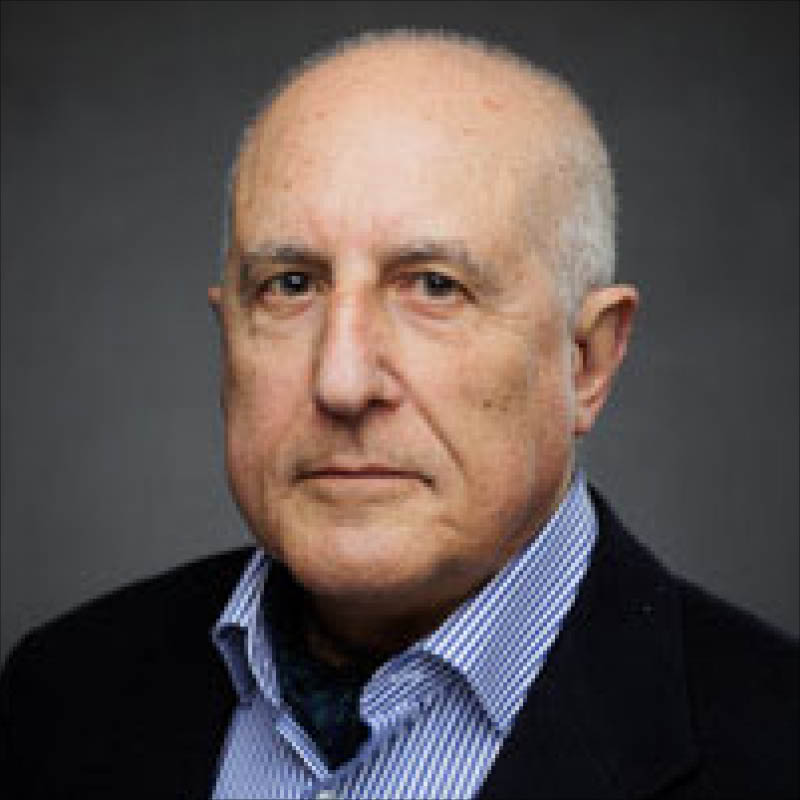
Fulvio's research and teaching has consistently focused on international politics and the European Union.
He has been Chair of the Italian Association of Political Science and Jean Monnet Chair Ad Personam.
He is the author of books and essays on world politics, multilateral security, EU politics, Euro-Mediterranean relations, mass migration and climate policy.
He has been a visiting professor at foreign universities, including the Chinese Academy of Social Sciences, Columbia University, New York University, and Shandong University.
At Catania, he currently teaches ‘World Institutions and Policies’ and ‘Methodology of Political Research’.
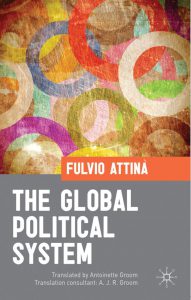
The Global Political System
Palgrave, 2011
also published in Italian, Spanish and Russian
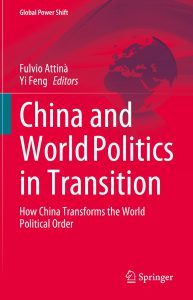
China and World Politics in Transition
Editor, with Yi Feng
Springer, 2023
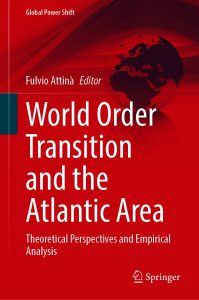
World Order Transition and the Atlantic Area
Editor
Springer, 2021


