Hira Yousaf finds that political participation and good governance move together across countries, but that link mostly disappears within countries over time. The gap matters for anyone hoping that civic engagement reforms will, on their own, improve how governments actually perform
Governments love a participation reform. Participatory budgeting, decentralisation, civic-engagement schemes: all get sold on the idea that giving citizens more voice will make governments work better. Cross-country data seems to support this story. My research with Ghulam Mustafa Mir asked a more specific question: when a country's own participation levels rise, does its governance improve afterwards? Mostly, it does not.
Countries with more voting, consultation and civic engagement do tend to score better on corruption control and rule of law. That correlation is real, and it has justified a great deal of policy over the past two decades, from governance-focused aid programmes to national decentralisation drives. But this comparison quietly mixes together two different questions.
One is whether more participatory countries are, in general, better governed than less participatory ones. The other is whether a specific country, having become more participatory, then governs better as a result. Development agencies design reforms hoping for the second effect. Cross-country comparisons can really only speak to the first. Treating a correlation between countries as if it were a causal story about change within one country is a bigger claim than the data can support on its own.
Participatory countries are, in general, better governed than less participatory ones. But if a country becomes more participatory, does it automatically follow that they govern better?
This distinction sounds academic, but it isn't. A donor funding a civic-engagement programme is implicitly betting on the second story: raise participation here, watch governance improve here, within a reasonable timeframe. If the true mechanism is closer to the first story, where participation and governance both trail a country's deeper institutional history, that bet has much weaker foundations than the headline correlation suggests.
The dataset behind this finding covers 270 country-year observations across 108 countries, drawn from the World Values Survey between 1996 and 2021, matched against the World Bank's Worldwide Governance Indicators. I tested five participation measures against six governance dimensions, plus a combined index.
Compared across countries, the relationship is about as strong as this literature gets. Petition-signing correlates with Voice and Accountability at 0.75 and, with the combined governance index at 0.71, explains roughly half the cross-country variance in governance quality. Boycotting and demonstrating show similarly strong, positive, highly significant relationships across every governance dimension.
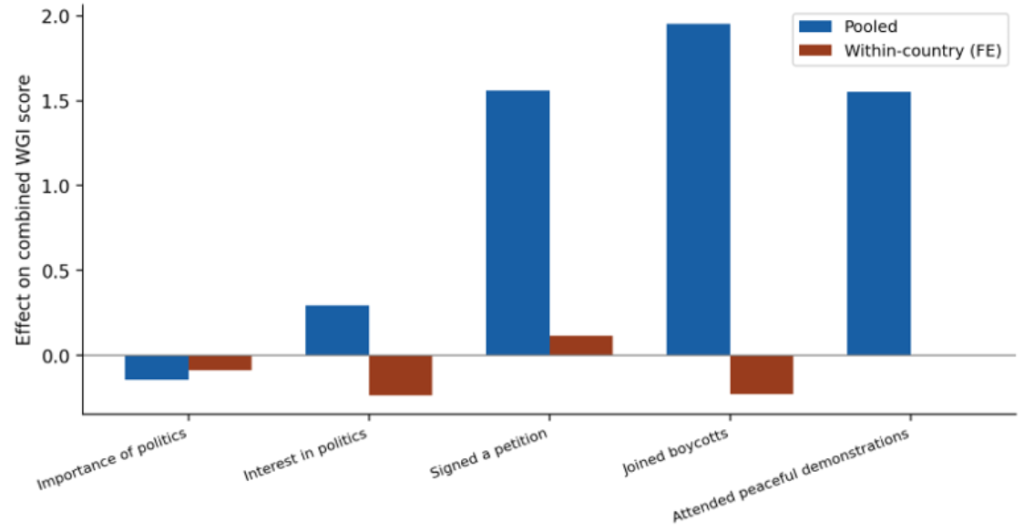
Track the same countries over time, though, and nearly all of that relationship disappears. On the combined governance index, petition-signing's coefficient shrinks from a strongly significant 1.56 in the cross-country comparison to a statistically indistinguishable-from-zero 0.11 once I compared each country only to itself. A lagged version of the test, checking whether participation today predicts a governance change tomorrow, finds almost nothing either: out of 35 separate participation-governance pairings, only two reach conventional significance, roughly what chance alone would produce across that many tests.
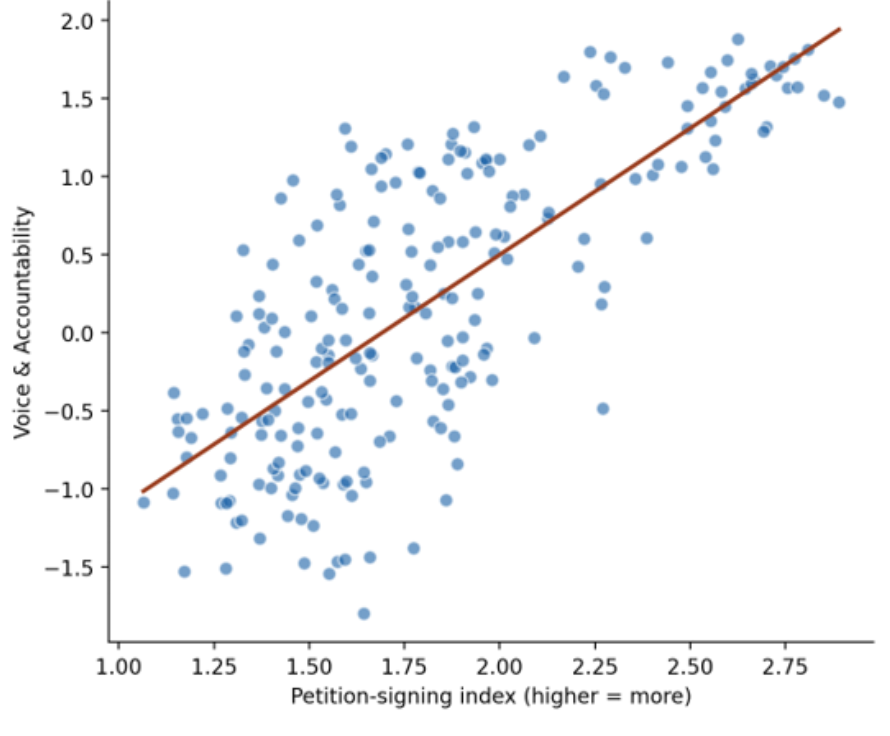
The obvious worry is that this is GDP wearing a disguise: richer countries participate more and govern better, and neither one causes the other. Adding GDP directly to the models leaves the cross-country association almost completely unchanged, so GDP alone isn't the hidden story. Some other bundle of slow-moving national traits, shaped by history and institutional inheritance, is likely doing the work, rather than anything a short-term reform can realistically replicate.
Richer countries participate more and govern better – but their success is shaped by history and institutional inheritance rather than GDP alone
There's one honest complication worth flagging, though. Separately balancing countries on GDP and regime type, rather than comparing each country to itself over time, cuts the raw participation-governance gap roughly in half, but a real, statistically significant gap still remains. That sits in some tension with the near-zero within-country result. Either the within-country comparisons are absorbing confounders that GDP and regime type alone don't capture, or that test simply lacks the statistical power, over a two-to-five-wave panel, to detect a real but modest effect. The data can't fully settle which explanation is right, and it's worth saying so plainly rather than picking whichever answer suits the headline.
None of this is an argument against participation. It simply suggests that leaning on it as a stand-alone governance fix may be asking more of it than the evidence can support. Where the specific goal is reducing corruption or strengthening rule of law, participation reforms may work best alongside direct institutional changes, rather than as a substitute for them. Participation still matters, for its own sake and quite possibly for others, just perhaps not for the specific reason many funding proposals lean on.
Participation reforms may work best alongside direct institutional changes, rather than as a substitute for them
None of this rules out a real effect somewhere. The countries in this sample shifted their participation levels over a fairly short window, two to five survey waves each, which limits how confidently a null result can be read as a true zero rather than an underpowered one. What the pattern does suggest is that betting a reform's success on a quick governance payoff, based mainly on the cross-country correlation, is a riskier assumption than the size of that correlation might suggest.
The next time a participatory budgeting pilot gets pitched as a governance solution, the more useful question may not be whether participation and governance are related. They clearly are. It might instead be worth asking why that relationship looks so convincing from a distance, and considerably thinner up close.
This piece is based on research co-authored with Ghulam Mustafa Mir, currently under review at Political Science Research and Methods