
NATO’s Article 3 requires members 'to maintain and develop their individual and collective capacity to resist armed attack.' This includes psychological resistance and the involvement of civil resources and civil actors. Oscar Larsson analyses NATO's current discourse, and traces its evolution, to reveal the shift in vocabulary from civil defence to resilience
The war in Ukraine has forced NATO to look closely at its own backyard. Article 5 may dominate public headlines. But Article 3 of the North Atlantic Treaty has quietly become the real engine for increased interest in civil resources and civil actors in the current notions of whole-of-government and whole-of-society. This approach encourages member states to maintain and develop their individual and collective capacity to resist armed attack. In the current era of grey-zone politics and hybrid threats, governments also encourage civil actors to help build resilience to withstand crises, hybrid threats and, ultimately, war.
Yet, NATO remains a fundamentally intergovernmental alliance, lacking supranational legislative powers over domestic laws. It cannot force sovereign states to build shelters, secure power grids, or stockpile medicine. Instead, coordination relies on strategic vocabulary and discursive persuasion. To this end, NATO adopted the Seven Baseline Requirements for National Resilience at the 2016 Warsaw Summit. By defining the parameters of security and resilience, NATO intended this form of soft and indirect governance to trickle down to member states and civil administration, but also civil actors, populations, and individuals. In mid-September 2026, it presented an updated and detailed operationalisation with clear objectives of what these baseline requirements should entail. Thus, resilience is now the leading concept for organising the civil dimensions of resistance and war.
The alliance's conceptualisation of 'home front' has undergone massive historical evolution. As I explore in NATO’s Approach to the Civil Dimensions of War, the alliance never had a static definition of civil defence and preparedness. Thus, contrary to the current policy hype around resilience and whole-of-society, interest in the home front was not born of Russia's post-2014 hybrid warfare. Rather, it has been part of the defence-and-deterrence package almost since the North Atlantic Treaty Organization's inception in 1949.
NATO is, foremost, a military alliance. Yet it quickly became clear that modern war and ideological conflict with the Soviet Union required a sturdy home front. The first Secretary General, Lord Hastings Ismay, was one of the first officials to incorporate this issue into NATO's mindset:
The armed forces are, in fact, only the cutting edge of a mechanism which involves every single national activity. The skill of the Commanders, the valour of the troops, the excellence of their equipment will be of no avail if the home front cracks
Lord Hastings Ismay, NATO secretary general, 1952–1957
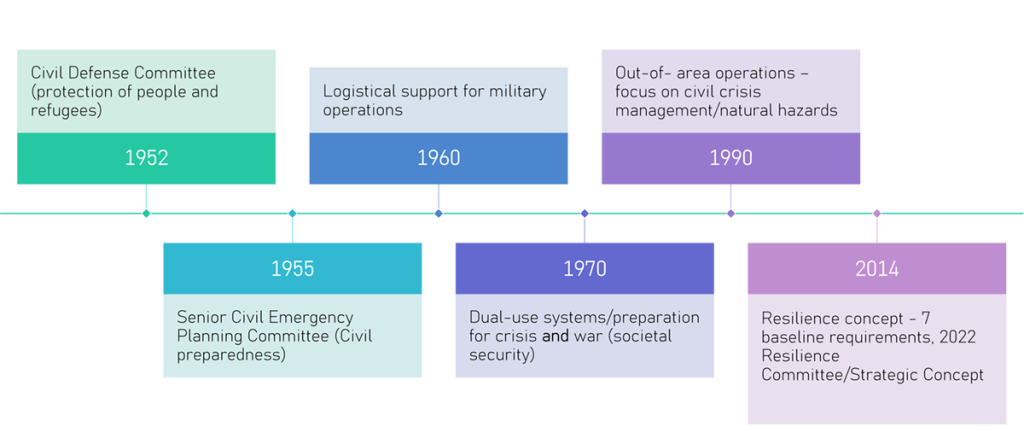
NATO established its Civil Defense Committee, oriented toward protecting populations and refugees during war, in 1952. In 1955, it became a subcommittee of the Senior Civil Emergency Planning Committee. The latter had a broader focus to consider all civil resources and planning to ensure the continued ability to wage war, even after a nuclear exchange.
However, records show that member states consistently resisted investing heavily in shelters or the civil defence infrastructure recommended by NATO experts. Efforts to map all civil resources for the war effort were complex and slow.
By the 1960s, the mission expanded as civil resources and actors were expected to function as logistical support for military operations. Despite many large-scale exercises, serious miscommunication persisted between NATO's civil and military committees. Most evaluations of exercises and readiness for war painted a bleak picture.
In the 1970s, NATO suggested extended civil-military collaboration and dual-use systems for crisis and war, giving it a more societal-security orientation. Here, we find the first traces of dual-use language, and the pairing of crisis and war.
The end of the Cold War clearly challenged NATO. Its longstanding rationale, to deter Soviet expansion, created a vacuum demanding to be filled with new tasks. NATO quickly identified the need to engage in out-of-area operations. To this end, it developed the Partnership for Peace programme, and showed growing interest in civil crisis management, domestically and globally. Immediate interest in traditional and domestic civil defence diminished but was never fully erased.
The end of the Cold War removed NATO’s longstanding rationale of deterring Soviet expansion, prompting the alliance to redefine its role, and to place increasing emphasis on civil crisis management
Following the Russian annexation of Crimea in 2014 and the full-scale invasion of Ukraine in 2022, NATO quickly wanted to return to its core tasks of territorial defence and overall deterrence against Russia. In 2016, NATO formalised this shift through its Seven Baseline Requirements for Resilience. By 2022, NATO had renamed its Senior Civil Emergency Planning Committee the Resilience Committee.
This rapid conceptual turn presents resilience as a promising panacea for modern geopolitical turmoil. However, resilience's conceptual foundation is problematic. It is ambiguous and often functions as an empty signifier in public policy. It is a fashionable word filled with highly contradictory content and meanings.
The core meaning of resilience creates a dangerous paradox in policymaking. It signals intense bureaucratic action but can ultimately lead to policy inertia on the ground
When NATO and member states build policies around resilience, they gloss over this ambiguity. Because the core meaning of resilience remains indecisive, it creates a dangerous paradox in policymaking. It signals intense bureaucratic action but can ultimately lead to policy inertia on the ground.
In the grey-zone era, Article 3 drives NATO’s home-front defence. Yet lacking supranational power for real change, the alliance must depend on indirect governance and moral persuasion. Shifting the concept from civil defence to resilience does not do the trick. If deterrence is just a matter of language, we end up trying to build a fortress out of a dictionary.

Oscar's work critically analyses the intersection of public policy, network governance, and national security architectures.
His previous publications include a genealogical study on the blurring boundaries of civil and war preparedness in Security Dialogue, as well as a comprehensive analysis of constitutional security management and voluntary compliance during Sweden's pandemic response in the European Journal of International Security.
NATO’s Approach to the Civil Dimensions of War: From Defense to Resilience
Palgrave Macmillan, 2026
Oscar's new open-access book examines the historical trajectory of Article 3 and civil preparedness within the alliance.


