

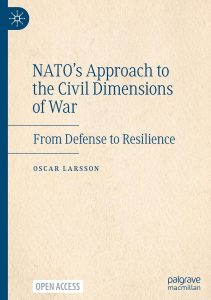
NATO’s Article 3 requires members 'to maintain and develop their individual and collective capacity to resist armed attack.' This includes psychological resistance and the involvement of civil resources and civil actors. Oscar Larsson analyses NATO's current discourse, and traces its evolution, to reveal the shift in vocabulary from civil defence to resilience
Unlike most other countries, Sweden adopted a ‘soft’ approach to managing the Coronavirus pandemic, flying in the face of ‘securitisation theory’. Oscar Larsson considers whether its approach will succeed
Senior Lecturer in Political Science, Swedish Defence University
Oscar's work critically analyses the intersection of public policy, network governance, and national security architectures.
His previous publications include a genealogical study on the blurring boundaries of civil and war preparedness in Security Dialogue, as well as a comprehensive analysis of constitutional security management and voluntary compliance during Sweden's pandemic response in the European Journal of International Security.
We use necessary cookies to make our site work. We'd also like to set analytics cookies that help us make improvements by measuring how you use the site. These will be set only if you accept.
▼
Strictly Necessary Cookies
Necessary cookies enable core functionality such as security, network management, and accessibility. You may disable these by changing your browser settings, but this may affect how the website functions.
▼
Analytics Cookies
Google Analytics
We'd like to set Google Analytics cookies to help us improve our website by collecting and reporting information on how you use it. The cookies collect information in a way that does not directly identify anyone. For more information on how these cookies work please see our Privacy Notice.