Is the global economy being weaponised at an unprecedented scale? Analysing decades of global trade and globalisation data, Thies Niemeier argues no. Sanctions have certainly grown more frequent and complex, but only to keep pace with a massive expansion in global integration
There’s a popular story going around in foreign policy circles: the world has entered an unprecedented 'age of sanctions'. Countries, the argument goes, are cutting each other off economically at a scale never seen before, wielding trade and finance as weapons more than ever in history.
It’s a good story. And it's true. But it's missing crucial context.
Here’s the thing that gets left out of the 'age of sanctions' story: the world today is far more economically connected than it used to be. I show this in the figure below with trade data from the Correlates of War project. Back in 1950, only about half of all possible country-to-country pairs actually traded with each other. By 2014, that number had climbed to roughly 85%. Almost everyone trades with almost everyone now.
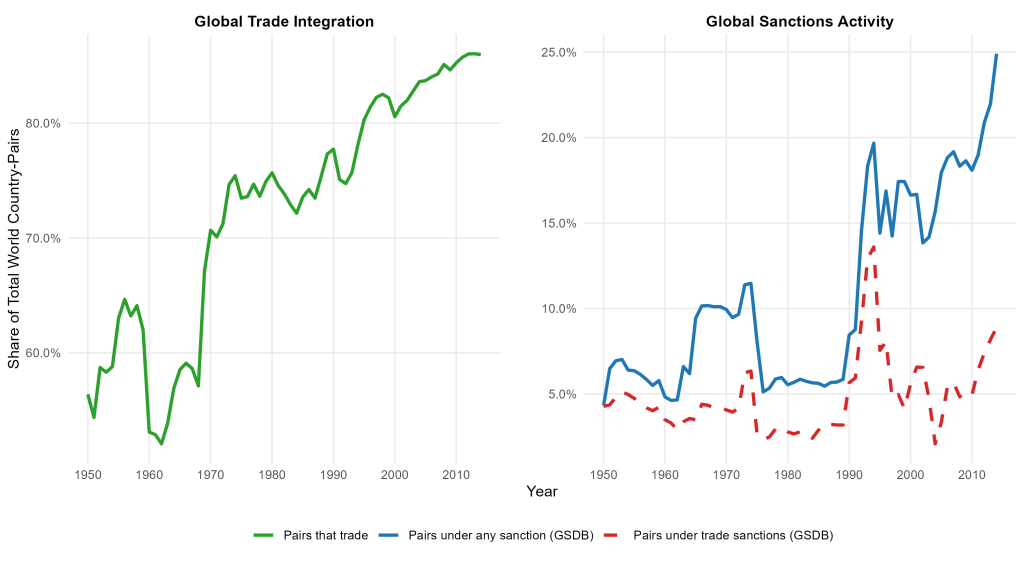
So when we ask 'how many countries are being sanctioned?', we should really be asking it against that bigger backdrop. And when you do that, the picture changes a lot. To show this, the figure also includes the share of country-to-country pairs under (trade) sanctions with the Global Sanctions Database.
Sanctions haven't been taking over the world. They've been keeping pace with it
Yes, the share of country pairs hit by sanctions has gone up – there’s a noticeable jump after the Cold War ended, and another one after 2010. But it’s still a small slice of the pie: even at its peak, only about a quarter of all country pairs face any kind of sanction at all. And trade sanctions specifically? They went from affecting about 5% of all trading relationships in the mid-twentieth century to about 8.5% in 2014.
In other words, sanctions haven’t been taking over the world. They’ve been keeping pace with it.
The other half of the age-of-sanctions argument is that today’s sanctions aren’t simply more common – they’re more severe and layered than ever. Countries don’t just ban one type of exchange any more; they combine travel bans, financial restrictions, arms embargoes, and more, all stacked on top of each other. I can track this evolution in the Global Sanctions Database too, by comparing the share of sanctioned country-to-country pairs under several kinds of sanctions (trade, financial, travel, etc).
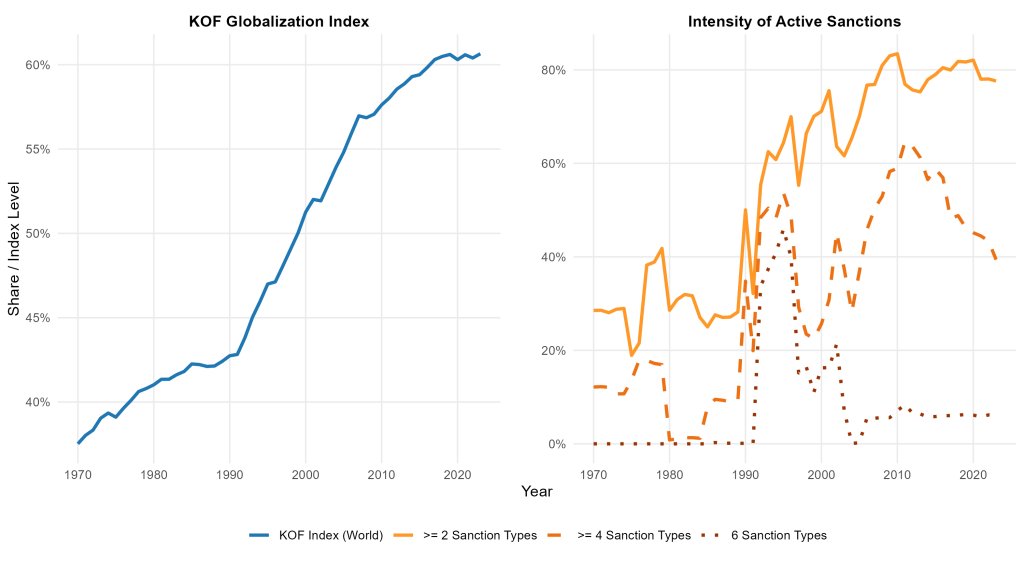
Again, the age-of-sanctions hypothesis is not wrong. Sanction regimes are characterised by ever more different kinds of sanctions employed at the same time. In 1970, around 30% of sanctioned pairs saw more than two kinds of sanctions simultaneously. In 2020, this number had increased to more than 80%.
However, context also matters for the severity of sanctions. I compare this trend to a well-known measure of global interconnectedness, the KOF Globalization Index, which tracks how economically, socially, and politically linked countries are over time.
Back when the world was less interconnected, sanctions were usually just a a trade ban. In today's globalised world, sanctions are far more complex
Globalisation and the complexity of sanctions move together almost step for step. Before 1990, when the world was less interconnected, sanctions tended to be simple – usually just a trade ban. As globalisation sped up after 1990, sanctions got more complex right alongside it.
That’s not a coincidence. If you want to meaningfully restrict a country that’s plugged into dozens of financial systems and supply chains, a single trade ban won’t cut it anymore. You need a toolkit that matches the complexity of the target. Sanctions got more sophisticated because the world did.
I draw on three well-established datasets – one tracking sanctions since 1950, one tracking historical trade relationships, and one measuring globalisation – and put them side by side. The pattern that emerges is simple: sanctions have changed, but not in the way the age-of-sanctions story suggests. They haven’t grown to cut off more and more of global exchange than ever before. What’s changed is the environment they operate in.
Sanctions aren't simply cutting off more and more global exchange. What’s changed is the environment they operate in
More countries trade with each other than ever before, so there are more relationships available to sanction. And those relationships are more complex than ever before, so the sanctions used to disrupt them are more complex. Sanctions have scaled up because the world did, not because states suddenly discovered a dramatic new weapon.
If people still believe we're living in an age of sanctions, it's because they are looking at them in a vacuum. When we look at the current scale of interconnectedness, the picture changes. We’re living in an age of exchange, and the tools of economic coercion have simply grown to match it.