
Mattia Zulianello introduces The PopulisTree, a new taxonomy and open-access dataset that maps the full diversity of populist parties across Europe over recent decades. Building upon and expanding the existing PopuList database, PopulisTree helps scholars, journalists, and policymakers analyse one of the most important political phenomena of our times
If you have ever tried to make sense of European populism, you may have felt lost. Parties as different as Giorgia Meloni’s Brothers of Italy, the Czech ANO 2011, La France Insoumise, Bündnis Sahra Wagenknecht in Germany, the Dutch BoerBurgerBeweging movement, and Fidesz in Hungary are routinely grouped under the same broad label: populist parties.
This shortcut is useful for identifying actors at a glance. It is far less useful for understanding how populist parties in Europe actually differ, why they mobilise voters in distinct ways, and how they behave once they enter government. A common thread in all the blogs in our 🔮Future of Populism series — in which this is the 100th instalment — has been that it is more useful to speak of populisms in the plural, rather than of populism as a single phenomenon. To capture that diversity, we need to see the whole forest — not just individual trees.
For years, scholars and journalists have relied on The PopuList to distinguish populist parties from non-populist ones. PopuList is a hugely valuable resource. Indeed, it has shaped much of what we know about populism in Europe, especially in comparative research.
Yet PopuList works with three very broad categories: far right, far left, and a residual group of other, heterogeneous, populist parties. This structure makes it hard to capture the real-world diversity of populism. Not all right populists are far right. Not all left populists fit into a far-left box. And the generic 'populist' category groups together parties that present a similar populist core but are ideologically very different.
Until now, scholars have relied upon The PopuList database for information on populist parties. With only three broad categories, however, PopuList's structure fails to truly capture populism's real-world diversity
This is where the PopulisTree, my new taxonomy and datasets, comes in. It builds on PopuList’s crucial distinction between populist and non-populist parties, and then goes a step further. Indeed, PopulisTree's essential goal is to explore what kind of populism characterises a political party — and why that distinction matters.
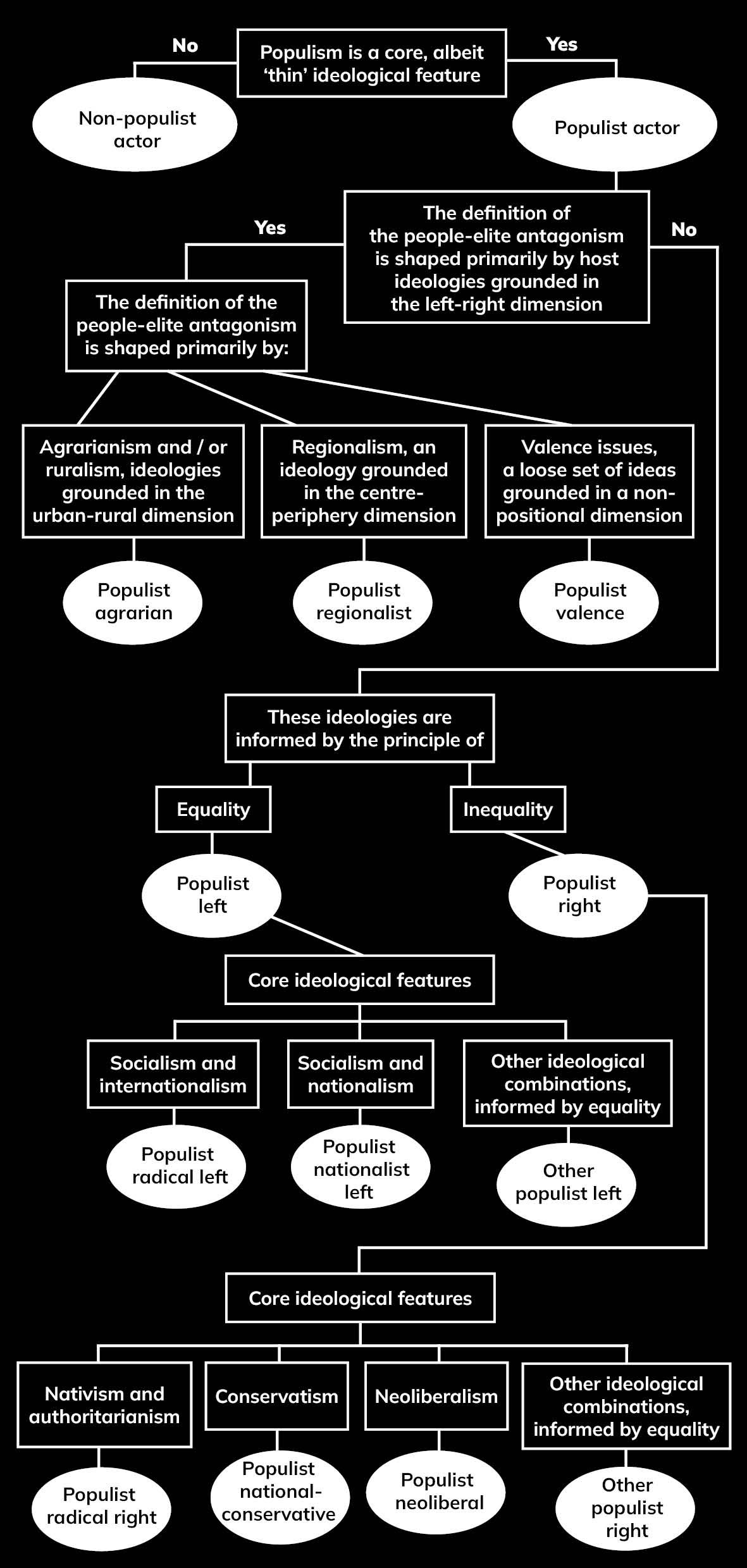
Scholars usually describe populism as a thin ideology. At its core lies a moral conflict between the 'pure people' and 'corrupt elite'. On its own, however, populism does not offer a full political agenda. To do that, it must combine with other ideologies or programmatic elements.
Using the existing literature on populism and political parties as a springboard, the PopulisTree maps these combinations theoretically and empirically. It identifies five main types of populism in Europe: right, left, agrarian, regionalist, and valence.
On the populist right, parties share an anti-egalitarian outlook but differ in how they define 'the people' and 'the elite'. The PopulisTree distinguishes between:
On the populist left, egalitarian ideas, usually rooted in different strands or hybrids of socialism, shape the people–elite divide. Here, the PopulisTree differentiates between:
But populism is not always about left- or right-wing ideologies. There are three other types of populism for which the conflict between the pure people and the corrupt elite is based on ideologies pointing to other dimensions.
Populism is not always about being left- or right-wing. In other types of populism, the conflict between the 'pure people' and 'corrupt elite' is based on ideologies pointing to other dimensions
Populist agrarian parties frame politics around the urban–rural dimension and defend the countryside against metropolitan elites. Populist regionalists mobilise the centre–periphery dimension within the national state. Finally, populist valence parties focus on a non-positional dimension constituted by broadly shared issues such as anti-corruption, political morality, and competence. Such parties often avoid adopting clear ideological stances.
Together, these branches reveal just how much diversity hides behind the single word populism and the overly broad and non-exhaustive far right, far left, and generic populist labels.
Building upon The PopuList, the PopulisTree dataset covers national elections in 31 European countries from 1989 to 2022. It also includes a dedicated dataset on European Parliament elections from 1979 to 2024. This makes it possible to track how different types of populism have evolved over time and across political arenas.
Looking at the 2024 European elections, for instance, the PopulisTree identifies 63 populist parties that obtained at least 1% of the vote. The picture is striking. The populist radical right dominates, both in numbers and geographical spread. Populist left parties are fewer and more geographically concentrated. Populist valence parties perform relatively well where anti-corruption appeals resonate, while populist agrarian parties remain rare but electorally relevant in specific contexts, such as the Netherlands.
In addition to national elections, PopulisTree provides unique data on how parties behave at EU level, revealing how populist parties make very different choices once they enter institutions
Crucially, the PopulisTree dataset also provides unique data on how these parties behave at EU level; namely, the groups in the European Parliament they joined. This matters, because populist parties make very different choices once they enter institutions.
Treating all populist parties as if they were the same — or grouping them into overly broad categories — creates serious analytical blind spots. It affects how we approach the phenomenon theoretically, and how we interpret electoral success. It also affects competitive strategies, and has an impact on policy at domestic, supranational, and international levels. And it can lead to misleading expectations about how these parties will govern once in office.
The PopulisTree helps avoid this problem. It builds on the reliable identification of populist actors performed by The PopuList, developing a fine-grained understanding of their ideological diversity. This makes it especially valuable for comparative scholars, journalists, and policymakers who need data that can travel across countries and over time.
Populism is not going away. But with the PopulisTree, we can finally stop wandering blindly — and see how the populist forest is really structured, branch by branch.


Mattia has published several articles in international journals.

Populist Radical-Right Parties in Action: The Survival of the Mass Party
Oxford University Press, 2025

Anti-System Parties: From Parliamentary Breakthrough to Government
Routledge, 2019



Thanks a lot!
I appreciate your strict use of "pop"as an adjective rather than a noun when characterising parties which, indeed, in practically all cases (the pure populist parties are rare, if at all) are primarily something else and only then populist.
Having said that, all these party categories do have a non-populist counterpart, at least conceptually. It would be useful to find out how these counterparts fare in real life in terms of the voter support compared to the pop siblings.