Israel's next election is often framed as a referendum on the country's longest-serving Prime Minister, Benjamin Netanyahu. Liran Harsgor and Alon Yakter argue that public opinion reveals two different political maps: a clear divide over democracy and institutions, but a far less coherent alternative on the Israeli-Palestinian conflict, where voters and candidates struggle to articulate a credible political horizon
On 27 October 2026, Israelis head to the polls to elect their next government. The outgoing coalition’s term has been extremely turbulent, with a contested judicial overhaul, mass counter-protests, the deadliest terror attack in the country’s history, and prolonged and controversial wars in Gaza, Lebanon, and Iran. In between, internal fractures involving the country’s Arab and Ultra-Orthodox populations have widened further.
And yet, Israeli public attention is mostly focused on a single question: will Benjamin Netanyahu remain in power? To understand what the election might actually change, the identity of Israel's next prime minister is only part of the story. We also need to ask what voters are choosing between on the issues that have defined Israeli politics over the past years.
Israeli society is often described as right-leaning. Data support part of that story: nominally, a clear majority of Jewish respondents locate themselves on the right, especially younger respondents.
Yet, on policy issues, ideological self-identification does not produce the same divide. The 2025 off-cycle study of the Israel National Election Studies (INES) makes this especially visible. In particular, it probes attitudes toward the two most pressing domains in the outgoing government’s term: democratic institutions and Israeli-Palestinian relations. Other cleavages, such as economic or cultural views, are traditionally weaker voting predictors.
Centrist Israeli Jews strongly support the Supreme Court's review powers, but only 32% support the creation of a Palestinian state
When Jewish respondents are placed on a left-right scale (the horizontal axis in the figure below), two different divisions emerge. On democracy and institutions, the shift toward strong checks and balances occurs at the political centre. At the scale’s midpoint, 79% support the Supreme Court's review powers and 70% oppose the government's judicial reform. On the Israeli-Palestinian conflict, however, the same centrist group looks very different: only 32% support a Palestinian state and just 12% believe a peace agreement is possible.
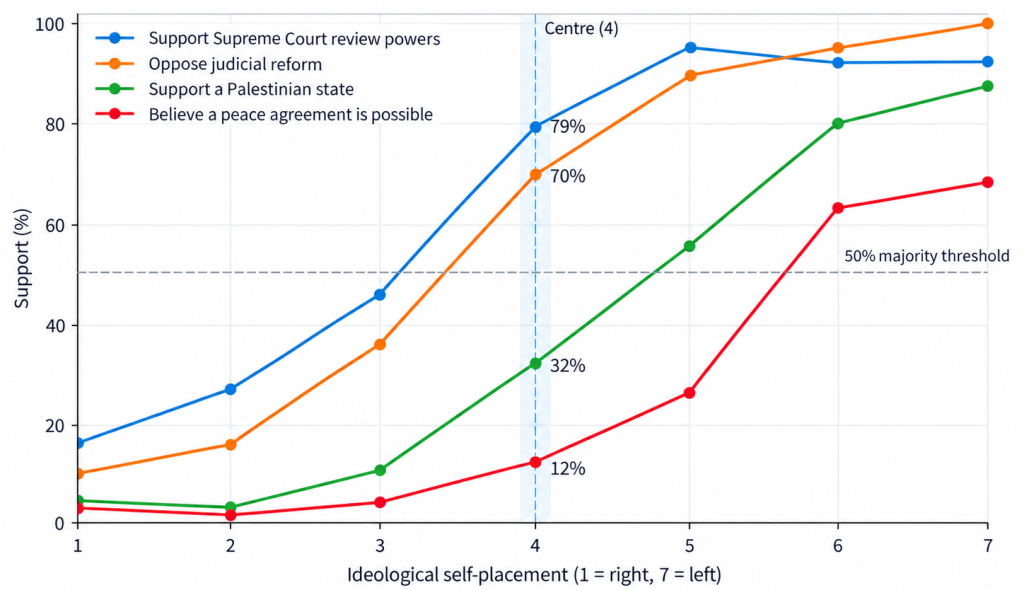
The figure captures an important feature of the Jewish-Israeli electorate: the centre resembles the left on democratic institutions but not on the conflict. Vote choice may therefore depend on which issue voters prioritise: democracy and government accountability, where centrists align with Netanyahu’s opponents, or security and the conflict, where many favour hawkish positions.
The campaign slogan of the ruling Likud party, 'Right or Palestine', speaks directly to this second divide. It presents the vote choice as being between right-wing hawkishness and national annihilation. This idea draws on a longstanding populist repertoire in Netanyahu’s politics. Netanyahu has repeatedly blurred the boundary between political opposition and disloyalty, casting the left, Arab parties, and even centre-right opponents as supporters of forces hostile to the nation.
Replacing Netanyahu could steer Israel's path away from populist autocratisation, yet still fail to revive the diplomatic agenda associated with the Israeli left
Meanwhile, the parties seeking to replace Netanyahu align on the first domain: reversing the judicial overhaul, establishing accountability for 7 October, and ending Ultra-Orthodox exemptions from military service. On the Israeli-Palestinian conflict, however, the alternative is less clear. Naftali Bennett and Gadi Eisenkot, the anti-Netanyahu bloc’s leading figures, do not align with the traditional peace camp. Bennett explicitly rejects Palestinian statehood. Eisenkot, too, has dismissed the establishment of a Palestinian state in the near or medium term.
Replacing Netanyahu could therefore substantially change the country’s path toward populist autocratisation, without reviving the diplomatic agenda associated with the Israeli left. The opposition contains real internal differences over Gaza, the West Bank, and international actors. Yet it lacks a clear, shared answer to what political order should replace indefinite conflict and Israeli control of the territories.
Recent Peace Index data show why this ideological absence matters. In July 2026, 82.5% of Jewish respondents said that continuation of the conflict harms Israel. About 62% opposed continuing the current situation. Yet when asked which outcome had the best chance of being realised in the foreseeable future, 46.8% predicted that the status quo will prevail. Only 13.3% expected an independent Palestinian state alongside Israel.
This is more revealing than left-right self-identification. A large share of the public sees the current situation as harmful but does not believe a different political outcome is likely.
Amid a lack of diplomatic vision from all parties, Israelis are in greater agreement about what is unacceptable than about a plausible political destination
Israel's rightward shift therefore captures political identity and attitudes toward the conflict, but not what Israelis want instead of the status quo. More agreement exists about what is unacceptable than about a plausible political destination.
It is tempting to treat this pessimism as a feature of public opinion. After years of violence, especially after 7 October, fewer Israelis believe in diplomatic solutions. But voters also form preferences vis-à-vis the options political leaders make visible and credible. On the eve of a critical election, held amid an ongoing security crisis, Israel’s leading candidates avoid articulating a concrete political end-state for Israeli-Palestinian relations.
This becomes a self-reinforcing cycle. Politicians see a pessimistic, increasingly right-identifying electorate and avoid ambitious diplomatic visions. Voters, in turn, encounter few realistic policy proposals and struggle to imagine anything else.
International actors also shape this environment. Israelis often see external criticism as evidence that outsiders misunderstand their security concerns, not as an argument for changing policy. In a 2025 INSS survey, 72% of Israelis viewed a critical British-French-Canadian statement on Gaza as either detached from reality or biased against Israel. Yet 64% were also concerned about Israel's growing international isolation. This suggests room for a more constructive international role in providing a credible and equitable political horizon while engaging Israelis’ anxieties.
A change of government, if it occurs, could therefore change Israel significantly without resolving its crisis of political imagination. For that, voters must look beyond the policies they reject. Political leaders, in turn, need to make alternative futures imaginable as real political choices.