In countries experiencing democratic backsliding, opposition MPs must confront not only the crisis of political representation but also structural constraints that limit their influence. Drawing on research in Hungary, Annamária Sebestyén argues that in such circumstances, opposition MPs develop innovative strategies to remain politically relevant. These strategies, however, have clear limits
Hungary is heading into a pivotal parliamentary election on 12 April 2026. But will the opposition be able to challenge Viktor Orbán’s 16-year rule? And can opposition MPs even remain politically relevant in an electoral autocracy designed to contain them?
Representative democracy is under growing pressure across Europe. Trust in political institutions is declining, and many citizens feel increasingly disconnected from their representatives. Recent reports, including the 2025 V-Dem dataset, suggest that democratic regression has accelerated since the 2010s.
These challenges are particularly evident in countries experiencing democratic backsliding and the emergence of electoral autocracies. In such systems, opposition politicians face severe constraints. Governments dominate the media, centralise resources, and weaken parliamentary oversight. Elections may still exist, but the playing field is deeply uneven.
Under these conditions, opposition MPs have little influence over legislation. Their proposals rarely pass, and parliamentary debate often becomes largely symbolic. Yet they cannot simply withdraw from politics. They must demonstrate their relevance to voters, maintain a visible presence in the public sphere, and communicate to the electorate why political representation still matters.
In countries experiencing democratic backsliding, opposition politicians must develop strategies of representation that extend beyond traditional parliamentary influence
To survive politically, opposition MPs must therefore develop strategies of representation that extend beyond traditional parliamentary influence. Yet they are not entirely powerless. Even under severe constraints, members of the opposition may find ways to remain visible, credible, and politically relevant.
Opposition MPs have different strategies in Hungary, widely considered the European Union’s only electoral autocracy. Four representative strategies prevail. Each reflects a distinct understanding of how to represent citizens when institutional power is limited and points to the underlying political logics and socialisation patterns shaping how opposition politicians interpret their role in such a constrained political environment.
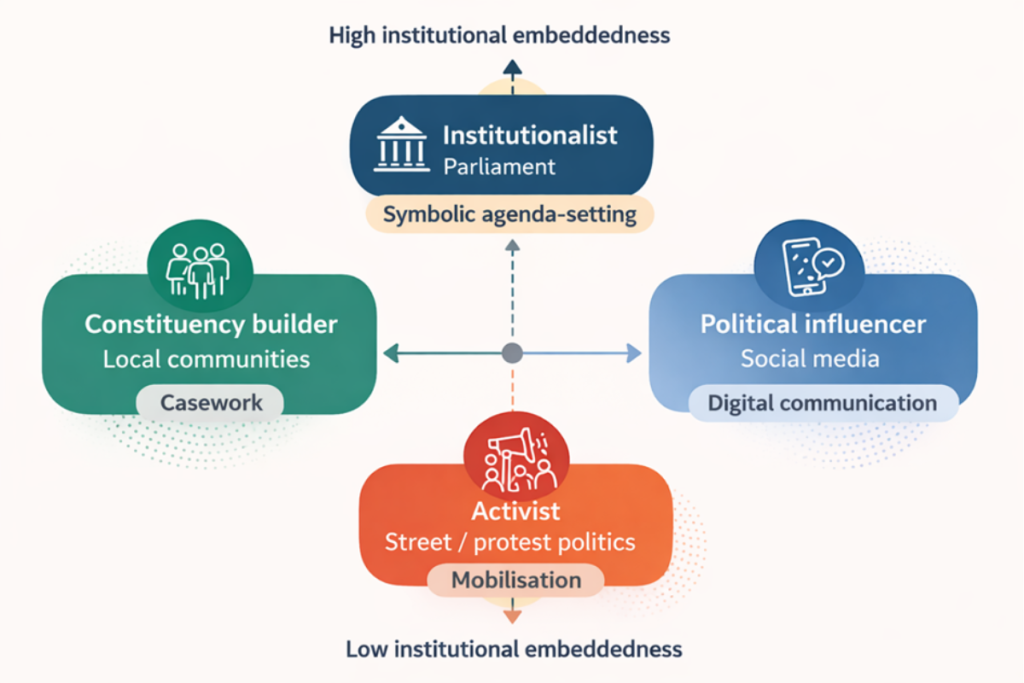
The constituency builder shifts the focus from national politics to local communities. Representation becomes an everyday service involving problem-solving, conflict mediation, and direct contact with citizens. This strategy derives its legitimacy from local presence and personal trust. However, its reach remains limited: while local responsiveness can sustain democratic practices within communities, it rarely produces broader political change.
The activist moves in the opposite direction. For these MPs, parliament is primarily a platform for protest and mobilisation. They enact representation through demonstrations, civic campaigns, and alliances with NGOs. Legitimacy must be constantly reproduced through visible action and public engagement. Yet protest rarely translates into institutional influence or policy change, and often compensates for the weakness of parliamentary opposition rather than overcoming it.
Political influencers relocate representation into the digital sphere. In a government-dominated media environment, social media becomes the primary arena of political communication. These MPs seek to shape narratives, expose injustices, and maintain public attention through continuous online presence. Yet digital visibility also turns representation into a struggle for attention in a highly polarised, algorithmically shaped information space, amplifying visibility without necessarily producing political influence.
Finally, the institutionalist remains committed to parliament itself. Even when legislative impact is limited, these MPs defend parliamentary procedures, raise policy issues, and seek to preserve the symbolic integrity of democratic institutions. In a dominant-party system, however, parliamentary activity often remains largely symbolic and rarely translates into meaningful political influence.
These strategies are not simply tactical choices. Rather, they reflect different socialisation experiences and political worldviews among young MPs – from local political careers and activist networks to digital media environments and parliamentary professionalisation.
As a result, young MPs interpret the constraints of electoral autocracy in different ways, and tend to reproduce the forms of representation with which they are most familiar. Local politicians focus on communities, activists on mobilisation, digital actors on online communication, and institutionalists on parliamentary work.
While constituency builder, activist, political influencer and institutionalist strategies help opposition MPs remain visible, they rarely alter the structural asymmetries of electoral autocracy
Yet despite these differences, all four strategies share a common limitation. They help opposition MPs remain visible and politically active, but they rarely alter the structural asymmetries of electoral autocracy. In this sense, adaptation becomes a paradox: the strategies that sustain opposition survival may also stabilise a system resistant to meaningful institutional change.
The Hungarian case offers a broader lesson about political representation during periods of democratic backsliding. When institutional power becomes concentrated, political representation does not simply disappear. Instead, it shifts across different arenas of political life.
These adaptive strategies help opposition actors survive politically. However, survival alone does not necessarily lead to systemic change. Opposition repertoires familiar from Western democracies – such as digital communication, activism, and protest politics – do not necessarily produce regime change, whether used separately or in combination.
What appears to be missing is a deeper process of political resocialisation and large-scale societal mobilisation. Opposition politics cannot rely solely on mediated communication or episodic protest. It must reconnect with citizens’ everyday experiences and re-establish politics as something embedded in ordinary social life.
Opposition politics must reconnect with citizens’ everyday experiences and re-establish politics as something embedded in our social life
Recent developments suggest that this equilibrium may not be permanent. Nationwide mobilisation efforts, including those of the political movement built by the Respect and Freedom Party (TISZA), indicate that structural constraints do not entirely eliminate the possibility of broader political realignment.
When politics reconnects with everyday, face-to-face experience, even a demobilised society can become responsive again. Path dependence is powerful, but not irreversible. Even in an electoral autocracy, political representation can regain social embeddedness by reconnecting with citizens’ lived experiences. The imminent elections may therefore offer an important empirical test of whether fragmented opposition survival strategies can converge into broader political transformation.