Refugees are not born of persecution; they are made by states. People may flee war, violence or persecution, but they only become refugees once a state decides they qualify for protection. Asylum is thus not simply a humanitarian matter; it is also a question of how states work. Pierre G. Van Wolleghem investigates the quiet politics of asylum decision-making
Almost all research on asylum has treated recognition as a binary: governments either grant or deny protection. That framing seems natural, but it misses something important. In the European Union, there is not one form of protection but several.
Refugee status, defined by the 1951 Geneva Convention, is the most generous: it offers longer residence permits, easier family reunification, and clearer pathways to permanent residence and citizenship. Subsidiary protections, introduced through EU secondary law, and nationally defined humanitarian statuses are comparatively thinner. They tend to be more temporary, grant fewer rights, and – especially in the case of national statuses – leave considerable discretion to the state.
EU member states offer several forms of protection. Treating asylum as a single yes-or-no outcome hides this entirely
This matters because it changes the question a government faces. A state cannot simply reject someone who genuinely qualifies for protection without breaching its obligation of non-refoulement. But it can choose which kind of protection to grant. That choice is where legal compliance and political preference meet. By granting a lesser status rather than full refugee status, a government can formally abide by its commitments under international law while, at the same time, limiting the longer-term settlement and integration of those it protects.
Treating asylum as a single yes-or-no outcome hides this room for manoeuvre entirely. Once we distinguish between statuses, a more revealing picture emerges.
My recent article in Political Research Quarterly models asylum decisions as the product of a tension between three actors, each following its own logic.
The first is the administration. First-instance asylum decisions in the EU are taken by civil servants who assess whether an applicant has a well-founded fear of persecution, against the criteria set out in the Geneva Convention. In Weberian terms, this is a rational-legal process: officials apply established rules with a degree of consistency and predictability, and are structurally insulated from electoral cycles. On the whole, the administration evaluates claims on their merit.
The second is the government. Governments are elected, respond to public opinion, and pursue policy preferences. Where a government holds restrictive views on immigration, it has incentives to steer the administration towards less generous outcomes; where it is more favourable, towards more generous ones. Crucially, the administration operates under the direction of the Interior or Justice Ministry, and policy changes are often procedural rather than legislative, which means they can bear the direct imprint of a government's preferences without any change in the law.
The third actor is public opinion. Here the key variable is not what the public thinks so much as how much attention it is paying. Salience – how important immigration is to voters at a given moment – shapes how much latitude a government has. When attention is low, governments can pursue their preferences relatively freely. When attention is high, they are more constrained, because their handling of asylum is being watched.
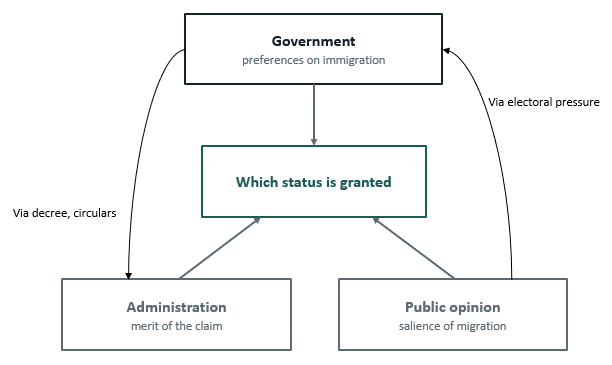
Drawing on Eurostat data on first-instance decisions across EU member states between 2008 and 2019, my analysis produces four main findings.
First, the merit of a claim matters – it consistently correlates with recognition rates. Where conditions in countries of origin point to a real risk of persecution, a government is more likely to grant refugee status, regardless of its stance. The humanitarian core of the system holds.
Second, when public attention is low, government preferences come to the fore. Governments favourable to immigration push towards refugee status; restrictive governments steer recognition towards subsidiary protection instead – granting some protection, but of a lesser kind.
Where conditions in countries of origin point to a real risk of persecution, a government is more likely to grant refugee status, regardless of its stance
Third, when claims are strong and the public is watching, restrictive governments can no longer deny refugee status to those who clearly qualify. But governments are not without options: they express their preferences by sharply curbing subsidiary protection. In one estimate, refugee recognition holds steady while subsidiary recognition falls by roughly twelve percentage points. The overall effect is still a reduction in protection, achieved not by refusing the deserving but by narrowing the granting of a lesser status.
Fourth, national protection statuses behave differently from the international ones. Their use tracks government preferences closely and is only weakly related to conditions in countries of origin or to public attention. Defined outside international agreements, they function as a flexible instrument that governments can adjust largely at will.
We should not understand recognition of international protection solely as the product of administrative processes or humanitarian imperatives. Nor does it depend on politics alone. Instead, it is a negotiated outcome, produced at the intersection between human rights, legal obligations, administrative institutions and democratic politics. Understanding asylum thus requires looking inside the state: the institutional apparatus that encompasses the government, the administration, and the rules that govern their interactions.
Recognition of international protection is a negotiated outcome, produced at the intersection between human rights, legal obligations, administrative institutions and democratic politics
This is no small matter, because asylum decisions are not ordinary administrative outputs; they determine the fate of people whose lives may be at risk. There is something reassuring in the finding that the risk of persecution remains a consistent driver of protection. It suggests the system still does what it was designed to do, at least to a meaningful extent.
But the fairness of that system rests on the robustness of the institutions built to uphold its principles. Where those institutions are strong, political pressure is absorbed. Where they are weak, it flows through. If we want governments to apply asylum more fairly, that is where attention belongs: on the design of the machinery through which protection is granted, and on how the institutional setting organises the interaction between the government and its administration.