
In 1963, the Munich Security Conference was founded to strengthen West Germany’s integration into NATO. The 62nd annual Conference, which took place 13–15 February 2026, shows the increasing influence of civilisationist politics on transatlantic relations, argues Josefin Graef
Last year, US Vice President JD Vance used his speech at the 2025 Munich Security Conference (MSC) to pose a provocative question: 'What is the positive vision that animates this shared security compact that we all believe is so important?'
This year, US Secretary of State Marco Rubio travelled to Munich to deliver the Trump administration's answer. And while Rubio may have adopted a warmer tone than Vance, he nevertheless tightened the thumbscrews on Europe.
During the Cold War, Rubio said, the transatlantic alliance had successfully defended Western civilisation against the Soviet Union. Now this alliance had to unite to defend it once again. This time, he said, the threat was coming from mass migration, the 'climate cult', and undemocratic global institutions. Would Europe renew its vow to the civilisational alliance and help 'build a new Western century'? If not, the US would 'do this alone'.
Rubio’s speech was a commitment ceremony ('we gather here today as members of a historic alliance') and a funeral service ('yesterday is over') rolled into one. It chimed with the civilisationist politics of the Trump administration. As the 2025 National Security Strategy put it, the US had to help a Europe faced with 'civilisational erasure' to regain its 'civilisational self-confidence' – mainly by increasing support for European far-right parties.
Unsurprisingly, conference participants aligned with Trumpism embraced Rubio’s message. This included Anna Rathert, one of three invited representatives from Germany’s Alternative für Deutschland party. Rathert thanked Rubio for a 'deeply moving and heartfelt speech' that had captured Western heritage with 'depth, substance, and grace'. Gladden J. Pappin, a US academic and think-tanker close to Viktor Orbán’s Hungarian government, pointed out that 'civilisation' was not a dirty word. He cited the preamble of the 1949 NATO treaty: 'The Parties to this Treaty…are determined to safeguard the…civilisation of their peoples, founded on the principles of democracy, individual liberty and the rule of law.'
Pappin had a point. Competing visions of the ancient notion of 'civilisation' shaped construction of the postwar global order. These visions saw civilisation realised in many different things, from religious faith and music to personal manners and national self-determination. They went hand in hand with the pre-war idea of civilisations as distinct cultural entities, with 'the West' considering itself more civilised than others. Rubio tapped into these histories by defining Western civilisation in relation to Christianity and white ancestry as well as science and the rule of law.
'Civilisationism' is a way of thinking about politics that sees it as an open and unruly competition for determining 'the good life'
These many meanings of civilisation and their embeddedness in political institutions enable today’s thriving civilisationism in and outside the West. The term captures that civilisationist politics is a new type of identity discourse accompanying a changing world order. But more than that, it is an international ideology in the making: a way of thinking about politics that sees it as an open and unruly competition for determining 'the good life' — and with or against whom to achieve it.
Contrary to popular belief, civilisationism is not limited to far-right and authoritarian actors.
In the EU, a liberal civilisationism has begun to take hold. It seeks to defend the 'European way of life' against outside threats, in particular migrants and Russia. In fact, European liberals may be particularly tempted to embrace civilisationism because they see 'Europe' as an alternative to the nationalism that resulted in two world wars.
In the EU, a new 'liberal civilisationism' seeks to defend the 'European way of life' against outside threats, in particular migrants and Russia
Responses to Rubio’s speech illustrate how liberal civilisationism now figures in Europe-US relations.
After Rubio had delivered his speech, MSC Chair Wolfgang Ischinger thanked him (twice) for 'offering this message of reassurance about our partnership'. German foreign minister Johann Wadephul called Rubio 'a true partner' who wanted to continue the US-Europe 'success story' despite diverging policy positions. European Commission President Ursula von der Leyen and British Prime Minister Keir Starmer emphasised that Rubio’s message was not at odds with their vision of an 'independent Europe'. As Starmer put it, Europeans had to become self-sufficient to 'protect our values and our way of life' while NATO remained; citing Ernest Bevin, 'a spiritual union of the West'.
None of these leaders wants to join the MAGA culture wars. Rather, they are aware that Europe remains technologically and militarily dependent on the US. While Europe is racing to intensify internal cooperation and diversify its global partnerships, civilisationism serves as a sticking plaster.
Other European leaders contradicted Rubio. EU High Representative for Foreign Affairs and Security Policy Kaja Kallas cited official rankings and the demand for EU accession in her denial that Europe was 'facing civilisational erasure'.
While they have no desire to join the MAGA culture wars, European leaders are aware that Europe remains technologically and militarily dependent on the US
Danish Prime Minister Mette Frederiksen chided the Trump administration for violating Greenland’s right to self-determination, a NATO core value. At the same time, Frederiksen suggested that the higher European defence spending the US is demanding is necessary to defeat the 'crazy' Russians who had attacked Ukraine’s energy system in the middle of winter. But this, she added, 'is how Russia is and it will not change. And the only language they understand is if we are as tough as they are'.
For French President Emmanuel Macron, 'defending European sovereignty' also meant regulating social media platforms to defend free speech, an idea rooted in the European enlightenment. A few days later he added at the AI Impact summit in New Delhi: 'Protecting our children is not regulation, it is civilisation'.
Liberal civilisationism thus serves as an ideological bridge between the Trump administration and the EU’s political establishment, but also enables the latter to project a credible vision of an 'independent Europe'. That it may also embolden European far-right leaders seems to have lost its terrifying quality since Italian Prime Minister Giorgia Meloni proved that a stronger far right does not necessarily spell the end of the EU. If the 2026 MSC is anything to go by — and the conference’s history suggests it is — transatlantic security is now happening between two civilisationist powers.


Josefin’s research focuses on right-wing politics and violence, liberal democracy, and political narratives in Europe and the 'global West'.
Her most recent published research is Civilizationism in the European Union beyond the far right: a morphological approach, written with Hans Kundani and published in the Journal of European Integration, 2025.
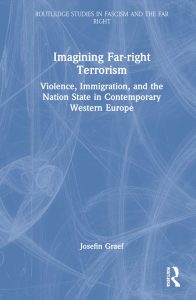
Imagining Far-right Terrorism: Violence, Immigration, and the Nation State in Contemporary Western Europe
Routledge, 2022


