On 23 November 2025, Birzeit University in the Palestinian West Bank halted all teaching to mourn one of its law students, killed by Israeli gunfire in a nearby village. The case, says Serena Fraiese, reveals how freedom crumbles in the world outside academe before it even reaches campus
We tend to assume that universities are protected spaces, buffered from the shocks of real-world events. In November 2025, Birzeit University in the West Bank challenged that assumption, suspending classes to mourn a student killed in a gunfight outside its campus.
Birzeit issued a public condolence, in Arabic, for 20 year-old law student Baraa Khairy Ali Maali, on whom Israeli forces inflicted fatal gun wounds in Deir Jarir on 23 November. The university encouraged collective mourning, while reaffirming its academic mission and commitment to human rights and civic values.
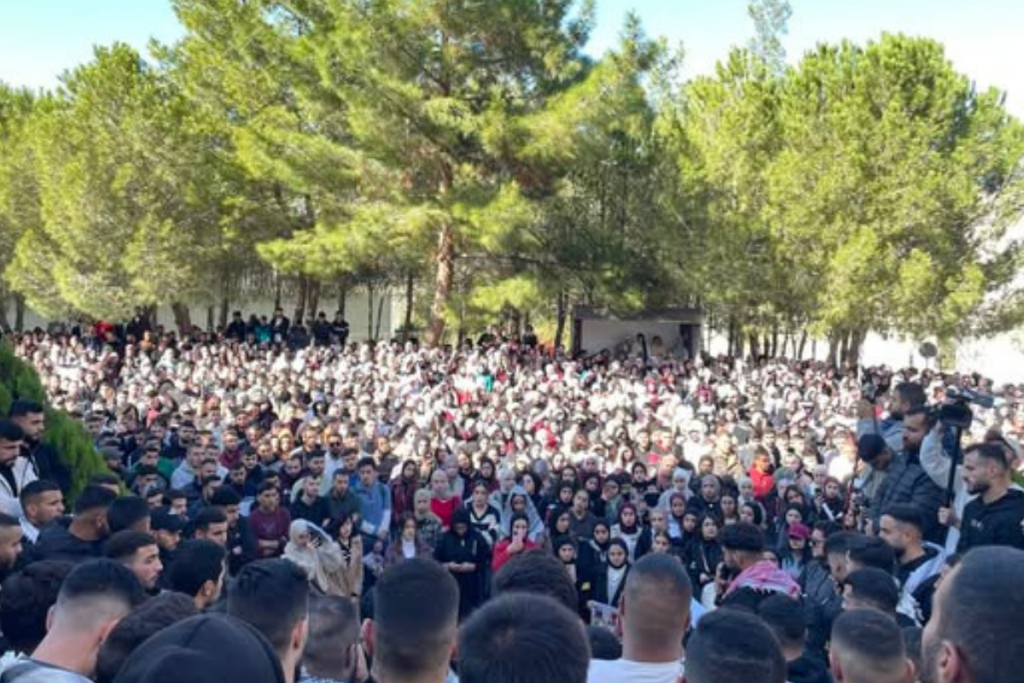
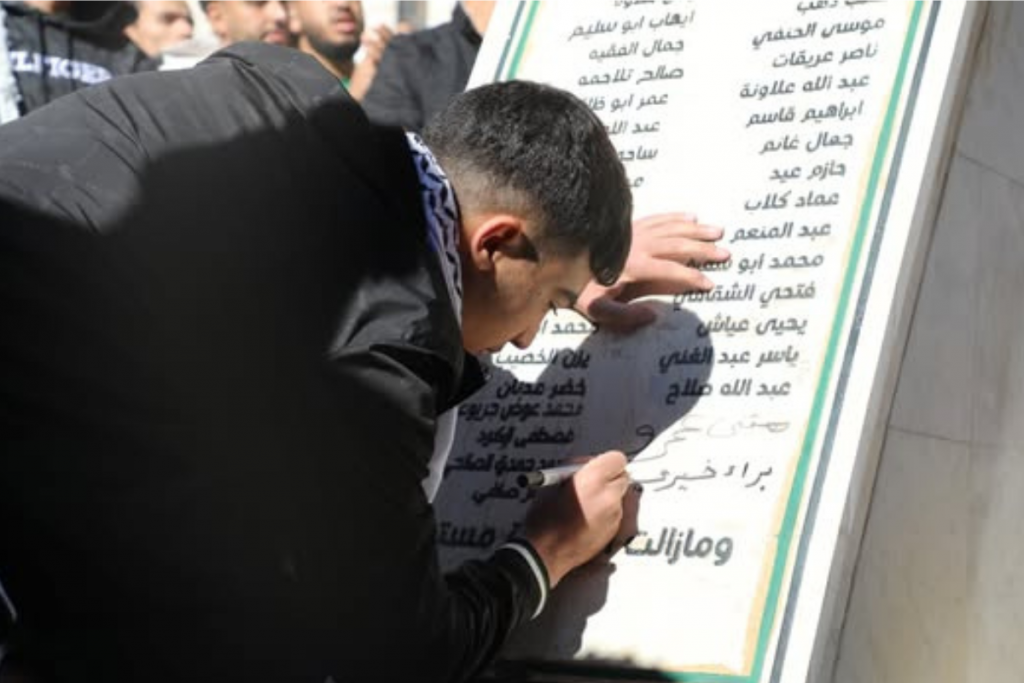
Source: Birzeit University Official Facebook page
Local, institutional, and regional sources all confirmed Maali’s death. The Arabic-language Hurriya News announced that the Birzeit student body would mount a general strike in mourning. National newspaper Al Ayyam cited Deir Jarir’s council leader, described Maali’s medical transfers, and gathered quotes from local residents defending their homes amid settler incursion under military guard.
The Jordan News Agency and the Times of Israel reported that the Israeli Defence Force (IDF) killed Maali during a settlers-and-soldiers raid. Both sources confirmed Maali was taken to a clinic in Silwad before dying at the Palestine Medical Complex, Ramallah. The IDF said it would ‘look into the report’.
The UN’s Office for the Coordination of Humanitarian Affairs (OCHA) records academic insecurity and disrupted access to education. OCHA's 27 November Situation Update confirms that Israeli forces killed a Palestinian man during a 23 November clash in Deir Jarir. But it does not provide the man’s name or age, a limitation consistent with OCHA’s conflict-constrained verification environment.
Academic freedom is not a purely intellectual privilege. It depends on mobility, safety, and continuity
The Situation Update also documents intensified movement restrictions across multiple West Bank communities. It reports prolonged checkpoints near schools, forced detours through settler-frequented zones, and recurring obstruction of safe access to education facilities.
When major Arab and Israeli sources converge on the same sequence of events, it's clear that academic freedom is not a purely intellectual privilege. It depends on mobility, safety, and continuity, without which ideas may never reach a page.
The Academic Freedom Index 2025 (AFI 2025) offers the most up-to-date measurement of constraints on universities. Based on expert assessments across 179 countries and territories, AFI groups academic systems into five statuses, from fully free (A) to fully restricted (E).
In its Free to Think 2025 report, Scholars at Risk (SAR) maps corroborating patterns through incident-based reporting. SAR logs hundreds of attacks across world regions, including the Middle East.
Scholars at Risk logs hundreds of attacks across the world such as student killings, detentions and university raids. It describes academic freedom as severely impacted across the Occupied Palestinian Territories
Violations include student killings, faculty intimidation, detentions, university raids, imposition of travel restrictions, censorship by non-academic actors, and governance interferences that leave institutions weaker and more exposed.
SAR codes the West Bank and Gaza as separate territories, describing academic freedom as severely impacted across the Occupied Palestinian Territories (OPT). Recent AFI and SAR assessments show a sharp contraction in mobility, autonomy, and access to education, while noting that conflict conditions limit incident verification.
How can we analyse a killing like Maali’s without treating it as an isolated tragedy? Political scientist Lars Lott has developed a model that is a useful lens through which to analyse Maali’s case. Lott argues that rights rarely erode through single, dramatic shocks. Instead, they decline through extended periods during which many smaller restrictions accumulate, such as limits on movement, increased checkpoints, campus raids or pressure on university governance.
Academic space in the West Bank is shrinking. Palestinians endure mobility restrictions, institutional vulnerability, and recurrent disruptions to education
Viewed this way, Maali’s death is not an 'accident' at the edge of campus life. It occurs within a longer episode of shrinking academic space in the West Bank, one that Scholars at Risk and the Academic Freedom Index monitor through patterns of mobility restrictions, institutional vulnerability, and recurrent disruptions to education.
Lott’s model doesn’t assign political blame. It simply provides an analytical way to connect individual events to broader trajectories of decline. This helps scholars understand when a university system is experiencing deeper structural deterioration rather than experiencing a one-off disruption.
Discussing academic constraint without putting scholars, institutions, or mobility at risk requires precise framing. That’s why I have not reported private conversations or personal identifiers. My account of events relies on public institutional texts, population-weighted data, and cross-verified media – in Arabic and English. I have not speculated on or attributed motives beyond what the sources themselves already state.
Birzeit’s statements speak of ‘homeland’, ‘struggle’, and ‘martyrdom’. AFI 2025 does not interpret such words as statistically significant. Instead, we should understand such expressions as a local vocabulary of institutional grief.
This lexicon is not imported activism: it is the terminology of an institution that cannot rely on ordinary state protections for its students. As a scholar, I must parse the statement as an institutional function, not as endorsement. For comparative rigour, I must embed the Maali case in AFI 2025 scores, SAR incident frequencies, and Lott’s episodic measurement model.
Such an analytical exercise is the only ethically responsible one for this ⛓️ series. It transforms a tragedy into a measurable unit of comparison. This way, readers outside Palestine can understand structural fragility without interpreting it as a personal call to arms.
Academic freedom depends on material guarantees: safe access to campus, continuity of academic work without disruption, and institutional autonomy. It also relies on the ability of scholars to travel, research, publish, partner, and return without harassment or mobility restrictions imposed by non-academic actors.
At Birzeit University, safety and mobility protections failed before intellectual freedoms even had the chance to be tested. This is what made it possible for me to conduct an ethical comparative framing without implying endorsement of one side or the other.
⛓️ No.13 in a Loop series examining constraints on academic freedom in a variety of global contexts