Under growing public scrutiny and growing demands for public communication, how does the European Commission respond to various political pressures? Drawing on two new studies, Radu-Mihai Triculescu, Leonce Röth, Christoph Ivanusch and Klaus H. Goetz show how the European Commission balances and communicatively addresses problems and public pressures in migration and asylum policy
Following a deadly incident off the island of Chios in February 2026, a European Commission spokesperson put it plainly: 'Every life lost at sea is a tragedy'. Meanwhile, the International Organization for Migration (IOM) estimated that 7,667 people died or went missing on migration routes worldwide in 2025. Sea crossings remained among the deadliest journeys, including at least 2,108 deaths in the Mediterranean. And the toll continued into 2026, with 606 deaths in the Mediterranean recorded by 24 February.
But in EU migration politics, tragedy is almost always accompanied by the politics of time. Leaders insist that now is the moment to act. Or they argue the opposite, that Europe must proceed slowly and carefully. In Brussels, 'time' isn’t just a backdrop, but an important part of the decision-making. When leaders talk about urgency they are not only describing reality. They are staking a claim about what should happen next, and about who should be responsible for making it happen.
The European Commission is criticised from both directions. One story paints it as a slow technocratic machine, insulated from political pressure. Another portrays it as a crisis entrepreneur, constantly dramatising events to expand its power. But this distinction misses an important point: the Commission is not a single actor, and its leaders do not all communicate in the same way.
Migration policy in the EU is often negotiated under intense scrutiny. Tragedies generate demands for immediate action, so the way leaders talk about time becomes an important tool
What do Commission leaders say in public when migration and asylum are on the agenda? Across more than three decades of public speeches, we tracked when leaders use time-pressure language – calls to act 'now', stressing deadlines or 'last chances'. Such rhetoric matters because migration policy in the EU is often negotiated under intense scrutiny. Tragedies generate immediate demands for action, while actual decision-making remains constrained by law, capacity, and member-state politics. In that environment, the way leaders talk about time becomes an important tool.
Do Commission leaders publicly push for speed on migration and asylum? There is a link between time-pressure language and changes in asylum numbers (problem pressure) and data capturing when citizens say migration is among the most important issues (public pressure). Before the Lisbon Treaty, we find no consistent link between pressures and urgent Commission communication. But after 2009, the relationship becomes strong and robust: when asylum numbers rise and when public salience rises, Commission leaders become more likely to invoke urgency.
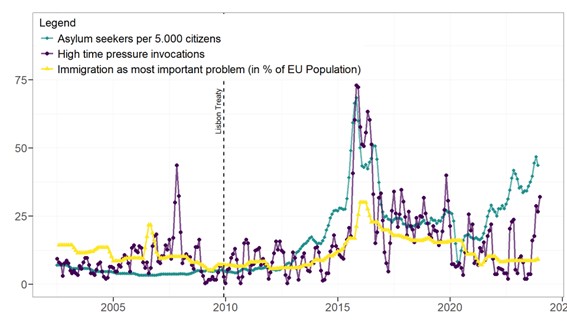
This matters because it complicates the 'unresponsive technocracy' stereotype. The Commission’s top-level communication has become more politically attuned over time, especially as its authority in migration and asylum expanded and expectations of EU-level leadership grew. Hence, the story of the Commission being a 'permanent crisis entrepreneur' is not completely correct. If urgency language rises and falls with pressure, this represents, at least in part, a form of responsiveness where leaders recognise what’s happening and treat it as politically urgent.
Comparison of speeches made by Commission Presidents and Home Affairs Commissioners reveals that Presidents are consistently more likely to invoke high time pressure, to claim political leadership for the institution and put pressure member states. If the problem is urgent, delay becomes harder to justify.
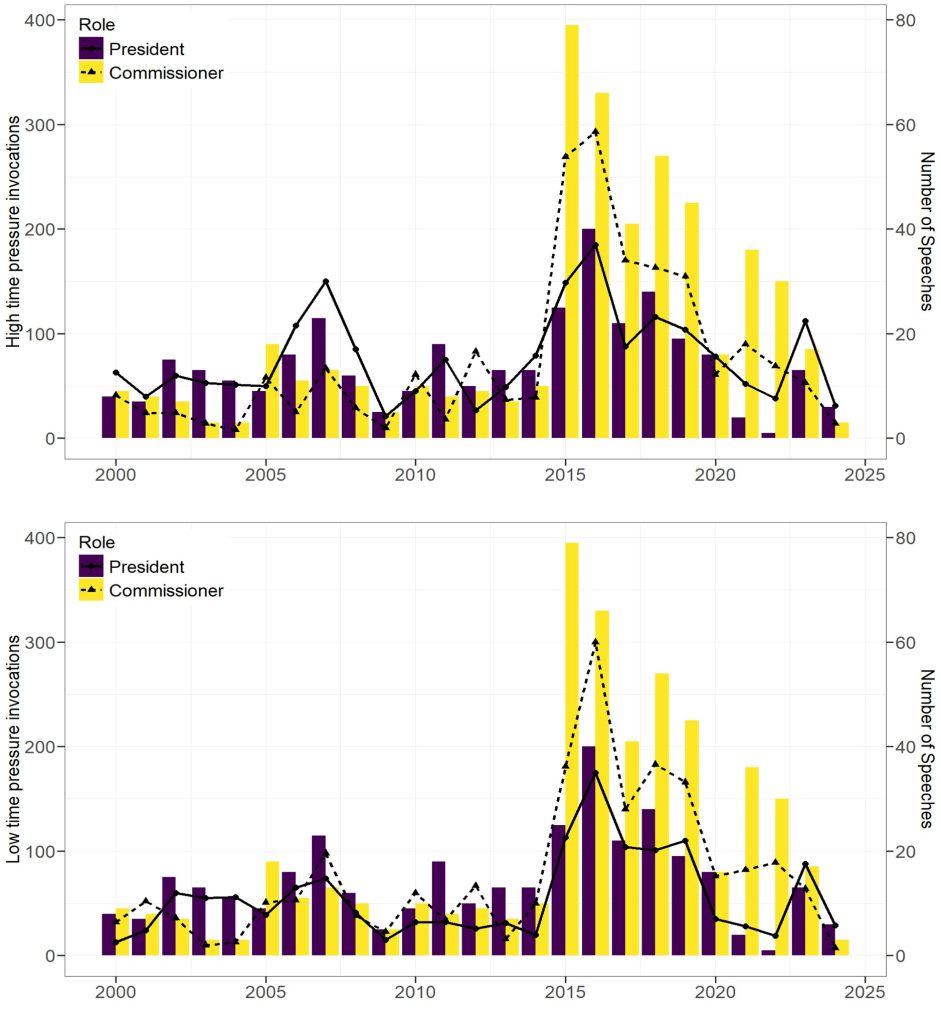
Commissioners have, historically, done almost the opposite. For much of the pre-Lisbon and early post-Lisbon period, they were more likely to stress low time pressure: careful implementation, technical feasibility, steady coalition-building. This more cautious tone fits their job of day-to-day policy management and intergovernmental bargaining. They must sound reliable to national ministries and agencies, avoid over-promising, and protect the Commission’s reputation as a competent administrator.
Commission Presidents are consistently more likely to invoke high time pressure. Historically, Commissioners have stressed low time pressure, but this gap has narrowed since the 2015–16 refugee crisis
Yet this split is not fixed. Following the 2015–16 refugee crisis, Commissioners, too, increasingly adopted the language of urgency. As public demands for EU action intensified and the political stakes rose, the gap between Presidents and Commissioners narrowed. Both began invoking high time pressure more often. Presidents did so to dramatise stakes and push in high-level political arenas; Commissioners did so more selectively, their statements often tied to specific operational or legislative needs.
The Commission is not simply slow or fast, responsive or unresponsive. It is an institution trying to reconcile competing expectations through communication about time. That matters right now, because the facts on the ground remain harsh. The IOM’s warning is that deaths are not inevitable; when safe routes shrink, people are pushed into more dangerous journeys. In that context, calls to 'act now' can be morally and politically necessary.
When safe routes shrink, people are pushed into more dangerous migration journeys. In that context, calls to 'act now' can be morally and politically necessary
But urgency can cut both ways. Used well, it can break deadlock and keep consequences visible. Used poorly, it can become disconnected from follow-through, and corrosive to trust when 'now' keeps returning without resolution. If the EU wants credibility, the challenge is not only choosing the right policies. It is also aligning the clock of politics with the slower realities of building legal, workable agreements across all member states. That tension will not disappear.
But understanding how the Commission talks about time helps explain why urgency can sometimes mean genuine mobilisation and at others mean a struggle to govern under impossible demands.
The research that informs this blog was conducted as part of the ERC Advanced Grant SYNCPOL – Synchronised Politics: Multiple Times and Political Power (Number 101054122), funded by the European Union.