Democratic legitimacy runs on citizens’ trust in public institutions. We often assume citizens critically monitor their institutions, only granting trust when they perform well. However, Linde Stals and Carmen van Alebeek show that much of this institutional trust is learned, rather than earned. Their findings raise important questions about democratic accountability
At the heart of institutional trust lie two rival theories about its nature. The evaluative perspective views trust as conditional: citizens critically judge institutions by their performance and output, adjusting their trust accordingly. In this view, institutions earn citizens' trust – and citizens may also withdraw it. The socialisation perspective, by contrast, views trust as a learned and stable disposition. From an early age, citizens internalise cultural narratives about which institutions deserve trust and which do not. Here, trust is less about what institutions currently do and more about what citizens have learned they inherently are.
Institutional trust is central to citizens’ long-term political engagement and, ultimately, to democratic legitimacy. Such legitimacy rests on vigilant and critical citizens who scrutinise institutions and demand responsiveness from those in power. Evaluative trust supports such critical engagement. Uncritical, socially transmitted trust, meanwhile, risks fostering passive acceptance of authority and weakening democratic checks. Understanding how institutional trust develops is therefore crucial for determining whether evaluation or socialisation predominates – and, in this way, for identifying the policies needed to sustain democratic accountability.
The literature has largely focused on how much citizens trust public institutions and how these trust levels vary over time. However, the tension between evaluation and socialisation is most visible in the structure of institutional trust. Empirical findings on this matter vary.
On the one hand, factor analytical studies show that citizens do not treat all institutions interchangeably. Instead, they differentiate between clusters of institutions – a feature known as subdomain-specificity. Citizens judge representative institutions such as governments, parliaments, and political parties independently and distinctly (i.e., by different yardsticks) from order institutions such as the police, judiciary, or military. The former citizens often see as partial, serving only segments of society. The latter they perceive as impartial, enforcing rules uniformly.
Citizens do not treat all institutions interchangeably. Instead, they differentiate between clusters of institutions
On the other hand, studies departing from item response theory show that trust judgments follow a shared hierarchy along a single dimension. Across countries, citizens consistently rank order institutions higher than representative ones. Politicians sit at the bottom of the scale. This one-dimensionality suggests that citizens can treat institutions interchangeably. Some, however, may simply require a higher threshold of trust than others.
This empirical paradox raises a deeper question: how can institutional trust appear both evaluative, shaped by subdomain-specific assessments, and socialised, producing a shared ranking of institutional trustworthiness?
To address this question, our recent article in the European Journal of Political Research advances a macro-level socialisation perspective. Specifically, we argue that what scholars often interpret as evaluative differentiation – citizens distinguishing between subdomains of trust – can also be socialised. From an early age, young people reproduce a culturally transmitted ranking of institutional subdomains. This suggests that both structural features – subdomain-specificity and hierarchical one-dimensionality – are rooted in shared cultural scripts about the trustworthiness of order versus representative institutions.
What scholars often interpret as evaluative differentiation – citizens distinguishing between subdomains of trust – can also be socialised
To test this argument, we examined the period when institutional trust first takes shape: adolescence. A person's early- to mid-teens are a critical formative stage marked by strong cognitive and political growth. Drawing on four waves of panel data from the Dutch Adolescent Panel on Democratic Values (DAPDV) 2018–2022, we tracked secondary school students from the age of 12 (wave 1) to 16 (wave 4) to study the longitudinal development of institutional trust structures using Confirmatory Factor Analysis and Mokken Scale Analysis.
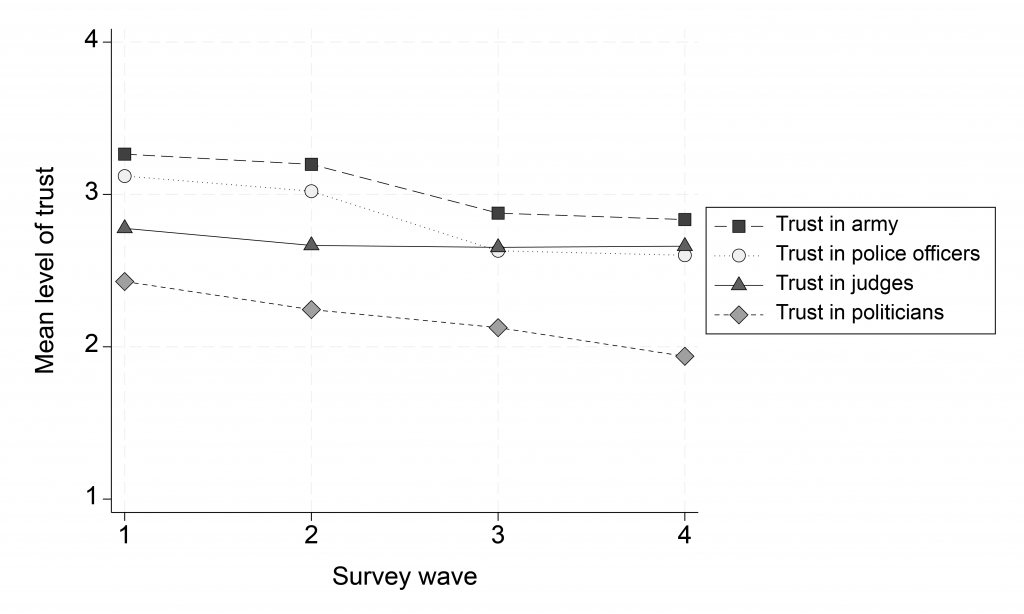
Our results support a dual-process model of institutional trust development. As the graph below shows, adolescents as young as 12, with limited political experience, already distinguish between order and representative institutions, and consistently rank those institutions in ways that mirror adult trust structures. Over time, the gap between order institutions narrows, yet their distance from politicians grows. This grouping effect shows that students increasingly differentiate between institutional branches while reproducing the shared hierarchy.
These patterns hold for adolescents across different levels of cognitive resources, operationalised by school track and political sophistication. However, group-specific analyses (not presented here) show that this early institutional trust blueprint becomes less stable in mid-to-late adolescence among adolescents with higher cognitive resources. Specifically, students enrolled in a pre-academic track and those with high political knowledge increasingly deviate from this collective ranking, suggesting the emergence of more individualised, evaluative reasoning.
Adolescents as young as 12, with limited political experience, already distinguish between order and representative institutions
Taken together, our findings suggest that while early macro-level socialisation provides a collectively shared baseline blueprint of institutional trust, more sophisticated citizens may later recalibrate this through individual evaluation.
These insights raise pressing concerns for policy. Specifically, our education systems may be equipping young citizens unevenly. While some learn to scrutinise public institutions, others remain socialised into passive reproduction. This divergence means that democratic accountability may be unevenly demanded: if critical evaluation is concentrated among the well educated while broad segments of citizens accept authority without challenge, political responsiveness risks skewing toward the demands of the most sophisticated. In effect, accountability becomes unequal, as political actors grow disproportionately attuned to the concerns of the critically engaged rather than to the public as a whole.